
Custom gate fabrication
A gate should not be treated as a standard fence panel with hinges attached. It is a moving structure that must support its weight, fit the opening, clear the ground, and withstand repeated operation.
Built for the opening, the property and the intended use
Modern Fence Company fabricates custom gates for residential, agricultural, commercial, industrial, municipal, and government properties throughout Western Arkansas and Eastern Oklahoma.
Our custom gate capabilities include
- Residential walk gates
- Wood gates with fabricated steel frames
- Driveway gates
- Estate entrance gates
- Ranch gates
- Ornamental iron gates
- Chain link gates
- Double-drive gates
- Commercial vehicle gates
- Industrial security gates
- Swing gates
- Sliding gates
- Cantilever gates
- Custom hillside gates
- Automatic gate frames
- Controlled pedestrian gates
- Replacement gates
We fabricate through our own metal facility. This gives us control over the measurements, frame construction, welding, hardware placement, ground clearance, and connection to the surrounding fence.

Standard gates work when the property is simple
Many properties are not that simple.
The goal is not simply to build a gate that fills the opening. We plan the gate around how it will move, how often it will be used, what it must secure, and how it connects to the rest of the property.
Custom fabrication may be appropriate when
- The opening is wider than a standard gate
- The driveway or ground is sloped
- Large trucks or trailers use the entrance
- Existing masonry columns must be incorporated
- The gate must match an ornamental fence
- A steel frame is needed behind wood boards
- The entrance requires a sliding or cantilever gate
- Automatic operation is planned
- The original gate repeatedly sags
- The gate must handle frequent commercial use
- Standard hardware does not fit the application
- The gate needs custom decorative details
- An older gate must be replaced within an existing fence
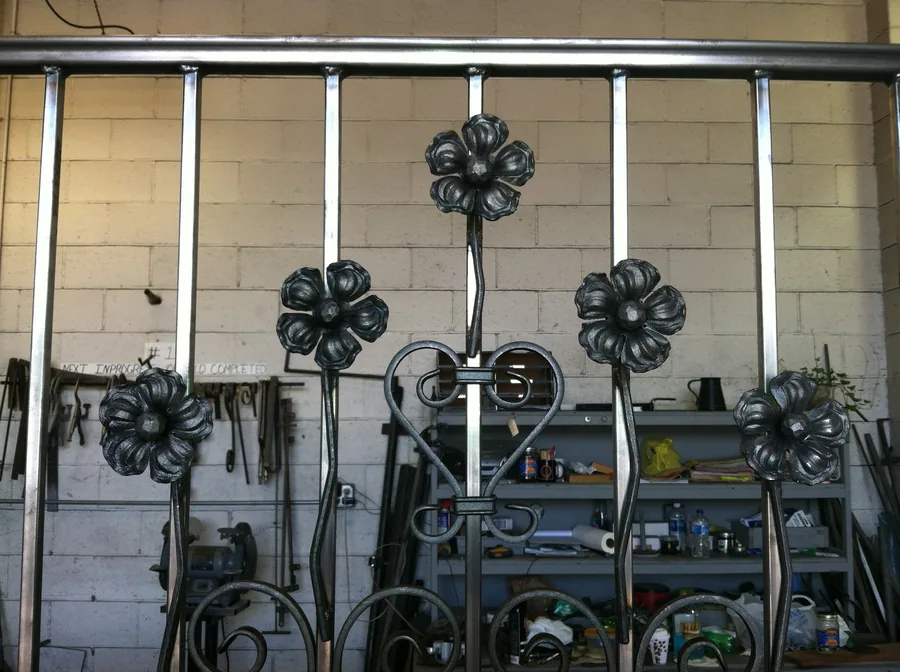
The crew measuring the gate can talk to the shop building it
Keeping this work within our company helps us coordinate:
- Field measurements
- Gate dimensions
- Frame layout
- Steel selection
- Welded connections
- Hinge or roller placement
- Latch locations
- Bottom clearance
- Support posts
- Operator attachment points
- Decorative components
- Connections to the surrounding fence
This is especially important when the project includes a slope, unusual opening, existing columns, custom metalwork, or an automatic operator. Our broader metal fabrication services also cover selected posts, panels, rails, and architectural components connected to the gate.
Driveway, estate, commercial and everything between
Custom driveway gates
A custom driveway gate can provide a defined entrance and greater control over vehicle access. Before fabricating, we consider:
- Clear opening width
- Driveway width
- Road width
- Vehicle size
- Turning radius
- Approach angle
- Gate setback
- Property slope
- Swing or slide clearance
- Manual or automatic operation
- Emergency access
- Surrounding fence material
Estate and ranch gates
Custom estate and ranch gates create a distinct entrance while providing dependable access. Designs may include:
- Ornamental iron gates
- Steel-framed entrance gates
- Ranch-style gates
- Arched gate designs
- Straight-top gates
- Decorative pickets
- Custom finials
- Scrollwork
- Double-swing gates
- Sliding gates
- Automatic entrances
Commercial and industrial
Custom commercial and industrial gates handle wider openings, heavier construction and more cycles. Planning may involve:
- Truck and trailer access
- Equipment clearance
- Frequent opening cycles
- Employee entry
- Visitor access
- Deliveries
- Emergency vehicles
- Security requirements
- Pedestrian separation
- Automatic operation
- Keypad or credential access
A gate that is wide enough by measurement may still be difficult for a tractor-trailer to use when the road, approach angle, or gate setback is too tight. We review the entrance as a traffic area rather than focusing only on the gate opening.
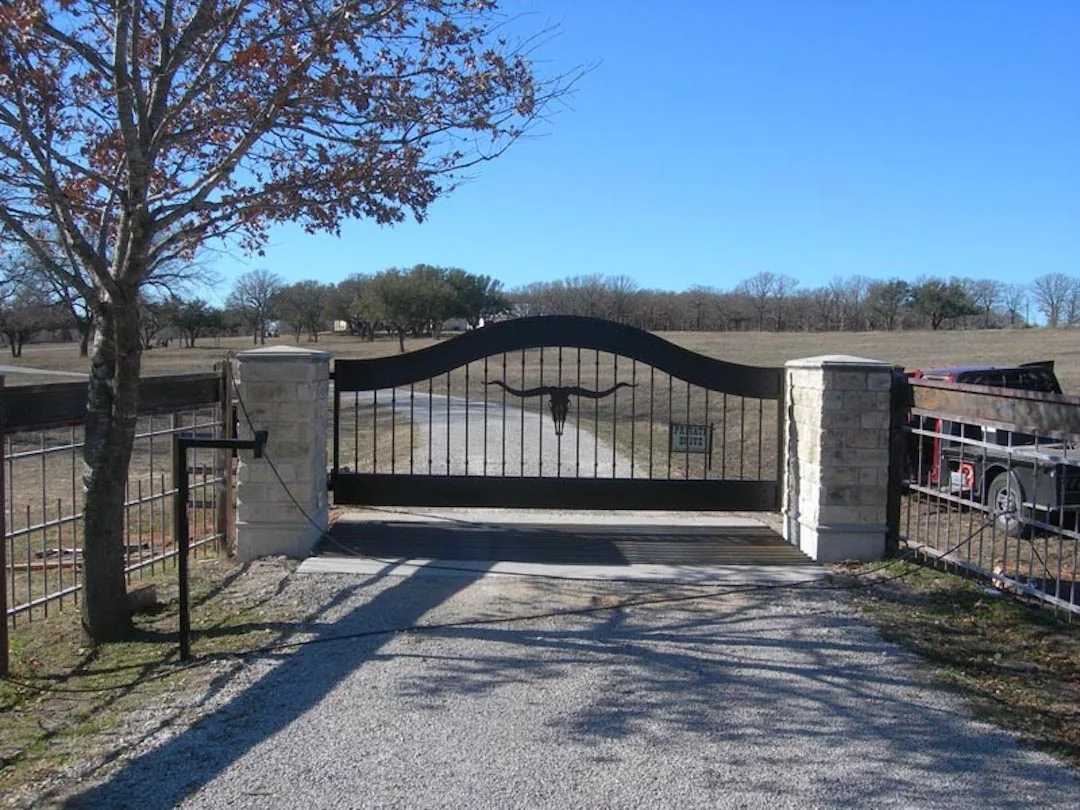
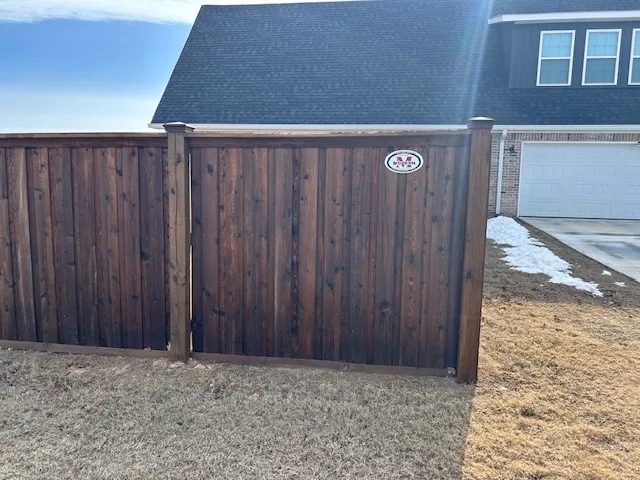
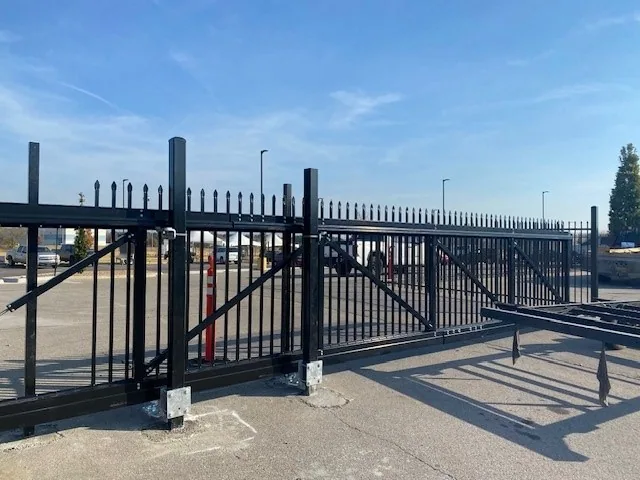
Security with visibility
Design options may include straight or arched tops, vertical pickets, decorative finials, scrollwork, custom posts, accent panels, single and double gates, sliding and cantilever configurations.
Existing metalwork may be difficult to reproduce exactly when the original components are discontinued, heavily weathered, or fabricated by another company.
A stable frame behind the boards
Wood gates can sag or twist when the frame is not strong enough for the opening. Suitable for privacy, board-on-board, horizontal and cap-and-trim fences, wider walk gates, double gates, driveway openings and commercial screening fences.
New wood may initially look different beside an older fence because of natural color, moisture, age, and weather exposure.
Practical access through any system
- Walk gates
- Double-drive gates
- Equipment gates
- Commercial vehicle gates
- Sliding gates
- Cantilever gates
- Galvanized gates
- Black-coated gates
- Security gates
A small residential walk gate does not require the same construction as a wide industrial entrance used by trucks and equipment.
Slopes are the most common reason a gate needs custom planning
A standard square gate installed across a sloped opening may drag against the ground, leave an excessive gap beneath one side, fail to open fully, swing downhill, reduce vehicle clearance, place added pressure on hinges, or interfere with automatic operation.
The solution may involve
- A custom hillside gate
- Revised frame geometry
- A different swing direction
- Moving the gate farther from the road
- A sliding gate
- A cantilever gate
- Adjustments to the surrounding fence
Columns finished before measuring create fit problems
Important details include:
- Finished distance between columns
- Column alignment
- Column height
- Gate clearance
- Hinge or support method
- Operator placement
- Electrical access
- Entry-device placement
- Drainage
- Finished driveway elevation
Gate, masonry, electrical, and driveway work should be coordinated before fabrication begins.
Identify automation before fabrication
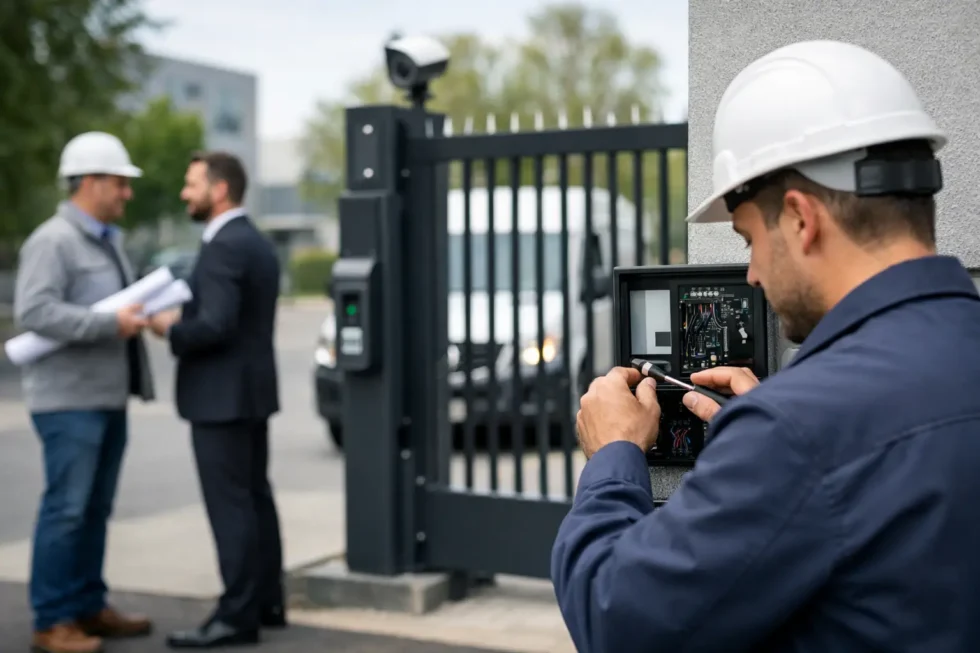
An automatic gate frame must work with the selected operator, operator attachment points, expected gate movement, safety devices, vehicle-detection equipment, access-control equipment, power availability and daily cycle requirements.
Automation does not correct a dragging, twisted, poorly balanced, or badly supported gate. The gate should move freely and remain properly aligned before the operator is installed.
Access control integration
A custom gate may be connected to an access control system with remote controls, keypads, card readers, RFID credentials, cellular entry, telephone entry, intercoms, timed access and camera integration.
For vehicle entrances, we consider whether a driver can reach the device without leaving the vehicle, blocking a road, or stopping in the gate’s travel area. Commercial properties may also need a separate pedestrian gate.
Our custom gate fabrication process
1
Property evaluation
We review the opening, grade, surrounding fence, columns, vehicles, traffic, and intended gate use.
2
Gate recommendation
Material, design, width, height, swing or travel direction, hardware, manual or automatic operation, and access-control needs.
3
Written proposal
The proposal identifies the major gate components, fabrication, installation, and related work included.
4
Final measurements
Measurements are confirmed before fabrication. Existing columns, posts, pavement, and grade are reviewed as needed.
5
Shop fabrication
The gate frame and approved custom components are measured, cut, fitted, and welded in our fabrication facility.
6
Post and support installation
Gate posts, supports, and connected fence sections are installed according to the approved project scope.
7
Gate installation
The gate is hung or installed on its support system and adjusted for fit, movement, and clearance.
8
Automation and access equipment
Operators and approved entry devices are installed when included in the project.
9
Final review
We inspect the completed gate and address documented project concerns.
Frames, entrances and replacement gates
Visit our project gallery for custom steel and ornamental gates, steel-frame wood gates, chain link double-drive gates, sliding and cantilever entrances and access-controlled openings.
Custom gate fabrication questions
Visit our fencing and access control FAQ for more answers.
Do you fabricate gates in your own shop?
Yes. We fabricate custom steel, ornamental, chain link, and steel-frame wood gate components through our own facility.
Can you build a gate for an unusual opening?
Yes. We measure the opening and evaluate the grade, posts, columns, fence, and intended use before recommending a design.
Can you build a gate for a sloped driveway?
Yes. Depending on the property, we may recommend a custom hillside, sliding, cantilever, or revised swing-gate design.
Can you fabricate a wide commercial gate?
Yes. The opening should be planned around the vehicles, traffic, turning radius, gate type, and available support area.
Do you fabricate cantilever gates?
Yes. We fabricate cantilever gates for qualifying commercial, industrial, apartment, and controlled-access properties.
Can you build a wood gate with a steel frame?
Yes. Steel-frame wood gates can be built to coordinate with selected privacy, board-on-board, and horizontal wood fences.
Can you match an existing ornamental fence?
We can often create a compatible design, but an exact match may not be possible when the original components or coating are unavailable.
Can a custom gate be automated?
Yes. Automatic operation should be included in the planning process so the gate and operator are compatible.
Can you install a keypad or card reader?
Yes. Keypad, card, RFID, telephone entry, intercom, and other access options are available for qualifying projects.
Do you repair custom gates?
Yes. We repair qualifying gates when the frame, supports, and surrounding system remain suitable.
How long does fabrication take?
Timing depends on the gate design, materials, measurements, special components, workload, and installation schedule. We do not promise one standard turnaround for every project.
Do you provide free estimates?
Yes. Contact us with the property location, opening size, gate type, vehicles using the entrance, and any automatic-entry requirements.
A gate built for the opening and the way it will be used
We will evaluate the property and recommend a gate built for the opening and the way it will be used.
Tell us
- Where the property is located
- Whether the gate is residential or commercial
- What type of fence surrounds the opening
- The approximate opening width and height
- Whether the entrance is sloped
- The largest vehicles using the gate
- Whether swing, sliding, or cantilever operation is preferred
- Whether manual or automatic operation is needed
- Whether a keypad, card reader, intercom, or other access system is required
- Whether existing gates or posts must be removed
- Whether masonry columns are involved
- The design or appearance you prefer
- Your preferred project timing
