
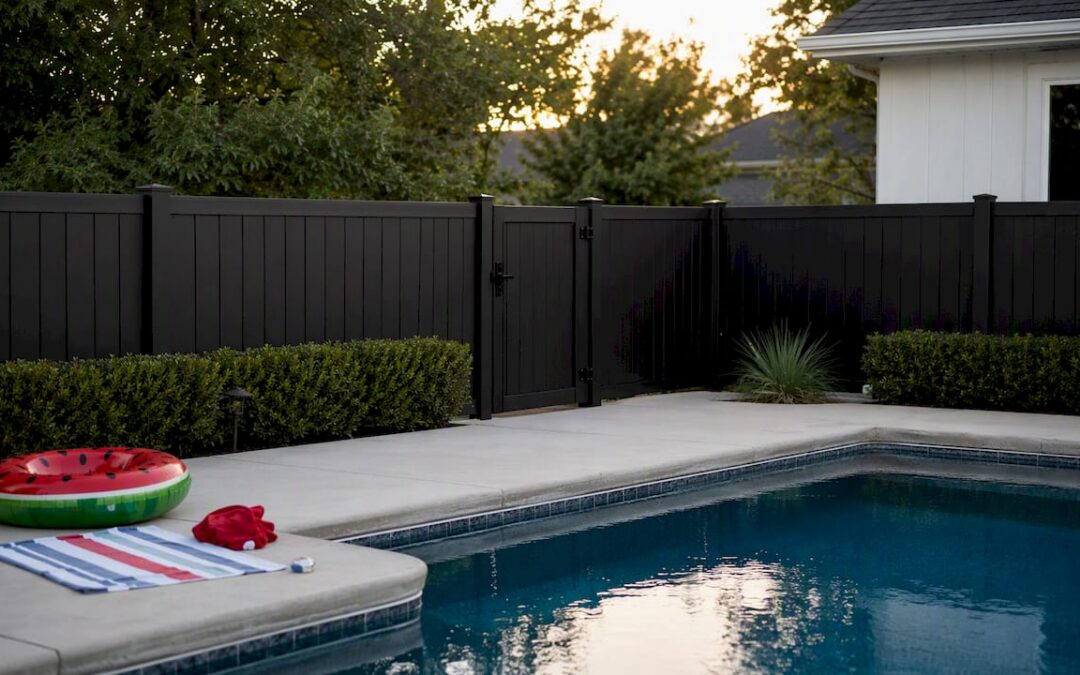
For most family pools, removable mesh fencing is the safest short-term barrier for homes with young children, while permanent non-climbable options like frameless glass or vertical-picket aluminum are the strongest long-term solutions. Your immediate next steps: measure your pool perimeter, check your local code for height requirements (minimum 48 inches, many local codes require 60 inches), confirm your gate is self-closing and self-latching, and contact a licensed installer if anything is unclear.
- Top picks: Removable mesh (young kids, temporary), frameless glass or vertical-picket aluminum (permanent, non-climbable, low maintenance)
- Next step: Measure your pool perimeter, verify local code height requirements, and inspect gate hardware before buying anything
- When to call a pro: If your current fence has gaps over 4 inches, a gate that doesn’t self-close, or no latch, schedule a professional inspection now
Key Takeaways
The safest pool fence combines a non-climbable barrier of at least 48 inches with a self-closing, self-latching gate and at least one additional safety layer such as a pool alarm or safety cover.
| Point | Details |
|---|---|
| Top fence picks for families | Removable mesh for young children short-term; permanent aluminum picket or frameless glass for long-term non-climbable barriers. |
| Gate hardware is critical | Self-closing hinges and tamper-resistant latches at 54 inches are where most barriers fail; spend here before anywhere else. |
| Check local codes first | Minimum height is 48 inches nationally, but many jurisdictions require 60 inches; always verify before purchasing. |
| Layer your safety measures | A fence alone is not enough; add a pool alarm, safety cover, or door alarm on any house door leading to the pool. |
| Modernfence for professional installation | Modernfence is a licensed and insured installer serving Western Arkansas and Eastern Oklahoma with 70+ years of experience across aluminum, iron, wood, and vinyl pool fencing. |
Table of Contents
- What are the best pool fence types for protecting children and pets?
- What safety standards does every pool fence need to meet?
- Pros, cons, and the best situations for each fence type
- How do professionals install pool fences for lasting safety?
- How do you keep sightlines open while keeping the pool safe?
- What does a pool fence cost, and how long does installation take?
- How do you choose the right pool fence for your yard and family?
- Why the gate matters more than the fence material
- Modernfence can handle your pool fence from measurement to inspection
- Useful sources for pool fence research
What are the best pool fence types for protecting children and pets?
Choosing the right pool safety fence comes down to three factors: how well it resists climbing, how clearly you can see through it, and how reliably it keeps a gate closed. Each fence type handles those priorities differently.
Removable mesh
Removable mesh is the go-to childproof pool fencing for families with toddlers. Posts anchor into deck-mounted sleeves, and the mesh itself creates a non-climbable surface with no horizontal rails a child could use as a foothold. According to CPSC PoolSafely guidance, posts should extend a minimum of 3 inches below grade, spacing between posts should be no greater than 40 inches, and the bottom of the mesh should sit no more than 1 inch above the deck. The best systems lock into the sleeves so they can’t be casually removed. ASTM F2286 covers the specific performance requirements for removable mesh barriers.
Aluminum and metal picket
Vertical-picket aluminum is one of the most popular permanent pool fence options in the U.S. The pickets run vertically with no horizontal rails on the outside, making it genuinely difficult to climb. It resists rust, requires almost no upkeep, and comes in powder-coated black finishes that look clean against most pool decks. Black aluminum is a leading design choice precisely because it delivers code-compliant safety while nearly disappearing visually against landscaping.
Wrought iron and steel
Wrought iron offers the same vertical-picket geometry as aluminum but with more visual weight and a longer lifespan when properly maintained. The trade-off is cost and upkeep: iron requires periodic painting or coating to prevent rust, especially in humid climates. For a historic home or a property where the fence needs to match existing ironwork, it’s worth the extra maintenance.
Frameless and semi-frameless glass
Glass panels give you an unobstructed view of the pool from any angle, which is the single biggest supervision advantage of any fence type. Glass is inherently non-climbable, and installed prices for frameless glass typically range from roughly $110 to $220+ per linear foot depending on hardware and site complexity. Semi-frameless glass uses aluminum posts between panels, which reduces cost while keeping most of the sightline benefit.
Wood and composite slat
Wood privacy fencing around a pool is common but carries real safety trade-offs. Horizontal rails on the outside of the fence create a ladder. If you use wood, keep horizontal rails on the pool-facing side and keep gap spacing tight. Composite slat fencing behaves similarly but holds up better against moisture and UV exposure. Neither option is ideal for families with young children unless the design specifically eliminates climbable surfaces.
Chain link with slats
Chain link is affordable and durable, but standard chain link is easy to climb. Adding privacy slats reduces climbability somewhat and blocks sightlines, which cuts into your ability to supervise. For pool use, chain link is generally a budget option best suited to secondary barriers or pet enclosures rather than the primary child safety barrier.
| Feature | Removable Mesh | Aluminum Picket | Wrought Iron | Frameless Glass | Wood/Composite | Chain Link |
|---|---|---|---|---|---|---|
| Climb resistance | High | High | High | Very high | Low–Medium | Low |
| Visibility | Medium | High | High | Very high | Low | Medium |
| Maintenance | Low | Very low | Medium–High | Low | Medium–High | Low |
| Typical cost range | — | — | $110–$220+ per linear foot | $110–$220+/linear ft | — | — |
| DIY feasibility | Medium | Low–Medium | Low | Very low | Medium | Medium |
| Best use case | Young kids, temporary | Permanent family barrier | Historic/architectural | Supervision-critical areas | Privacy secondary barrier | Pet enclosures, budget |
Note: Removable mesh posts should extend a minimum of 3 inches below grade, spacing no greater than 40 inches, and the bottom of mesh should sit no more than 1 inch above the deck.
What safety standards does every pool fence need to meet?
Pool barrier safety isn’t optional, and the rules are more specific than most homeowners expect. The CPSC PoolSafely safety barrier guidelines set the baseline that most local codes build on.
The non-negotiable minimums:
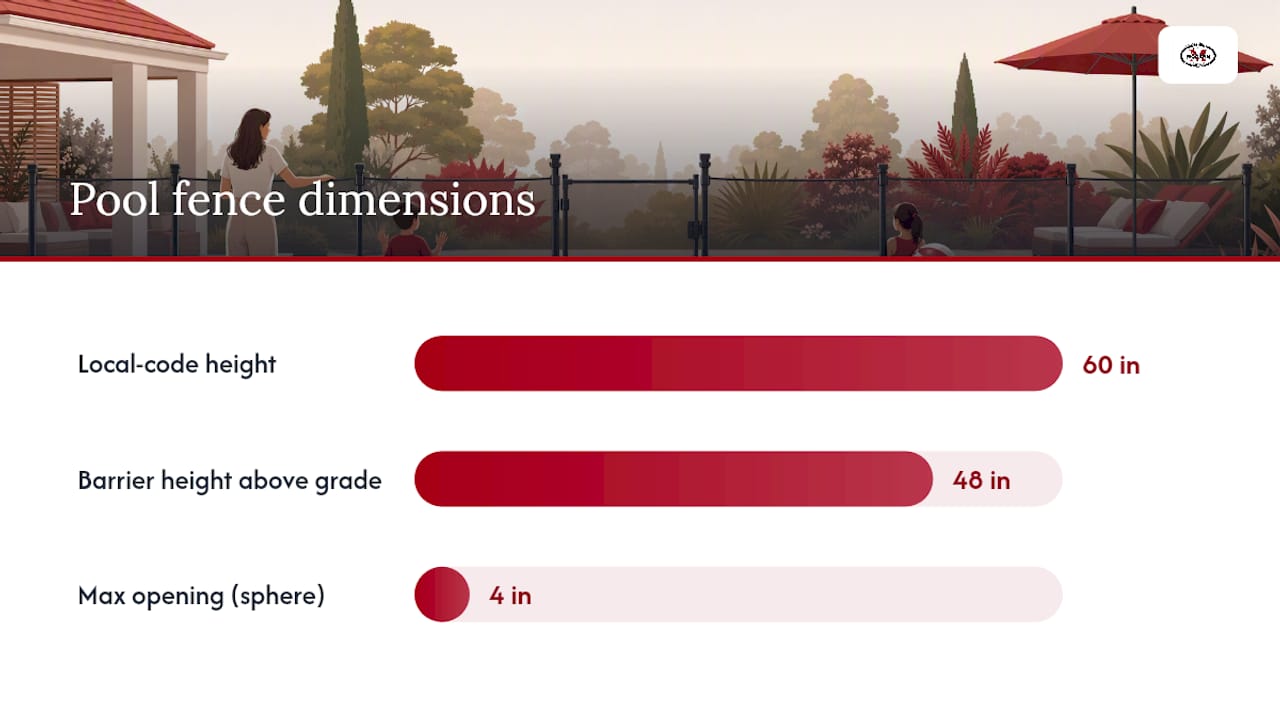
- Barrier height of at least 48 inches above grade; many jurisdictions require 60 inches
- No opening in the fence should allow passage of a 4-inch sphere
- Gates must be self-closing and self-latching, with the latch on the pool side of the gate
- Gates must swing outward away from the pool
- The latch release mechanism should be at a height or shielded so a child cannot reach it from outside
Removable mesh specifics (ASTM F2286):
- Posts must extend a minimum distance below grade into deck sleeves
- Post spacing must be limited to small intervals
- Bottom of mesh must be close to the deck surface to prevent gaps
- Mesh sections must lock into sleeves to prevent casual removal
When the house forms one side of the barrier:
If your home’s wall or door serves as one side of the pool enclosure, any door leading directly to the pool area must have a self-closing, self-latching mechanism or a door alarm that sounds when the door opens. This is a frequently missed requirement during inspections.
Pool drowning is the leading cause of accidental death for children ages 1–4 in the United States, according to the CPSC PoolSafely program. A properly installed four-sided barrier reduces drowning risk significantly — but only when the gate closes and latches reliably.
Quick retrofit options if your current fence falls short:
- Add a self-closing hinge kit to an existing gate
- Install a pool alarm on the gate or on any door leading to the pool
- Add a pool surface alarm or safety cover as a secondary layer
- Replace a standard latch with a key-lockable, pool-side-mounted latch
Pro Tip: Check your local building department’s specific requirements before purchasing any fence. State and municipal codes often exceed the CPSC minimums, and some jurisdictions require a permit and inspection before the fence can be used.
Pros, cons, and the best situations for each fence type
Knowing which fence type works best on paper is one thing. Knowing where each one fails in real yards is what actually protects your family.
Removable mesh
Pros: Non-climbable surface, no horizontal rails, can be removed for adult entertaining, relatively affordable, works on most deck surfaces.
Cons: Requires proper sleeve installation to be effective; improperly anchored mesh is a serious hazard; not a permanent solution for families with ongoing child safety needs.
Best for: Families with toddlers who want a temporary or seasonal barrier, or homeowners who want a secondary layer over an existing fence.
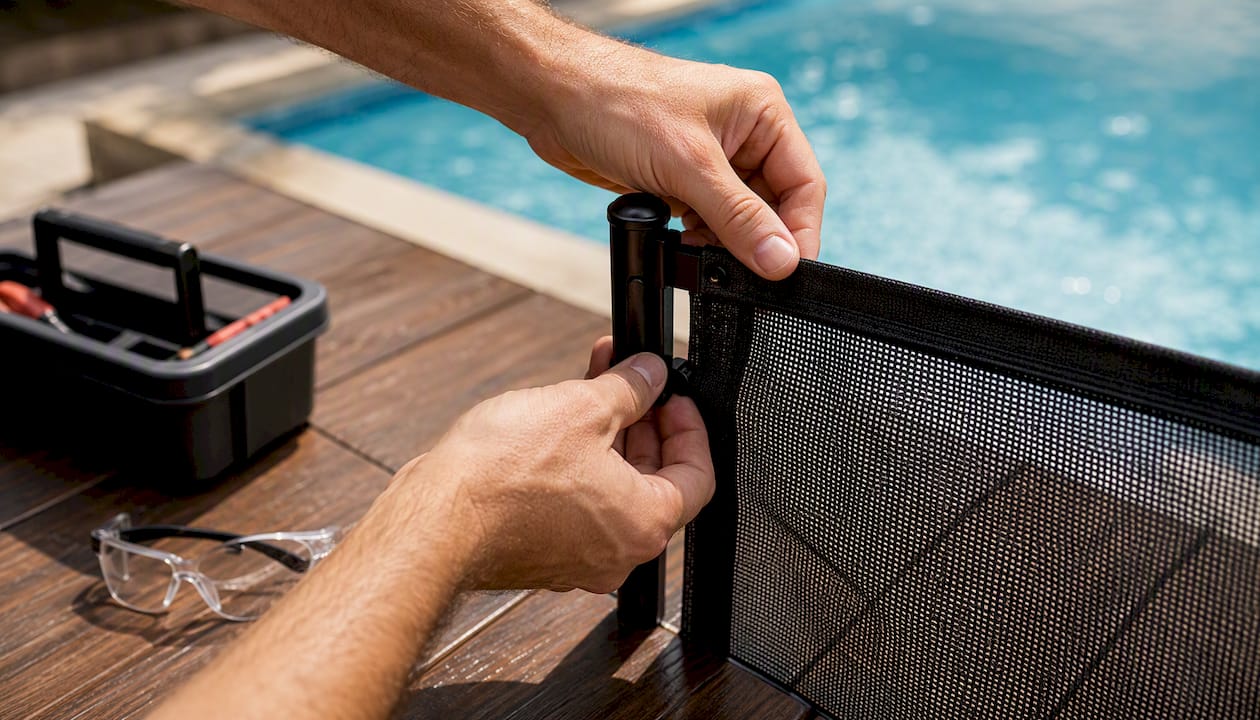
Certified removable mesh products tested to ASTM F2286 provide measurable assurance of strength and tamper resistance. Uncertified mesh products vary widely in quality, so certification matters here more than in almost any other fence category.
Aluminum picket
Pros: Virtually maintenance-free, rust-resistant, strong vertical geometry, wide range of heights and styles, long lifespan.
Cons: Higher upfront cost than chain link or wood; professional installation strongly recommended for correct post depth and gate alignment.
Best for: Permanent family barriers where low maintenance and clean aesthetics both matter. This is the most common choice for residential pools in the U.S. for good reason.
For homeowners comparing property security fence options, aluminum picket consistently ranks high because it combines durability with a non-climbable profile.
Wrought iron and steel
Pros: Extremely durable, high visual impact, can be custom-fabricated to match architectural details.
Cons: Requires periodic rust treatment; heavier and more expensive to install; not DIY-friendly.
Best for: Historic homes, properties with existing ironwork, or homeowners who want a fence that lasts decades with proper care. Modernfence offers iron fence installation for homeowners who want this level of permanence.
Frameless glass
Pros: Maximum visibility for supervision, non-climbable, modern aesthetic, low maintenance once installed.
Cons: Highest installed cost ($110–$220+ per linear foot); requires professional installation; glass panels need periodic cleaning; can show water spots and fingerprints.
Best for: Homeowners who prioritize sightlines above all else, or pool areas adjacent to living spaces where an unobstructed view is critical for supervision.
Wood and composite slat
Pros: Privacy, natural look, lower material cost for wood.
Cons: Wood requires regular sealing and painting; horizontal rails create climbable surfaces unless placed on the pool-facing side; composite costs more upfront but holds up better.
Best for: Secondary privacy barriers or properties where aesthetics and privacy matter more than maximum visibility. Not recommended as the sole barrier for families with young children unless the design eliminates all climbable surfaces.
Chain link
Pros: Lowest cost, durable, easy to repair.
Cons: Standard chain link is climbable; slats reduce climbability but also block sightlines; not the strongest aesthetic choice.
Best for: Pet enclosures, budget-constrained secondary barriers, or commercial applications where appearance is secondary to function.
| Fence Type | Typical Lifespan | Upkeep Level | Typical Installed Cost |
|---|---|---|---|
| Removable mesh | 5 years | Low | — |
| Aluminum picket | long lifespan | Very low | — |
| Wrought iron | long lifespan | Medium | $110–$220+ per linear foot |
| Frameless glass | — | Low | $110–$220+/linear ft |
| Wood/composite | — | Medium–High | — |
| Chain link | — | Low | — |
Removable mesh specifics: Posts should extend a minimum of 3 inches below grade, spacing no greater than 40 inches, and bottom mesh no more than 1 inch above the deck.
How do professionals install pool fences for lasting safety?
A pool fence installed correctly on day one is far less likely to fail at the moment it matters most. Professional installation focuses on three things: structural permanence, non-climbable geometry, and gate function that works every single time.
What a professional installation looks like
A licensed installer starts with a site survey: measuring the pool perimeter, identifying grade changes, locating underground utilities, and noting any existing structures that could serve as climbing aids. From there, the workflow follows a clear sequence.
Standard pro installation steps:
- Mark post locations at correct spacing intervals (typically 6–8 feet for aluminum, 40 inches max for removable mesh)
- Dig or drill post holes to the required depth (typically 24–36 inches for permanent fences, minimum 3 inches below grade for mesh sleeves)
- Set posts in concrete footings and allow cure time before attaching panels
- Attach fence panels with hardware on the pool-facing side to eliminate external footholds
- Install gate with self-closing hinges adjusted to close from any open position
- Set latch at the correct height (at least 54 inches from ground, or shielded on the pool side)
- Test gate function: open fully, release, and confirm it closes and latches without assistance
For removable mesh specifically, sleeve depth and alignment are critical. Sleeves set too shallow allow posts to be pulled out; sleeves set at an angle cause mesh sections to gap at the bottom. A professional installer checks both.
Pro Tip: Spend on gate hardware. A self-closing hinge that fails after two seasons and a latch that a child can reach from outside are the two most common reasons a code-compliant fence stops being safe. Specify stainless steel or powder-coated hardware rated for outdoor pool environments, and ask your installer about tamper-resistant latch covers.
Maintenance schedule homeowners should follow
A pool fence doesn’t stay safe on its own. Annual inspections catch problems before they become hazards.
Annual inspection checklist:
- Test gate self-closing function from multiple open positions
- Check latch engagement: does it catch every time without manual assistance?
- Inspect all post bases for movement, rust, or concrete cracking
- Check mesh bottom clearance: still no more than 1 inch above deck?
- Look for bent or missing pickets, cracked glass panels, or warped wood sections
- Clear any furniture, planters, or equipment within 3–5 feet of the fence exterior
Simple repairs homeowners can handle: tightening loose hinge screws, cleaning gate latch mechanisms, repainting minor rust spots on iron, and re-sealing wood sections. Anything involving post movement, gate misalignment, or structural damage to panels warrants a call to a licensed contractor. A fence maintenance schedule keeps small issues from becoming safety failures.
| Maintenance Task | Frequency | DIY or Pro? |
|---|---|---|
| Gate function test | Monthly | DIY |
| Full fence inspection | Annually | DIY |
| Hardware lubrication | Annually | DIY |
| Post base inspection | Annually | DIY |
| Structural repair | As needed | Pro |
| Rust treatment (iron) | Every 2–3 years | DIY or Pro |
| Wood sealing/painting | Every 1–2 years | DIY or Pro |
For a complete residential fence installation guide, Modernfence covers workmanship expectations and what homeowners should look for during and after installation.
How do you keep sightlines open while keeping the pool safe?
Good supervision is itself a safety measure. A fence that blocks your view of the pool from the house or patio creates a blind spot that no alarm can fully replace. The good news: you can have clear sightlines and a code-compliant barrier at the same time.
Frameless glass on primary sightlines, paired with black aluminum or mesh on side runs, is the most practical hybrid approach. You get an unobstructed view from the house or main entertaining area, and the side and rear runs use a more affordable material without sacrificing safety performance. The gate stays in the aluminum or mesh run, not the glass section, which keeps hardware costs manageable.
Quick design swaps that reduce climbability and improve aesthetics:
- Switch any horizontal rails to the pool-facing (interior) side of the fence
- Reduce picket or slat gaps to under 4 inches to meet code and eliminate footholds
- Use vertical pickets instead of horizontal slats wherever climbability is a concern
- Keep furniture, planters, and storage at least 3–5 feet from the fence exterior
- Use plantings on the outside of the fence rather than inside, so they don’t create a climbing aid
- Choose a hidden bottom rail design to give the fence a cleaner, more finished look from the pool deck
For homeowners who want privacy without sacrificing safety, privacy fencing options can be designed with the pool code in mind from the start.
Family Handyman’s pool fence design guidance reinforces the same principle: when horizontal rails are unavoidable, placing them on the pool-facing side with gaps under 45 inches keeps the fence code-compliant and significantly harder to climb from the outside.
Pro Tip: Put your hardware budget into the gate, not the fence panels. A frameless glass run with a cheap gate latch is less safe than aluminum pickets with a commercial-grade self-closing hinge and a tamper-resistant latch. The gate is where most barriers fail, so that’s where the money should go.
What does a pool fence cost, and how long does installation take?
Cost varies more by material and site conditions than most homeowners expect. A flat yard with a simple rectangular pool costs significantly less to fence than a sloped site with multiple gates and an irregular pool shape.
| Fence Type | Typical Installed Cost | Relative Lifespan | Typical Install Time |
|---|---|---|---|
| Removable mesh | — | 5 years | 1–2 days |
| Aluminum picket | — | long lifespan | 1–3 days |
| Wrought iron | $110–$220+ per linear foot | long lifespan | 2–4 days |
| Frameless glass | $110–$220+/linear ft | — | 2–5 days |
| Wood/composite | — | — | 1–3 days |
| Chain link | — | — | 1–2 days |
Removable mesh systems: Posts should extend a minimum of 3 inches below grade into deck sleeves, spacing between posts no greater than 40 inches, and bottom mesh sits no more than 1 inch above the deck.
The frameless glass price range comes from professionally installed frameless glass pool fencing, where hardware selection and site complexity drive the upper end of the range.
What pushes cost up:
- Significant grade changes or sloped terrain requiring custom post heights
- Multiple gates (each gate adds hardware cost and installation time)
- Premium hardware: self-closing hinges, tamper-resistant latches, key-lockable mechanisms
- Local permit and inspection fees (required in many jurisdictions)
- Removal and disposal of an existing fence
- Concrete footings in rocky or clay-heavy soil
What keeps cost down:
- Simple rectangular pool with a single gate
- Aluminum picket or removable mesh instead of glass
- Flat, accessible terrain with no underground obstacles
- Combining a DIY-friendly material (mesh, some wood) with professional gate installation only
DIY installation is feasible for removable mesh and some wood fencing, but gate hardware alignment and post footing depth are where DIY installs most often fall short of code. For permanent aluminum, iron, or glass, professional installation is the right call.
How do you choose the right pool fence for your yard and family?
Match your fence to your primary priority first, then work through the details. A family with a 2-year-old has different needs than a household with older children and a dog.
Six-step decision checklist:
- Measure your pool perimeter and note any grade changes, existing structures, or access points
- Check local code for height requirements (minimum 48 inches, many local codes require 60 inches), permit requirements, and inspection rules; Texas homeowners can review Texas pool fence requirements as a state-specific starting point
- Pick your material based on primary priority: mesh for young children and temporary use, aluminum or glass for permanent non-climbable barriers, wood or chain link only for secondary barriers
- Specify gate hardware before you finalize the fence: self-closing hinge, self-latching latch at 54 inches or shielded, outward swing, pool-side latch placement
- Confirm anchoring method: permanent concrete footings for aluminum/iron/glass, deck-sleeve anchoring for removable mesh
- Vet your contractor: licensed, insured, experienced with pool code compliance, and willing to provide a written warranty
Questions to ask any installer before signing:
- Are you licensed and insured in this state?
- Have you installed pool fences that passed local inspection?
- What hardware do you specify for self-closing gates, and what is the latch height?
- Do you pull the permit, or is that my responsibility?
- What is your warranty on installation workmanship?
- How long will the project take from start to inspection?
DIY vs. pro: when each makes sense:
- DIY is reasonable for: removable mesh on a flat deck with clear sleeve locations, simple wood panel replacement, minor hardware repairs
- Hire a pro for: any permanent fence installation, gate hardware alignment, post footing work, glass panel installation, or any situation where a code inspection is required
A residential fence contractor checklist can help you prepare the right questions and know what to expect from a professional estimate.
Why the gate matters more than the fence material
Most homeowners spend the bulk of their research time comparing fence materials, and that’s understandable. The visual difference between frameless glass and aluminum picket is obvious. The difference between a $40 gate latch and a $120 tamper-resistant, self-closing mechanism is not.
But field experience tells a consistent story: the fence panel almost never fails. The gate does. A gate that doesn’t fully close because a hinge is slightly out of alignment, a latch that a 4-year-old can reach from outside, a gate propped open with a pool toy — these are the actual failure modes that matter. CPSC guidance on this point is clear, and installers who work pool fences regularly see it confirmed in every inspection.
There’s also a tendency to treat the fence as the complete solution. It isn’t. A four-sided barrier with a functioning gate reduces risk substantially, but the layer-of-protection model is the right framework: fence plus alarm plus cover plus supervision. No single barrier is a substitute for all the others.
The other thing worth saying plainly: removable mesh is genuinely excellent for families with toddlers, but only when it’s installed correctly. Mesh that isn’t locked into deck sleeves, or that has posts set too shallow, or that gaps at the bottom, is not a safety barrier. It’s a visual deterrent. The difference between a certified, properly installed mesh system and a loose one is the difference between a barrier that works and one that doesn’t. Certification to ASTM F2286 and professional installation of the sleeve anchors are not optional details.
Modernfence can handle your pool fence from measurement to inspection
If you’re ready to move from research to installation, Modernfence brings more than 70 years of licensed and insured fencing experience to pool fence projects across Western Arkansas and Eastern Oklahoma. The team handles the full process: site measurement, local code review, material selection, permit coordination, and installation to a standard that passes inspection.
Whether you need a permanent aluminum picket barrier, a custom iron fence to match your home’s architecture, or a removable mesh system installed with properly anchored deck sleeves, Modernfence has the materials and the field experience to do it right. Every project comes with licensed and insured workmanship and a clear timeline from estimate to completion.
Read the fence installation guide for lasting results to see what a professional pool fence installation looks like from start to finish, or contact Modernfence directly to schedule your free estimate. A site visit takes the guesswork out of material selection, code compliance, and gate placement before you spend a dollar on materials.
Useful sources for pool fence research
Before you buy or install any pool fence, verify the rules that apply to your specific property and jurisdiction. These are the primary references worth bookmarking.
- 362 Safety Barrier Guidelines for Pools
- Pool Fence Ideas: Glass, Metal & Safe Fencing for 2026 | PoolPad
- Frameless Glass Pool Fence | Instant Price Online | Groupe ENO
- 8 Best Pool Safety Fences in 2026 – Pooln
- Pool fence ideas — Family Handyman
- Modern Fence Company | Fence Installation in Fort Smith, AR
Pool drowning remains the leading cause of accidental death for children ages 1–4 in the United States. A properly installed, four-sided pool barrier with a self-closing, self-latching gate is the single most effective structural intervention available to homeowners, according to CPSC PoolSafely.
This article provides general information about pool fence safety standards and installation practices. Always confirm current local code requirements with your building department or a licensed contractor before purchasing or installing any pool barrier.