
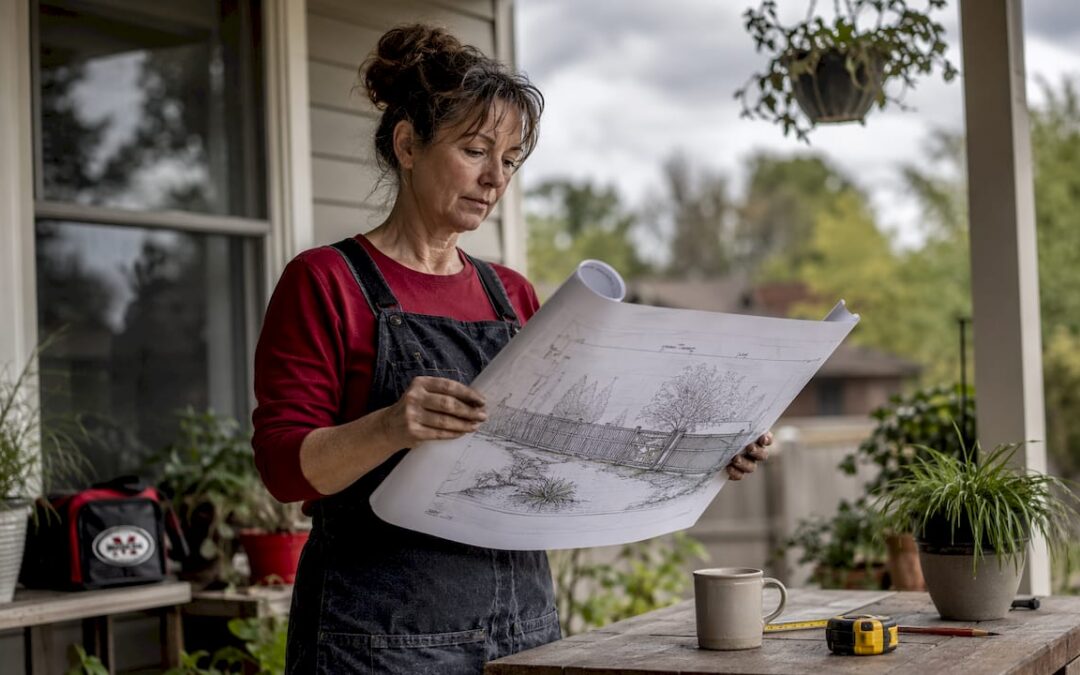
The smartest approach to landscaping with fences is to treat the fence and the planting as a single system from day one. Choose your fence material and height based on function first, then design the plant layers to complement it. That sequence prevents the most common and costly mistakes: plants that trap moisture against wood boards, roots that push fence posts out of plumb, and beds so dense that staining or repairs become impossible.
Here is what to lock in before you dig or plant:
- Measure your planting bed depth. Narrow beds call for columnar or upright plants. Standard beds support a full layered border. Deep beds can carry mixed shrubs and small trees.
- Note sun exposure. A south-facing wood fence in Arkansas reflects heat; a north-facing one stays damp. Both affect what thrives nearby.
- Pick a layout. Three patterns cover most yards: a classic layered border (tall back, mid mass, low edge), a rhythm layout (repeating anchor plants at even intervals), or a narrow-bed vertical (columnar plants and wall-mounted trellises).
- Plan clearance from the start. Leave space between plants and wood fence boards for maintenance access, staining, and airflow.
- Call 811 before digging. Utility marking is free and required in Arkansas before any post installation.
- Check local rules. Arkansas fence placement is governed primarily by local municipalities and HOAs, not state law, so verify height and setback limits with your planning department before you build.
Modernfence serves homeowners across Western Arkansas and Eastern Oklahoma and can coordinate fence installation with your landscape plan so both systems work together from the start.
Pro Tip: Sketch your fence line on paper and mark where the sun hits longest. That single step will tell you whether you need drought-tolerant ornamental grasses or shade-tolerant hydrangeas before you spend a dollar on plants.
Table of Contents
- Design principles that make fence and landscape look intentional
- How fence material and style shape your planting choices
- Plant palettes and placement recipes for fence borders
- Privacy and screening strategies that actually work
- How to handle narrow strips, slopes, and awkward corners
- Maintenance rules that protect your fence and your plants
- Planning checklist before you build or plant
- How Modernfence coordinates fence installs with landscape plans
- Key takeaways
- A note from the Modernfence team
- Modernfence can help you get the fence and landscape right
- Useful sources and further reading
Design principles that make fence and landscape look intentional
Good fence landscaping comes down to four rules: scale, sightlines, rhythm, and seasonal interest. Get these right and the fence disappears into the yard. Get them wrong and the fence looks like an afterthought.
Scale means matching plant height to fence height. A 6-foot privacy fence needs at least one plant tier that reaches 5–6 feet to anchor the composition. Low perennials alone leave the fence looking exposed. Conversely, planting 8-foot shrubs against a 4-foot decorative fence overwhelms the structure.
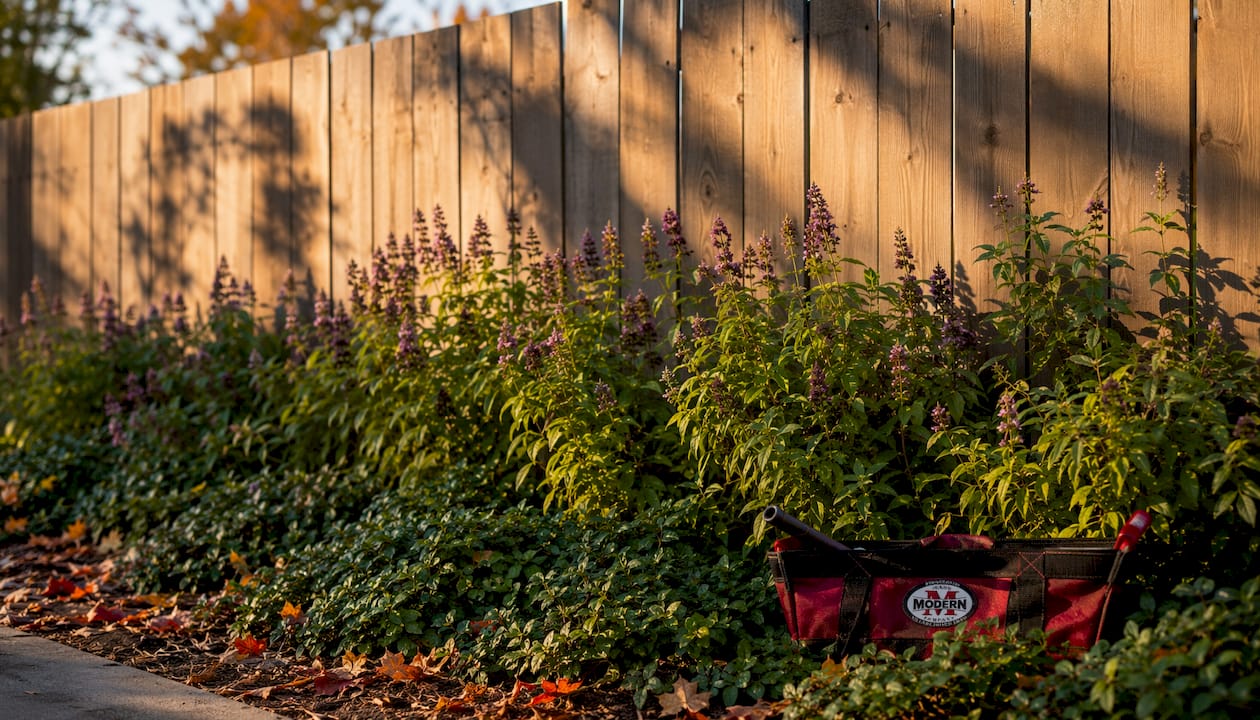
Sightlines matter more than most homeowners expect. Leave view corridors at gates and corners. Use taller anchor plants at intervals of 8–12 feet rather than running a continuous hedge, which reads as a wall-on-a-wall. Those gaps create rhythm and let the fence itself contribute to the design.
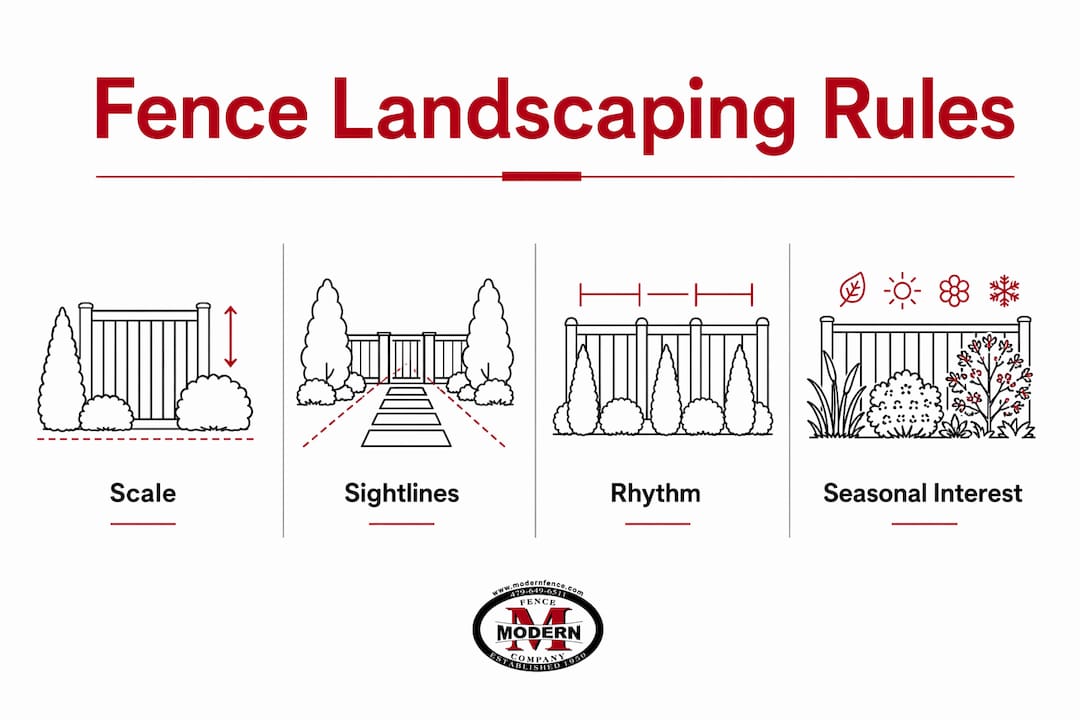
Repetition is the fastest route to a high-end planted look with limited variety. Repeat a few plant types in groups rather than planting one of everything. The eye reads repetition as intentional design.
Seasonal interest keeps the border attractive year-round. Combine:
- Evergreen structure (boxwood, upright hollies, arborvitae) for winter form
- Deciduous flowering shrubs (hydrangea, spirea) for spring and summer color
- Ornamental grasses for late-season texture and movement
- Low groundcovers at the front edge for continuous green
Bed depth shapes all of these decisions. A 4–15 foot bed gives designers room to curve the front edge and create planting pockets. A narrow strip of 18–24 inches forces a single-tier solution, which is fine as long as you choose plants that stay upright and don’t sprawl into walkways.
How fence material and style shape your planting choices
The fence material you choose affects what you can plant nearby, how close you can plant it, and how much maintenance the combination will demand.
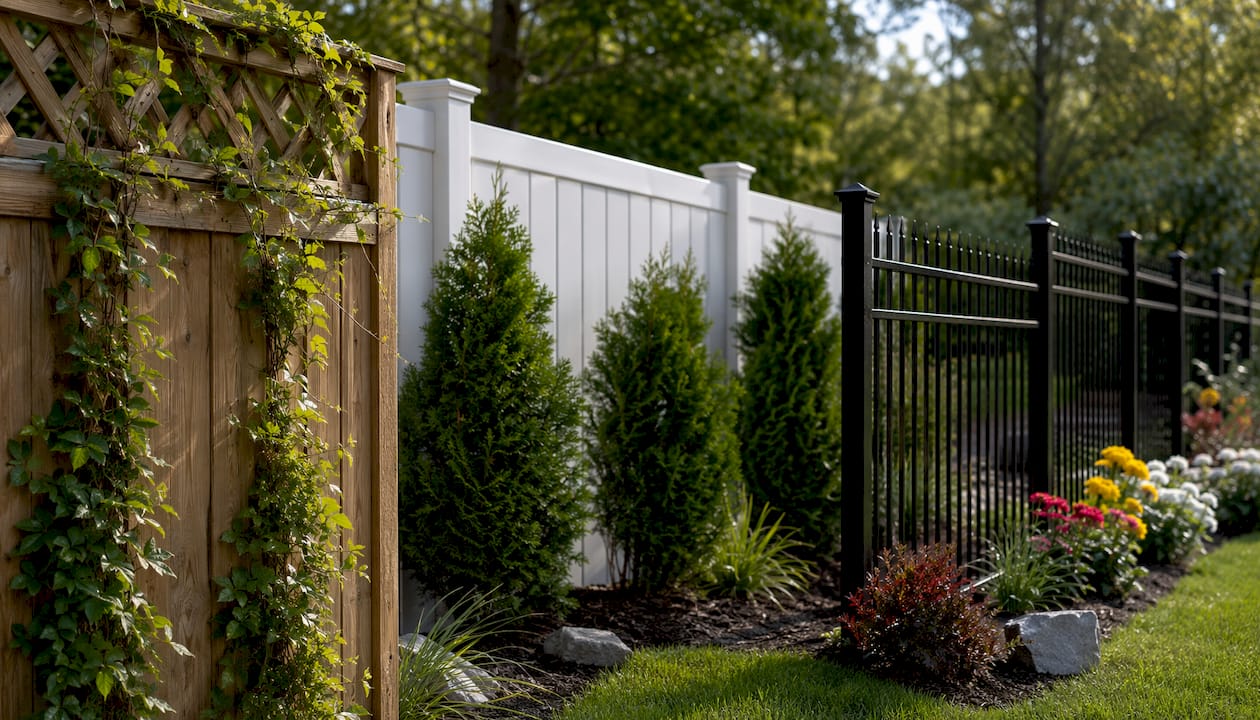
Wood fences are porous and absorb moisture. Dense plantings directly against boards accelerate rot. They also need staining every 2–4 years, which requires clear access on both sides. Plan a working clearance of at least 12 inches on the planting side. Rustic board-on-board or picket styles pair naturally with cottage-style plantings: hydrangeas, climbing roses on a separate trellis, and soft ornamental grasses.
Vinyl fences are non-porous and resist moisture, so clearance rules are less critical for the fence itself. They do reflect heat in full sun, which can stress plants positioned directly against them. Vinyl’s clean lines suit modern or transitional plantings: clipped boxwood, upright ornamental grasses, and low-spreading groundcovers.
Ornamental iron is the most forgiving material for planting proximity because it doesn’t trap moisture and its open structure allows airflow. It pairs well with structural plantings: clipped evergreen shrubs, architectural grasses, and specimen perennials. For iron fence options that work with landscape plans, Modernfence offers several profiles suited to residential borders.
Lattice and trellis attachments are the right solution when you want climbers near a wood or vinyl fence. Mount the trellis 3–4 inches off the fence face so the boards can breathe. Clematis is the recommended climber for this application: it is non-invasive, manageable in size, and won’t damage fence boards the way vigorous vines like wisteria can.
- Avoid training vines directly on wood boards — the contact point stays wet and rots faster.
- Dark-colored metal fences absorb more heat; choose heat-tolerant plants for south-facing runs.
- Check low-maintenance fence materials if durability near dense plantings is a priority.
Pro Tip: If you love the look of climbing plants but have a wood fence, install a simple cedar trellis panel mounted on standoffs. It gives the vine a home, keeps the fence boards dry, and is easy to remove for staining season.
Plant palettes and placement recipes for fence borders
Layered plantings along a fence follow a simple three-tier logic: tall anchors at the back, mid-height mass in the middle, and low edging at the front. Every effective fence border uses some version of this structure.
Bed depth rules:
- Narrow beds: one tier only; use columnar or upright plants (Sky Pencil holly, columnar arborvitae, upright ornamental grasses)
- Moderate beds: full layered border with all three tiers
- Deep beds: add a small specimen tree or large shrub as a focal anchor
| Plant role | Example species | Mature size | Maintenance level |
|---|---|---|---|
| Privacy anchor (back row) | Green Giant arborvitae, Nellie Stevens holly | 6–15 ft tall | Low |
| Flowering shrub (mid row) | Hydrangea (Annabelle, Incrediball) | 3–5 ft tall | Low–medium |
| Structure/edging | Boxwood (Sprinter, Winter Gem) | 2–4 ft tall | Medium (shearing) |
| Seasonal color (mid row) | Coneflower, black-eyed Susan, salvia | 2–3 ft tall | Low |
| Climber (on trellis) | Clematis (Jackmanii, Sweet Autumn) | 8–12 ft vine | Low–medium |
| Ornamental grass | Karl Foerster feather reed grass, Shenandoah switchgrass | 3–5 ft tall | Low |
| Groundcover (front edge) | Liriope, creeping phlox, mondo grass | 6–18 in | Low |
Sun-based guidance:
- Full sun: ornamental grasses, coneflower, black-eyed Susan, salvia, boxwood
- Part sun/part shade: hydrangea, astilbe, hostas, Sweet Autumn clematis
- Full shade: liriope, mondo grass, ferns, oakleaf hydrangea
Pro Tip: Plant hydrangeas on the east side of a fence where they get morning sun and afternoon shade. In Arkansas summers, afternoon shade prevents the wilting that makes hydrangeas look stressed even when they’re well-watered.
Privacy and screening strategies that actually work
Privacy screening with fencing and plants works best when you layer hard and soft elements. The fence provides immediate, year-round structure. Plants add depth, soften the visual line, and over time can carry most of the screening load on their own.
Quick solutions (results in one season):
- Lattice or trellis panels mounted above an existing fence line, planted with fast-growing clematis or annual vines
- Tall container plantings (arborvitae, bamboo in root-barrier pots) positioned along a fence for instant height
- Pre-grown privacy panels or screening hedges installed at near-mature size
Long-term living screens:
- Evergreen hedges: Green Giant arborvitae, Nellie Stevens holly, or Leyland cypress planted 4–6 feet apart form a dense screen in 3–5 years
- Columnar shrubs: Sky Pencil holly or columnar buckthorn work in narrow spaces where a spreading hedge won’t fit
- Clumping bamboo (Fargesia species) provides fast height without the invasive spread of running bamboo varieties
Invasive-plant caution: Running bamboo and some fast-growing vines (English ivy, kudzu, wisteria) spread aggressively and can damage fence structures. Stick with clumping bamboo varieties and non-invasive climbers like clematis. For privacy fencing options that pair well with living screens, Modernfence can advise on fence height and style before you commit to a plant palette.
Pro Tip: Install your fence first, then plant. Fence post installation disturbs soil and can damage root systems of recently planted shrubs. A two-week gap between fence completion and planting is enough.
How to handle narrow strips, slopes, and awkward corners
Constrained spaces are where most fence landscaping plans fall apart. Narrow strips get overpacked, slopes get ignored, and corners become dead zones. Each has a straightforward fix.
Narrow strips (under 30 inches):
- Use upright, columnar plants that grow tall without spreading wide
- Repeat one or two species rather than mixing many; it reads cleaner in tight spaces
- Keep the front edge clear with a low groundcover (liriope or creeping phlox) that won’t intrude on walkways
- Avoid spreading shrubs like forsythia or viburnum that will outgrow the space in two seasons
Slopes:
- Stagger plantings across the slope rather than planting in a straight line; staggered rows slow water runoff and reduce erosion
- Shallow terracing with landscape timbers or stone holds soil and creates level planting pockets
- Choose plants with fibrous root systems (ornamental grasses, native groundcovers) that knit soil without aggressive root lift that can push fence posts out of alignment
- For fence options that follow grade, Modernfence’s guide on fences for sloped yards covers racked and stepped panel approaches
Corners:
- Use a focal shrub or small ornamental tree (crape myrtle, serviceberry) at the corner where two fence lines meet
- Keep plantings low enough near gate corners to preserve sight triangles for safe entry and exit
- Avoid large shrubs that block gate swing or create blind spots at driveway corners
Pro Tip: On a slope, plant the tallest plants at the top of the grade and shorter ones downhill. This mirrors natural hillside vegetation patterns and makes the slope look intentional rather than planted in a hurry.
Maintenance rules that protect your fence and your plants
The biggest threat to a wood fence isn’t weather. It’s dense plantings that trap moisture against the boards. A simple maintenance plan protects both the fence and the border.
Clearance and access:
- Keep a 6–12 inch gap between plant stems and wood fence boards at all times
- Leave a working path of at least 18 inches behind the planting bed for staining and inspection access
- Use a mounted trellis offset 3–4 inches from the fence face if you want plants close to the boards
Irrigation:
- Drip irrigation on a timer reduces fungal disease risk on fence materials and delivers water directly to root zones rather than wetting boards
- Avoid overhead sprinklers aimed at the fence line; repeated wetting and drying cycles accelerate wood deterioration
Seasonal maintenance checklist:
- Spring: Inspect fence posts for heave or lean from winter frost; prune back any plants that grew into the fence boards over winter; check trellis mounts for looseness.
- Summer: Monitor drip irrigation for clogged emitters; trim fast-growing vines before they reach fence boards; spot-treat any fungal issues on plants near the fence.
- Fall: Cut back ornamental grasses and perennials to 4–6 inches; clear leaf debris from the base of the fence; apply mulch to a depth of 2–3 inches to protect roots and reduce moisture fluctuation.
- Stain/clean cadence: Most wood fences in Arkansas need periodic cleaning and re-staining depending on sun exposure and plant density nearby. For a full maintenance schedule, see Modernfence’s fence maintenance tips for Arkansas homeowners.
Planning checklist before you build or plant
Skipping the pre-project checklist is how homeowners end up with fence disputes, failed permits, and plants in the wrong place. Work through this list before you spend anything.
- Verify property lines. A survey or a recorded plat from your county assessor is the only reliable reference. Neighbor agreements are helpful but not legally binding on their own.
- Understand shared-fence rules. Under Ark. Code § 2-39-105, adjoining landowners share responsibility for a division fence in certain circumstances, which can create shared maintenance liability.
- Check municipal codes and HOA rules. Arkansas fence placement is governed locally. Most municipalities cap rear-yard fences at 6–8 feet and front-yard fences at 4 feet, but your city or HOA may set different limits. Verify before you order materials.
- Check for special-use rules. Pool barriers and safety enclosures may fall under building or health codes that impose specific gate and height requirements beyond standard zoning.
- Call 811 before digging. Free utility marking is required in Arkansas before any post installation. Allow 3 business days for marking to be completed.
- Sequence the work correctly. Install the fence first, then plant. Post installation disturbs soil, and planting before the fence is set risks root damage and misaligned beds.
- Budget for irrigation and soil amendment. Drip irrigation and a 3-inch mulch layer are not optional extras; they directly affect fence longevity and plant survival in Arkansas summers.
- Check easements. Utility and drainage easements often run along property lines. Fences and deep-rooted plants may be restricted within easement corridors.
For local permit questions specific to Northwest Arkansas, Modernfence’s homeowner’s guide covers common zoning scenarios.
How Modernfence coordinates fence installs with landscape plans
Modernfence has operated in Western Arkansas and Eastern Oklahoma for more than 70 years. That history means the team has seen every combination of fence material, plant choice, and site condition that Arkansas yards produce.
The coordination process works like this:
- Site assessment: Modernfence reviews the fence line, existing plantings, grade changes, and access points before installation begins.
- Shared planning: The team can work directly with your landscaper or provide clearance and spacing recommendations so the planting plan accounts for staining access, post locations, and finished-side orientation.
- Sequenced installation: Fence installation is scheduled before planting, with temporary protection for adjacent beds during post setting when needed.
- Material range: Wood, vinyl, ornamental iron, and chain link are all available, along with fence staining, cleaning, custom metal fabrication for trellis and gate work, and rental fences for temporary project needs.
Modernfence is licensed and insured, and all estimates are free. For installation best practices and how the process works from survey to completion, see the fence installation guide.
Key takeaways
Treat fence and planting as one integrated system, plan clearance before you plant, and match your fence material to your maintenance capacity for results that hold up through Arkansas seasons.
| Point | Details |
|---|---|
| Design as one system | Choose fence material and height first, then build the plant palette around it to avoid rework. |
| Clearance protects the fence | Keep 6–12 inches between wood boards and plant stems; leave an 18-inch access path for staining and repairs. |
| Layering creates the look | Use tall anchors at the back, mid-height mass in the middle, and low groundcovers at the front edge. |
| Check rules before you build | Verify property lines, local codes, HOA rules, and call 811 for utility marking before any post goes in the ground. |
| Modernfence coordinates the process | With 70+ years of experience in Western Arkansas and Eastern Oklahoma, Modernfence sequences fence and landscape work so both systems succeed. |
A note from the Modernfence team
We’ve coordinated fence installs alongside landscape projects long enough to know where things go wrong. The most common problem isn’t the fence or the plants. It’s the order of decisions. Homeowners pick plants they love, then try to fit a fence around them, and end up with a border that’s either impossible to maintain or a fence that rots in five years. Start with the fence line, the material, and the clearance plan. Then design the planting to complement it. That sequence is what separates a yard that looks great for a season from one that holds up for decades. We invite you to use the planning checklist in this guide before your first conversation with a contractor. And if you want a second set of eyes on your site, we’re here.
Modernfence can help you get the fence and landscape right
Coordinating a fence install with a planting plan takes more than picking a style you like online. Modernfence brings 70+ years of hands-on experience in Western Arkansas and Eastern Oklahoma to every project, which means you get practical guidance on material selection, clearance planning, and installation sequencing before a single post goes in the ground.
Services include wood, vinyl, and iron fence installation, fence staining and cleaning, custom metal fabrication for trellises and gates, and rental fences for temporary project needs. The process starts with a free estimate and a site visit. From there, Modernfence can work directly with your landscaper or provide a sequenced plan you can hand to one. To get started, visit the fence installation guide or call Modernfence directly for your free estimate.
Useful sources and further reading
Before you finalize your fence and landscape plan, verify local rules for your specific city or HOA. The resources below cover Arkansas law, plant selection, irrigation, and installation guidance.
- Arkansas state portal — starting point for local planning department contacts and zoning information: portal.arkansas.gov
- Ark. Code § 2-39-105 — the division-fence statute covering shared boundary responsibilities: codes.findlaw.com
- Arkansas fence rules overview — summary of statewide and local fence regulations including pool barriers: fencerules.com/arkansas
- Arkansas fence laws (LegalClarity) — plain-language guide to property boundaries, costs, and disputes: legalclarity.org
- University of Arkansas Extension — Home Landscaping — plant selection, soil, and design resources specific to Arkansas conditions: uaex.uada.edu
- Fence line gardening guide — practical layout and irrigation advice for long fence runs: backyardsuperstar.com
- Landscaping along a fence (GardenerBasics) — layered planting design and plant palette guidance: gardenerbasics.com
- Landscape lighting layering — techniques for integrating lighting into fence-line plantings for aesthetics and security: foreverglowlighting.com
- Modernfence — Northwest Arkansas homeowner’s guide — local permit questions and regional fence considerations: modernfence.com
This article provides general information for planning purposes. Verify current municipal codes, HOA covenants, and property boundaries with your local planning department or a qualified professional before starting any fence or landscape project.