Six commercial fence types cover nearly every property need: chain link, welded wire mesh, anti-climb panels, ornamental steel, ornamental aluminum, and privacy panels. The simplest rule of thumb: chain link for cost-effective large perimeters, welded mesh or 358 for anti-climb security, ornamental metal for customer-facing entrances, and privacy panels for visual screening. From there, a site survey and gate review turns your shortlist into real bids.
TL;DR:
- Chain link fencing remains the most cost-effective option for large commercial perimeters, especially when height and gauge are properly specified for security needs.
- Anti-climb 358 mesh offers the strongest resistance to climbing and cutting, making it ideal for critical infrastructure sites like data centers and utility substations.
- Aluminum fencing resists corrosion and is suitable for humid or coastal environments, while steel requires regular maintenance to prevent rust.
- Gate type and access control systems should match traffic patterns and security levels, with automated options providing convenience at higher costs.
- Proper installation depth, material specs, and vendor vetting are crucial to meet security standards and prevent costly upgrades or deficiencies.
Table of Contents
- What Are the Main Commercial Fence Types?
- What Do Commercial Fence Specs and Costs Look Like?
- How Do You Choose the Right Commercial Fence?
- Gates and Access Control Basics
- Maintenance, Lifespan, and Warranty Basics
- Why Professional Installation Matters for Commercial Fencing
- A Balanced Approach To Security and Curb Appeal
- Get a Commercial Fence Quote That Fits Your Property
- Sources
- FAQ
What Are the Main Commercial Fence Types?
Each fence family solves a different problem. Some hold a perimeter cheaply over long distances. Others resist cutting tools or climbing attempts. A few exist mainly to look good while still doing security work in the background.
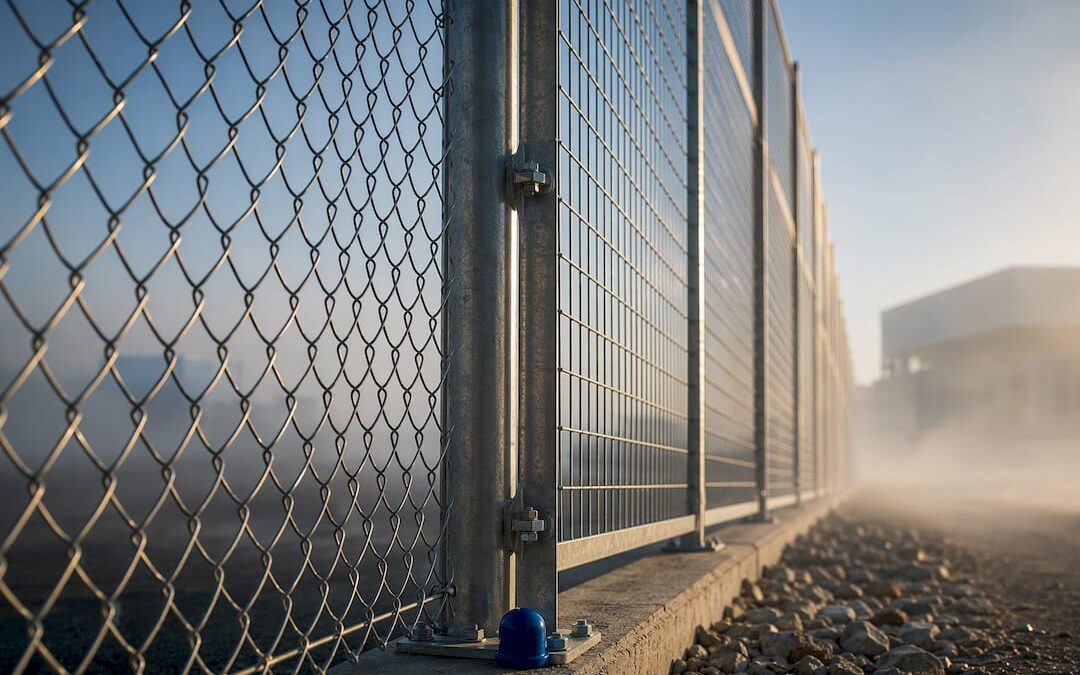
Chain link remains the workhorse for large commercial perimeters. It’s galvanized or vinyl-coated steel wire woven into a diamond pattern, typically running from moderate to taller heights in commercial applications, with heavier gauge wire specified for industrial or high-security sites. It balances affordability, durability, and visibility better than almost any other option, and it adapts easily to upgrades: privacy slats woven through the mesh, windscreens for construction sites, or barbed and razor wire installed along the top for added deterrence.
Welded wire mesh trades chain link’s flexible diamond pattern for a rigid grid, and that rigidity is the point. It resists bolt cutters and climbing far better than standard chain link because there’s no give in the wire to work with.
358 mesh, sometimes called anti-climb mesh, refers to openings roughly 3 by 0.5 inches. Those narrow gaps remove any foothold a climber could use and resist cutting tools better than wider mesh. Data centers, utility substations, and other critical infrastructure sites lean on 358 specifications for exactly this reason.
Ornamental steel, wrought iron, and aluminum show up where a property needs to look professional while still controlling access. Steel and wrought iron offer the most strength but need regular attention to prevent rust. Aluminum resists corrosion better, which makes it the practical choice in coastal or humid climates where salt air or moisture would eat through lesser coatings.
Privacy panels in vinyl, composite, or wood block sightlines completely, but they catch wind like a sail, so panel spacing and post depth matter more here than with open mesh systems. That wind loading issue is also why you rarely see privacy panels running the full length of a large industrial perimeter. Palisade and solid steel panel systems fill the gap when a site needs both a hard visual barrier and serious resistance to forced entry.
What Do Commercial Fence Specs and Costs Look Like?
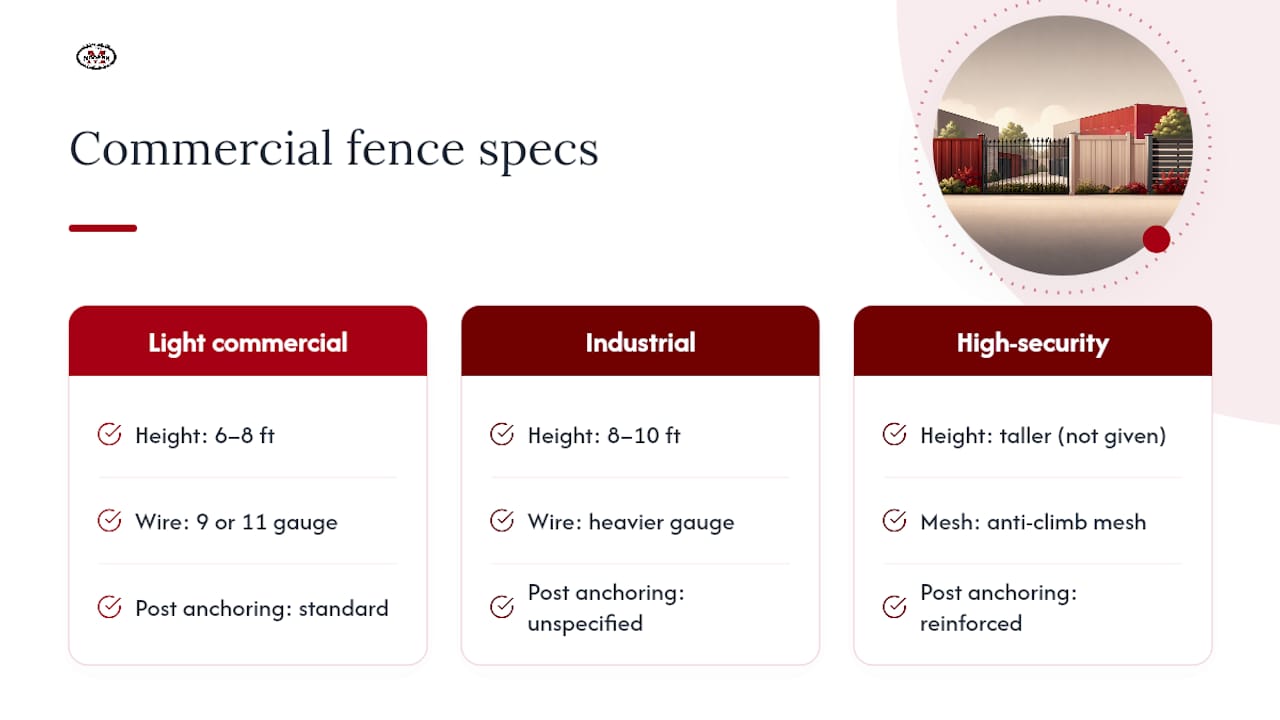
Height and gauge move together. Light commercial applications, like a retail lot or office park, typically run 6 to 8 feet with standard 9 or 11 gauge wire. Industrial sites push to 8 to 10 feet with heavier gauge. High-security applications, such as substations or data centers, often specify taller heights paired with anti-climb mesh and reinforced post anchoring.
Installed cost bands vary by family, and add-ons shift the number fast. Standard chain link tends to run at the lower end of the commercial cost spectrum, ornamental steel and aluminum systems cost more per foot, and 358 mesh sits above standard welded wire because of the material and labor involved in tighter openings. Barbed wire toppings, privacy slats, and automated gate operators each add to the base price, sometimes significantly.
Three spec items move the security needle more than anything else: mesh opening size, wire gauge, and post anchoring depth. A fence can look imposing and still fail at all three if the posts aren’t set deep enough to resist a vehicle strike or a determined push.
How Do You Choose the Right Commercial Fence?
Start with threat level, not aesthetics. A distribution warehouse in an industrial park has different needs than a medical office with a public entrance.
- Rank your priorities: security threat, public visibility, budget ceiling, vehicle and gate traffic, ongoing maintenance capacity, and local permitting rules.
- Ask contractors specific questions: what wire gauge and coating they use, how deep and how they set posts, what warranty terms cover materials versus labor, and whether they’ve integrated access control systems before.
- Watch for red flags: no proof of insurance, vague material specs without gauge or height numbers, or no references from past commercial jobs.
- Build your RFP checklist: material and coating specs, post size and depth, gate hardware and operator type, permit responsibility, and a written timeline.
Pro Tip: Get every bid on the same spec sheet before comparing prices. A quote that’s $3 cheaper per foot often means lighter gauge wire or shallower post footings, not a better deal.
Gates and Access Control Basics
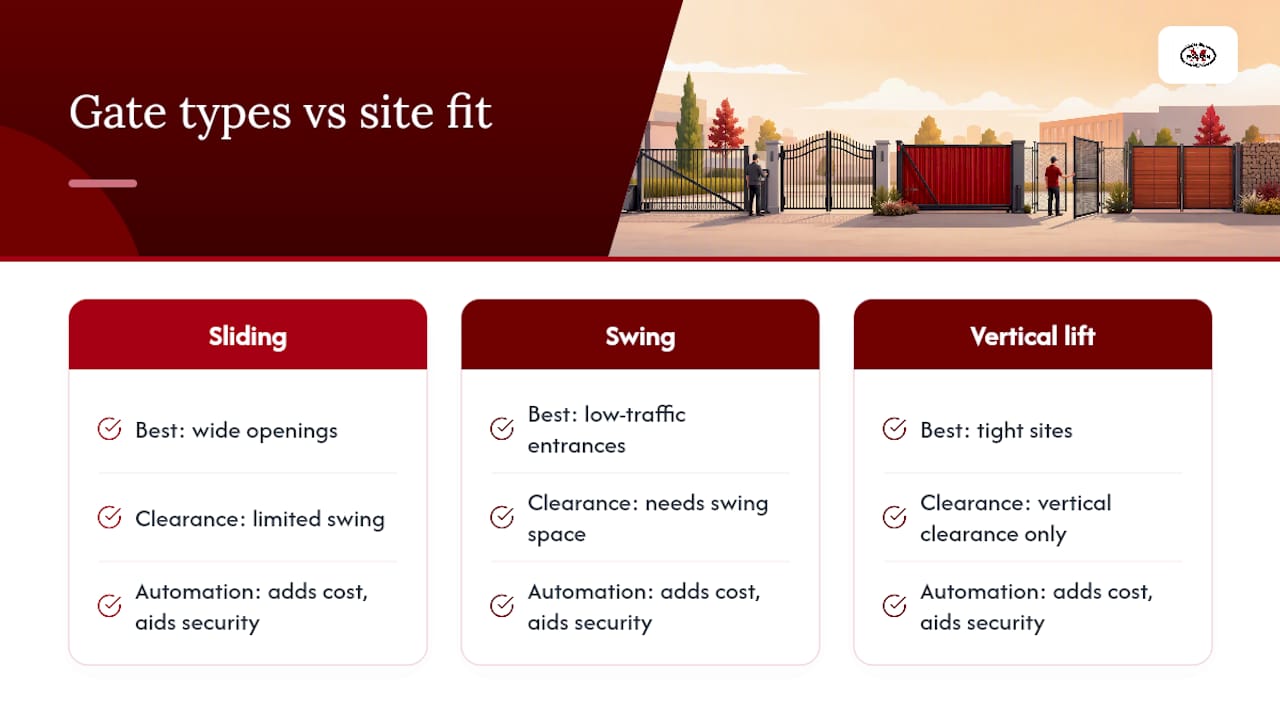
Gate type should match your traffic pattern. Sliding gates work well for wide openings with limited swing clearance; swing gates suit lower-traffic entrances; vertical lift gates fit tight sites. Automated operators add real cost but pay off in daily convenience and after-hours security.
Access control options range from simple keypads to card readers, intercom and video entry, and license plate recognition for higher-traffic sites. Your gate specification should match your fence’s security level. A 358 mesh perimeter with a basic keypad gate has an obvious weak point.
Maintenance, Lifespan, and Warranty Basics
Galvanized chain link can last decades with minimal upkeep. Coated chain link and aluminum resist corrosion well and need only occasional cleaning. Steel needs periodic rust checks and touch-up coating. Vinyl holds up with light washing, while wood needs the most frequent attention, including staining and sealing.
Ask vendors what their warranty actually covers. Some exclude labor after year one or limit coverage on coatings and finishes.
Why Professional Installation Matters for Commercial Fencing
Meeting commercial specs, especially gate integration and access control wiring, takes installer experience most property owners don’t have in house. Modern Fence Company brings more than 70 years of combined installation history across wood, chain link, iron, and vinyl systems, plus full-spectrum services from fabrication to access control. Before hiring, request proof of insurance, project references, shop drawings, and written installation warranties.
A Balanced Approach To Security and Curb Appeal
Mixed strategies work best in practice: ornamental metal at public-facing entrances, tougher mesh systems elsewhere. Plan gate hardware and access control early. Retrofitting either after the fence goes up almost always costs more.
— mark
Get a Commercial Fence Quote That Fits Your Property
This fencing contractor handles a full range of commercial fencing types including chain link, ornamental steel and aluminum, vinyl privacy panels, custom gate fabrication, and access control integration, serving clients in the region. Need coverage during a construction phase or a special event instead of a permanent install? Our temporary fence rentals cover that gap too.
A site estimate from Modern Fence Company means someone walks your actual perimeter, checks soil and post conditions, and talks through gate placement and traffic flow before any numbers get written down. That’s how you avoid the mismatched bids that make comparing contractors so frustrating. Ready to get specific numbers for your property? Request a commercial perimeter fencing estimate and get a spec sheet you can actually compare against other bids.
Sources
This guide draws on Fence Advisors, Hurricane Fence, Scheiderer Fence, and Medallion Fence. Always confirm current local codes before finalizing a fence height or barbed wire installation.
- Commercial Fence Types: Security, Access Control & Perimeter Solutions
- Commercial Fence Types: Find the Best Fit for Your Business
- 7 Best Commercial Fence Types for Business Security
FAQ
What are the three main types of fences?
Fencing generally splits into three broad categories: chain link and welded mesh systems for security and cost efficiency, ornamental metal (steel, iron, aluminum) for appearance with strength, and privacy panels in vinyl, composite, or wood for visual screening.
What is the difference between a residential and a commercial fence?
Commercial fences are typically taller, built with heavier gauge materials, and engineered to meet stricter security and code requirements than residential fencing, which prioritizes privacy and curb appeal over perimeter defense.
What is the strongest commercial fence style?
Welded wire and 358 anti-climb mesh generally offer the strongest resistance to cutting and climbing, thanks to their rigid construction and small openings that eliminate footholds.
What is a type 3 fence?
There’s no single universal “type 3” fence standard across the industry; the term usually refers to a specific tier within a particular manufacturer’s or specification’s classification system, so confirm the exact definition with your fence contractor or the relevant spec sheet.
How much does commercial fencing typically cost installed?
Costs vary widely by material, height, and add-ons like automated gates or anti-climb mesh, with chain link generally landing at the lower end and ornamental metal or 358 mesh systems costing more per foot installed.