
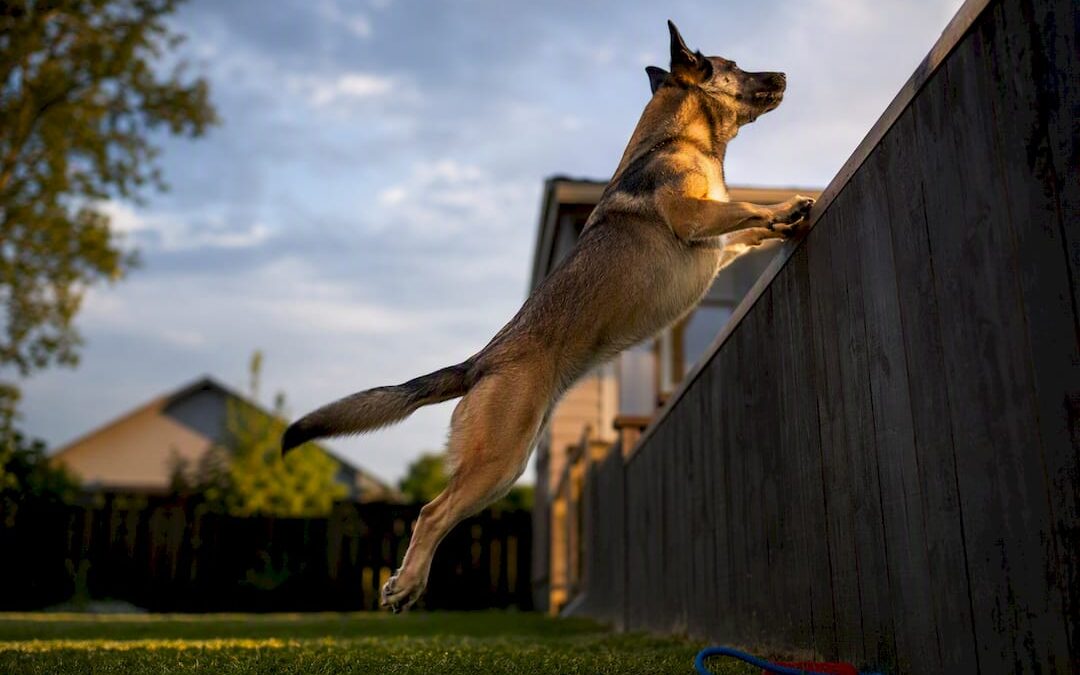
Stop a dog from jumping a fence by combining three things at once: enrichment and training that reduce the urge to escape, removal of every launch point in the yard, and a physical barrier upgrade like a roller or extension. Skip shock collars and invisible fences. They can cause fear without stopping a determined jumper. If escapes continue after a week of focused effort, it’s time to call a fence professional.
TL;DR:
- Reinforcing training and enrichment can reduce a dog’s motivation to jump, especially if combined with supervision and mental exercises.
- Removing launch points and adding physical barriers like rollers or inward-leaning extensions are effective in stopping known jump routes.
- Professional fence solutions are necessary if a dog persists after several weeks of DIY fixes and training, especially for athletic breeds or terrain issues.
- DIY fixes, such as PVC rollers or added fencing materials, are low-cost and quick to install but may not suffice for highly motivated or strong jumpers.
- Combining training, yard adjustments, and engineered fencing creates the most reliable long-term prevention against fence jumping.
Table of Contents
- Why Dogs Jump Fences: Motivation and the Launch-Point Problem
- Training and Enrichment to Reduce Escape Motivation
- Fence Modifications That Reliably Stop Jumpers
- Low-Cost DIY Fixes You Can Install This Weekend
- When to Call a Professional Fence Installer
- Quick Action Checklist: A Prioritized 1-Week Plan
- The Gap Between What Fence Products Promise and What Actually Stops a Jumper
- Get a Fence Built to Outlast Your Dog’s Best Jump
- Sources
Why Dogs Jump Fences: Motivation and the Launch-Point Problem
A dog that clears a fence about six feet high is usually solving a problem, not misbehaving for the fun of it. Figure out which problem it’s solving, and you’ll know whether training alone will fix this or whether you need to change the fence itself.
Most fence jumping traces back to one of these drivers:
- Boredom. A dog with nothing to do treats the yard as a puzzle to escape.
- Separation anxiety. Some dogs jump the moment they’re left alone, often within minutes.
- Prey drive. A squirrel, cat, or delivery truck on the other side can override almost any training in the moment.
- Mating drive. An intact dog that senses another dog nearby will try harder and jump higher than usual.
- Seeking company. Dogs are social animals, and an empty yard next to a busy sidewalk is a setup for escape attempts.
Launch points matter as much as motivation. A stacked woodpile, an air conditioning unit, a low retaining wall, or even a doghouse pushed against the fence line gives a dog the extra foot of height it needs to clear a barrier it couldn’t otherwise reach. Removing that object can solve the problem outright, without a single training session.
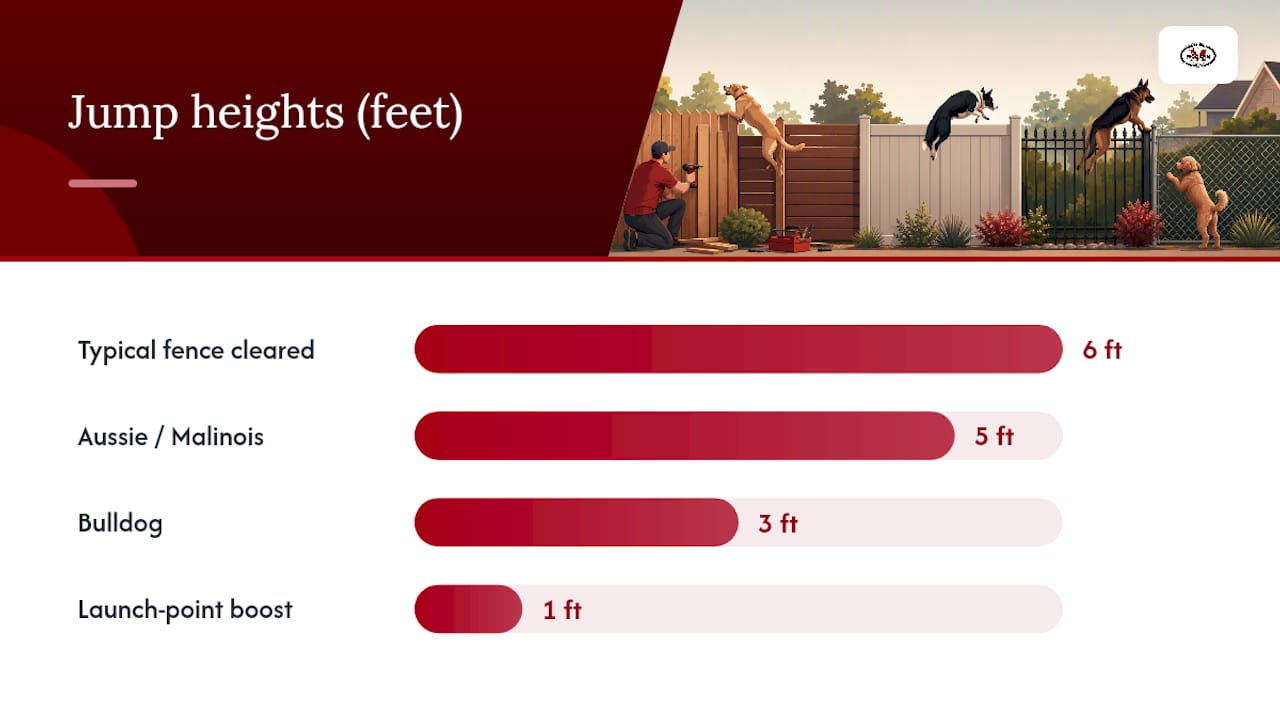
Breed and build set the ceiling on what training can accomplish. An Australian Shepherd or a Belbelgian Malinois can clear five feet from a flat-footed stance; a Bulldog usually can’t get past three. Match your expectations to your dog’s actual athleticism, not to what worked for a neighbor’s dog.
Training and Enrichment to Reduce Escape Motivation
Fix the motivation before you touch the fence, and you’ll often find the fence was never really the problem. Professional trainers point to mental and physical stimulation, things like scent work and brain games, because a tired dog is far less likely to try escaping in the first place.
Work through these steps in order:
- Exercise first, yard time second. A 20 to 30 minute walk or fetch session before unsupervised yard time burns off the energy that fuels jumping attempts.
- Add mental enrichment daily. Food puzzles, frozen Kongs, and short scent-work games (hiding treats around the yard) tire a dog’s brain as effectively as a run tires its legs.
- Teach a boundary stay. Walk your dog to the fence line on a leash, say “stay,” and reward calm behavior near the boundary. Repeat in five-minute sessions, several times a day, rather than one long drill.
- Build a rock-solid recall. Practice “come” in low-distraction settings first, then add distractions like a bouncing ball or a neighbor walking by. Reward every single correct response for the first few weeks.
- Supervise with a long line. Attach a 15 to 20 foot leash during yard time so you can interrupt a jump attempt before it happens, without needing to chase your dog down.
Short, consistent sessions supervised right in the yard beat one marathon training block on a Saturday. That pattern of frequent, brief repetition is what actually changes behavior over time.
Pro Tip: Practice recall and boundary stays in the exact spot where your dog usually tries to jump. Training in a different corner of the yard doesn’t transfer as well as practicing at the scene of the crime.
Avoid punishment-based tools during this phase. Shock collars and invisible fences are controversial for boundary training because they can trigger fear or panic in a dog that’s already anxious, and a highly motivated jumper will often push through the correction anyway.
Fence Modifications That Reliably Stop Jumpers
Training reduces the desire to jump. Physical barriers remove the ability. Most owners eventually need both, and the fence changes below range from a weekend project to a contractor call.
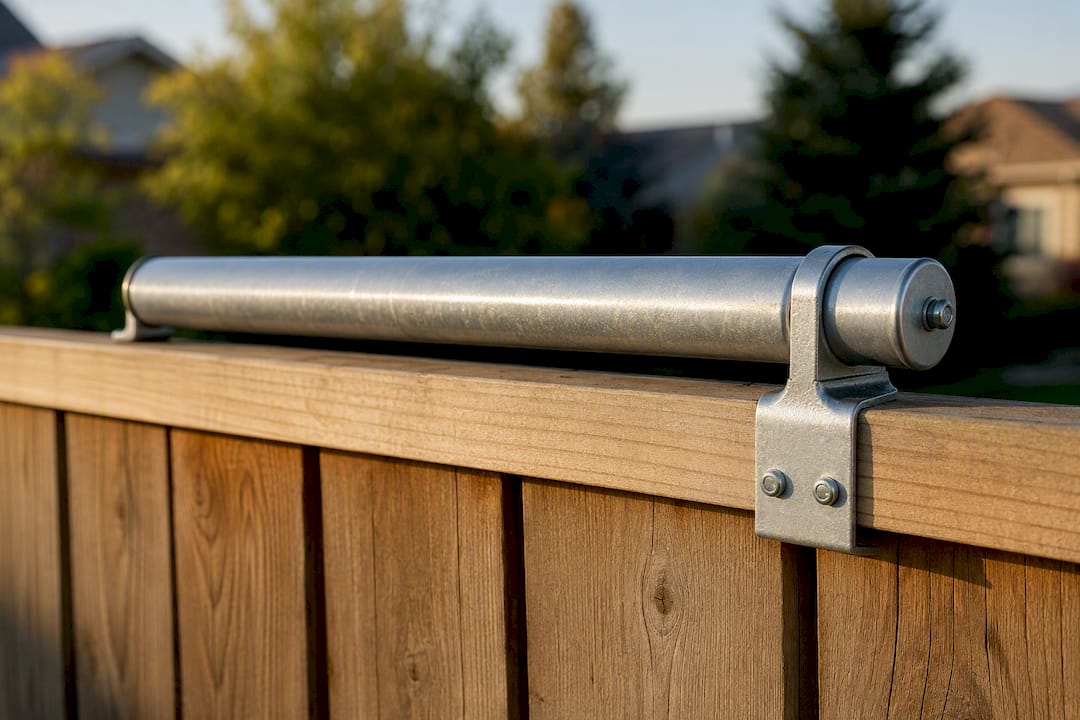
- Coyote rollers. A horizontal bar mounted along the top of the fence spins when a dog puts weight on it, so there’s nothing to grip and no way to pull up and over. Rollers cost roughly $5 to $10 per linear foot in materials for a DIY version, more for a professionally fabricated one, and they need periodic maintenance. Poorly spaced brackets can create pinch points, so test any installation with a supervised push before trusting it unattended.
- Height extensions and inward-leaning toppers. Adding some height extensions, angled inward to create an overhang, defeats the run-and-launch jump most dogs rely on. Check your local HOA rules or permit requirements before extending a fence past its original height. Some jurisdictions cap residential fence height at six feet.
- Privacy slats, bamboo, or lattice. Blocking the view removes the trigger, not just the ability. A dog that can’t see the cat next door has one less reason to try.
- L-footers and buried mesh. For diggers who tunnel under rather than jump over, burying or anchoring mesh along the base of the fence stops the problem at ground level. A poured concrete footer is the permanent fix for a determined digger.
- Gate security. Gates are the weakest point on most fence lines. A basic latch is easy for a dog to bump open or for a person to leave unlatched. Adding a secondary lock or a simple padlock is cheap and closes that gap fast.
For a dog that uses a two-stage jump, a run-up followed by a clear, adding a shorter redundant fence a few feet inside the main perimeter raises the difficulty enormously without redoing the entire yard. If you’re shopping for materials that hold up long term, these fence options built for active dogs cover what tends to actually last.
Low-Cost DIY Fixes You Can Install This Weekend
You don’t need a contractor to make real progress this weekend. Most of these fixes cost under $100 in materials and take an afternoon.
- Build a simple PVC coyote roller. Thread 4 to 6 foot sections of PVC pipe or electrical conduit onto a length of galvanized wire or cable, mount it along the top rail with carriage bolts and eye hooks, and leave enough slack for the pipe to spin freely. Test it yourself by pushing down hard before letting your dog near it unsupervised.
- Add chicken wire, bamboo, or lattice for temporary height. Zip-tie or staple the material to the top of the existing fence, checking that every attachment point is secure enough to resist a dog’s full body weight against it.
- Cut a peek-a-boo window in a solid privacy fence. A single clear panel or gap at nose height can reduce the frustration that drives some dogs to jump, since they can see what’s happening without needing to get over the fence to check.
- Walk the perimeter and clear launch points. Move woodpiles, patio furniture, trash cans, and anything else stacked within three feet of the fence line, then double-check every gate latch and add a padlock where needed.
When to Call a Professional Fence Installer
Some situations call for engineered solutions that go past what a weekend project can deliver. Consider a contractor when:
- Your dog keeps escaping despite two or three weeks of consistent training and DIY fixes.
- You own an athletic breed capable of clearing standard extensions, which sometimes calls for angled extensions or overhead netting built by a professional.
- Your yard has uneven terrain, slopes, or existing structures that complicate a DIY roller or extension.
- Local permit or HOA rules require a licensed installer for any height change.
A good contractor visit starts with a site walk to measure terrain, identify launch points you might have missed, and recommend materials suited to your dog’s size and drive. Ask about warranty terms, expected timeline, and what maintenance the finished fence will need. Modern Fence Company has spent more than 70 years installing wood, chain link, iron, and vinyl fencing across Western Arkansas and Eastern Oklahoma, and its residential fence installation guide walks through what a proper build actually involves. For dogs that need something closer to a security-grade barrier, anti-climb fence specifications show what an engineered solution looks like in practice.
Quick Action Checklist: A Prioritized 1-Week Plan
- Today: Supervise all yard time, clear obvious launch points, and add a padlock to every gate latch.
- This week: Start daily boundary-stay and recall sessions, plus one enrichment activity like a food puzzle or scent game.
- This weekend: Install a DIY coyote roller or privacy slats, then test recall and boundary behavior under close supervision.
- If escapes continue: Book a site visit with a fence professional for an engineered fix.
The Gap Between What Fence Products Promise and What Actually Stops a Jumper
Most advice on this topic treats the fence as the whole problem, when it’s usually half the problem at best. A $40 coyote roller kit will not fix a dog that’s jumping because it’s bored out of its mind or panicking over separation anxiety. It just changes where the failure happens. That’s the piece the marketing for fence gadgets tends to skip.
The conventional wisdom oversells DIY fixes as permanent solutions and undersells training as too slow to bother with. Both are backwards. Training is the part that actually addresses why a dog wants out, and it works faster than most owners expect when sessions are short and daily rather than occasional and long. Physical barriers matter too, but they work best as a backstop for a dog whose motivation to escape has already dropped.
Where the DIY route genuinely runs out of road is athletic breeds and yards with real terrain problems. That’s not a training failure. It’s a physics problem, and it usually needs an engineered fix rather than another roll of chicken wire.
— mark
Get a Fence Built to Outlast Your Dog’s Best Jump
If you’ve tried the training, cleared the launch points, and your dog still treats the fence like a minor speed bump, the next move is a fence engineered for the job rather than patched to survive it. A long-established fencing company installs wood, chain link, iron, and vinyl fencing for homeowners and has experience with various common dog escape issues and effective fixes.
Every project starts with a site visit, not a guess. A professional estimator can walk your yard, check for launch points and terrain issues a DIY fix might miss, and recommend materials sized to your dog’s height and drive rather than a one-size-fits-all extension kit. The fence installation guide breaks down what that process looks like from first call to finished gate. If your dog has already beaten a standard six-foot fence, ask about options built into Modernfence’s property security fencing line before you spend another weekend patching the same weak spot. Call for a free estimate and find out what a fence that actually holds looks like for your yard.
Sources
- How to stop your dog escaping | Best Friends Animal Society
- How to keep dog from jumping fence | Tractive blog
- How to keep your dog from escaping your yard | Dogster
- How To Stop A Dog From Jumping a Fence? (Training Guide) | GoldenPawPS