

Standard chain link fabric heights run 3’, 4’, 5’, 6’, 7’, 8’, 10’, and 12’, with special orders available up to approximately 20’. The decision rule is straightforward: use 3’–4’ for front yards and light decorative borders, 4’–6’ for backyards, pet containment, and pool enclosures, 8’–10’ for commercial perimeters and athletic facilities, and 8’–20’ for high-security installations. Before you finalize any height, consider these three checks:
- Local permit threshold: Many municipalities require permits for fences taller than 6’. Verify your local code before ordering.
- Privacy and containment needs: Chain link alone provides little visual privacy; height helps with containment but not screening.
- Professional installation: Any fence above 6’, on a slope, or with security toppers warrants a licensed contractor.
Key Takeaways
Standard chain link fabric heights run 3’–12’ (special orders to ~20’), and the right choice depends on application, local code, and structural spec, not just the height that looks right from the street.
| Point | Details |
|---|---|
| Standard heights by application | Use 3’–4’ for front yards, 4’–6’ for backyards and pools, 8’–10’ for commercial, 10’–12’+ for athletic and security. |
| Permit threshold | Fences above 6’ commonly require a permit and may need engineered footings; check local code before ordering. |
| Fabric vs. post height | Fabric height is the mesh measurement; finished post height is 1’–1.5’ taller to account for top rail and cap. |
| Material spec scales with height | Use 9-gauge fabric and Schedule 40 posts for 8’+ installations; specify K&K selvage for pools and play areas. |
| Modernfence for local projects | Modernfence serves Western Arkansas and Eastern Oklahoma with licensed chain link installation across all height ranges. |
Table of Contents
- What are the standard chain link heights and what is each one used for?
- How is chain link measured, sold, and ordered?
- How do you choose the right chain link height for your property?
- Can you raise an existing chain link fence?
- What materials and construction factors matter for taller fences?
- When should you hire a professional for chain link installation?
- Modernfence handles chain link height decisions from site to permit
- Sources
What are the standard chain link heights and what is each one used for?
Chain link fabric follows one-foot increments through the most common sizes, which makes matching fabric to posts and gates straightforward for most jobs. Here is how each height maps to real applications:
| Fabric Height | Typical Application | Mesh/Gauge Notes |
|---|---|---|
| 3’ | Front yard borders, garden edging | 11-gauge, 2" diamond |
| 4’ | Residential front/side yards, light pet containment | 11-gauge, 2" diamond |
| 5’ | Backyard perimeters, medium dog containment | 11-gauge, 2" diamond |
| 6’ | Backyard privacy perimeters, pool enclosures, residential security | 9–11-gauge, 2" diamond |
| 7’ | Commercial light-duty perimeters, upgraded residential | 9-gauge, 2" diamond |
| 8’ | Commercial and industrial perimeters, school yards | 9-gauge, 2" or 1.75" diamond |
| 10’ | Athletic courts, ballfields, commercial/industrial | 9-gauge, 1.75"–2" diamond |
| 12’ | Backstops, high-security perimeters, correctional facilities | 6–9-gauge, 1.75" diamond |
| 20’ (special order) | Maximum-security, correctional, utility sites | Heavy gauge, engineered posts |
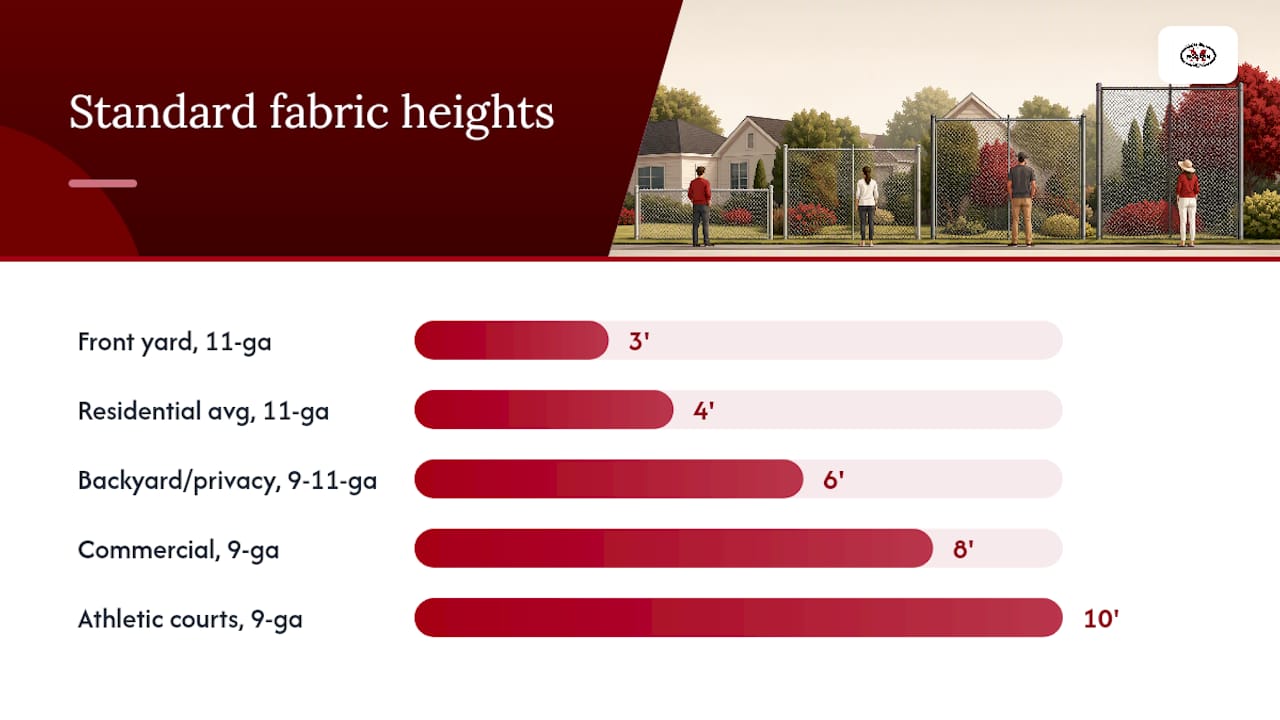
Front yard vs. backyard norms. HOA covenants frequently cap front-yard fences at 2’–4’ for curb-appeal reasons, while backyards commonly allow 4’–6’. Residential fabric heights typically run 4’–6’, with 4’ being the practical average for most neighborhood lots. If your HOA has written fence standards, pull that document before you measure anything.
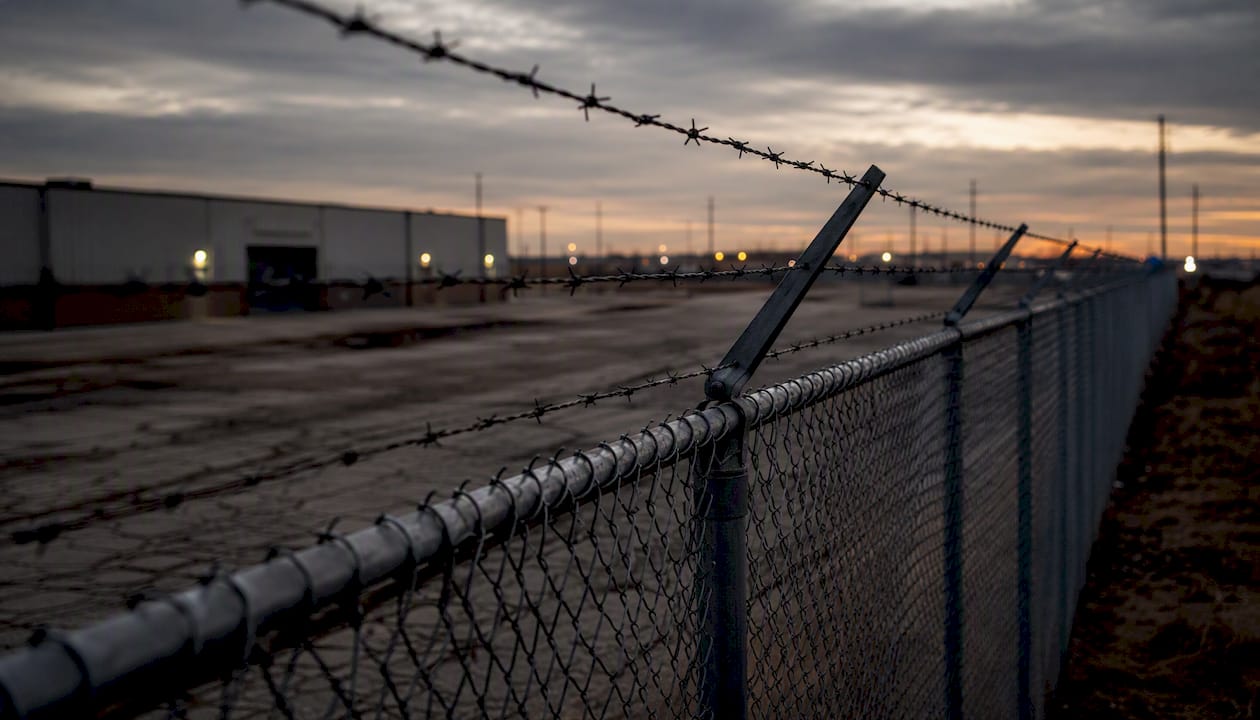
Athletic and high-security uses push the upper range hard. Tennis courts and ballfields commonly specify 10’–12’ fabric with a 1.75" diamond opening to prevent balls from lodging in the mesh. Correctional and utility perimeters often combine 12’+ fabric with barbed or razor-wire toppers, which adds another 1’–2’ of effective deterrent height above the fabric line.
How is chain link measured, sold, and ordered?
Understanding the difference between fabric height and finished fence height prevents the most common ordering mistake in the field.
- Fabric height is the measurement of the mesh roll itself, from bottom wire to top wire. This is the number listed on the product spec sheet and what you order.
- Finished post height is taller. Posts extend above the fabric to support the top rail and cap. A 6’ fabric fence typically requires posts set at roughly 7’–7.5’ above grade, accounting for the top rail fitting and post cap.
- Top rail and fittings add approximately 1"–2" above the fabric line. Factor this into your visual height expectation.
Chain link is commonly sold in 20-foot or 50-foot rolls. The 20’ roll suits smaller jobs and tight gate sections; the 50’ roll is standard for most residential and commercial runs. Ordering in full rolls reduces waste and avoids weak splice points mid-span. Gates are typically ordered separately and sized to match the fabric height, with the gate frame adding a few inches to the overall opening height.
For footing depth, ASTM F567 provides practical guidance that scales minimum footing depth with fence height. A general installer practice is a minimum 24" footing for fences up to 4’, with additional depth required as fabric height increases. On sloped terrain, posts must be set to a consistent height above grade rather than following the ground contour, or the finished fence will appear uneven.
Pro Tip: Before setting posts on a slope, stake the run and use a string line at finished fabric height. Walk the line and note where the grade drops more than 6" between posts. Those low spots may need the post set deeper or the fabric raked (angled) to follow the slope, depending on your local code and aesthetic preference.
How do you choose the right chain link height for your property?
Work through this checklist in order. Skipping a step is how property owners end up with a fence that violates code or fails to contain a dog.
- Identify the site type. Front yard, backyard, commercial lot, athletic facility, or high-security perimeter? Each carries different code and HOA expectations.
- Define your primary goal. Containment (pets, children), perimeter security, ball control, or pool barrier? The goal drives the minimum effective height.
- Check local code and HOA rules. Fences above 6’ frequently require permits or engineered footings. Pull your municipality’s zoning ordinance and your HOA’s architectural guidelines before ordering.
- Confirm pool barrier requirements. Most state and local codes require pool enclosures to be at least 4’ tall with specific gate latch requirements. For pool-specific height and safety guidance, pool fence safety requirements vary by state, so verify the rules that apply to your jurisdiction.
- Assess pet and child containment needs. A 4’ fence stops most small dogs; a determined large-breed jumper needs 5’–6’. Children’s play areas benefit from K&K selvage (no sharp wire ends) at any height.
- Set your budget. Taller fabric costs more per linear foot, and the cost compounds: heavier posts, deeper footings, and more concrete all add up.
Trade-offs worth knowing: every additional foot of fabric height increases wind load on the posts, which means heavier-gauge line posts and deeper footings. A 6’ fence on a windy site may need the same post spec as an 8’ fence in a sheltered yard. Mesh size also matters: 2" diamond is standard for residential, but 1.75" diamond is often specified for athletic and security applications where ball retention or climb resistance is a priority.
When reviewing a contractor bid, look for these specifics:
- Post diameter and schedule (Schedule 40 pipe for 8’+ fabric)
- Footing depth stated in inches, not just “per code”
- Fabric gauge and selvage type (K&K for play areas and pools)
- Whether the bid includes permit filing or leaves that to you
Can you raise an existing chain link fence?
Yes, but the answer depends on what your current posts can carry. The most practical modification methods are:
- Post extenders: Steel sleeves that slide over existing posts and add 1’–2’ of height. Only viable if the existing posts are in sound condition and the footings are deep enough to handle the added wind load.
- Stacking additional fabric: A second roll of fabric attached above the existing run using tension bands and line post ties. The seam must be secured carefully to avoid a weak joint. Match the selvage type and mesh size of the original fabric to keep the fence consistent.
- Welded extension poles: Welded or bolted steel extensions that replace the top section of the post. More structurally sound than sleeves for significant height additions, but they require cutting and welding on-site.
- Privacy slats and mesh toppers: Woven privacy slats threaded through the diamond mesh add visual screening without changing the structural height. Fabric mesh toppers can add a foot or more of height at the top of the fence line.
Structural limits matter here. If your posts are set in shallow footings or are showing rust at grade, adding height without replacing them creates a fence that can lean or fail in wind. Check the footing depth before committing to any retrofit.
Barbed wire and razor ribbon toppers require local approval in most jurisdictions and professional installation in virtually all of them. They also change the wind-load calculation for the entire fence. HOA communities almost universally prohibit them on residential lots.
Pro Tip: When stacking fabric, specify the same selvage on the new roll as the original. Mixing K&K bottom fabric with K&T top fabric creates a sharp wire edge at the seam height where people are most likely to make contact. Specify K&K throughout for any fence near a play area, pool, or public walkway.
What materials and construction factors matter for taller fences?
Height changes the structural demands on every component of the fence system. Here is how the specs shift as fabric height increases:
- Wire gauge: Residential 3’–5’ fences typically use 11-gauge fabric. At 6’–8’, 9-gauge fabric is the standard for added rigidity. Security and correctional installations at 10’–12’+ often specify 6-gauge or heavier.
- Mesh size: 2" diamond is the residential standard. Athletic and security applications frequently call for 1.75" diamond, which resists climbing and retains smaller balls.
- Line posts: Schedule 20 pipe suits residential heights. Schedule 40 pipe is the correct specification for 8’+ fabric, particularly on commercial or security perimeters.
- Post spacing: Standard 10’ spacing works for most residential heights. Taller fabric in high-wind areas may require 8’ spacing or engineered post sizing per ASCE 7 wind-load standards.
- Footing depth: Increases with fabric height. Deeper footings are non-negotiable for 8’+ installations; an engineer’s stamp may be required in coastal or high-wind zones.
- Selvage: Manufacturer specs recommend K&K selvage for play areas and consumer safety applications. K&T selvage (knuckle on one end, twist on the other) is used on some taller security fabric where the twist adds deterrence, but the sharp twist end should face away from areas where people may contact the mesh.
Vinyl coating adds corrosion resistance and a cleaner appearance at any height, and it is particularly worth specifying for coastal or humid climates. The coating adds a small amount to the wire diameter, which can affect how fittings seat, so confirm compatibility with your post and rail hardware before ordering.
Topper options for security fences include barbed wire (single or double strand), razor ribbon, and anti-climb attachments. Each adds effective deterrent height and changes the wind-load profile. Security fence options for commercial and high-security perimeters should be specified by a contractor familiar with local code and ASCE 7 requirements.
When should you hire a professional for chain link installation?
Some fence projects are straightforward enough for an experienced property owner. Others are not. These are the hard triggers to bring in a licensed contractor:
- Fabric height exceeds 6’ (permit required in most municipalities)
- Site is in a coastal, high-wind, or seismically active zone requiring engineered footings
- Terrain is sloped, rocky, or has buried utilities that complicate post placement
- The project includes security toppers (barbed wire, razor ribbon, anti-climb devices)
- The fence borders a pool, school, or public right-of-way with specific code requirements
- The existing posts need replacement as part of a height modification
A qualified contractor should provide a written scope that includes post diameter and schedule, footing depth in inches, fabric gauge and selvage specification, and whether permit filing is included. For taller or commercial installations, ask specifically whether the footing design has been reviewed against local installation standards and whether a stamped engineering drawing is required by your municipality.
When hiring, verify the contractor’s license and insurance, ask for references on comparable-height projects, and confirm the written bid specifies materials by gauge and selvage type, not just “chain link fabric.”
What experienced contractors notice that property owners often miss
The most common mistake on taller chain link jobs is undersized posts. A property owner sees a 6’ fence and orders the same post diameter they used for a 4’ fence ten years ago. The math does not work. Wind load on a 6’ fence is meaningfully higher than on a 4’ fence, and a post that was marginal at 4’ will lean or fail at 6’.
The second most common issue is skipping the HOA or permit check. Permits and HOA rules are the deciding factor more often than structural capability. Many properties could physically support 8’ fabric, but codes or covenants cap them at 6’. Finding that out after the posts are set is an expensive lesson.
A quick on-site checklist before any installation: measure the slope across the full run, check neighbor fence heights (they often reflect what the HOA or code actually allows), verify the planned footing depth against the fabric height, and confirm wind exposure. In Western Arkansas and Eastern Oklahoma, Modernfence’s crews routinely encounter sites where the terrain and wind exposure require a heavier post spec than the fabric height alone would suggest. That regional experience is worth something when you are specifying a fence that needs to last 20 years.
Modernfence handles chain link height decisions from site to permit
Choosing the right fabric height is one decision. Getting the posts, footings, gauge, selvage, and permits right is the rest of the project. Modernfence brings more than 70 years of licensed, insured installation experience across Western Arkansas and Eastern Oklahoma, which means your fence is specified correctly from the first site visit.
Whether you need a 4’ residential perimeter, a 10’ athletic backstop, or a high-security installation with engineered footings and topper hardware, Modernfence handles the full scope: site assessment, permit filing, custom fabric orders, and installation to spec. The chain link installation service covers every height range, and the team can advise on gauge, selvage, and post sizing before you commit to a single roll of fabric. For a complete project overview, the fence installation guide walks through every stage from site prep to final inspection. Call Modernfence or submit a contact form for a FREE on-site estimate.
Sources
These are the core references used throughout this guide. Each one is worth bookmarking for your own project planning:
- Chain Link Fencing: Specifications and Installation Standards | National Fencing Authority
- MASTER HALCO CHAIN LINK FABRIC SELECTION
- How Tall Should My Fence Be? – Resources Hub
- Chain-link fencing — Wikipedia