

Follow a minimum 4-foot fence, ≤4-inch ground clearance, a 3.5 inch entrapment threshold, and no protrusions below 54 inches, per the CPSC handbook and ASTM F2049. Gates need self-closing, self-latching hardware with the release set at least 48 inches high. Once those numbers are on your spec sheet, confirm your state’s licensing overlay and get the permit and inspection scheduled before crews break ground.
TL;DR:
- Fence height must be at least 48 inches, with 6 feet required near roads or water hazards, and ground clearance must stay within 4 inches to prevent climbs.
- Horizontal picket spacing varies from 1.75 inches when rails are under 45 inches apart to 4 inches when rails are 45 inches or more, and mesh openings must stay below 1.75 inches.
- Gate hardware, including self-closing hinges and latch release height of 48 inches, must remain operational and properly maintained to ensure safety and compliance.
- States often layer their requirements over CPSC and ASTM standards, adding hazards-related height increases or alternative barriers like dense hedges, which require thorough documentation.
- Regular inspections focus on hardware integrity, ground clearance, and gate latch function, with maintenance issues causing most violations over design flaws.
Table of Contents
- What Are Playground Fence Standards, and Where Do the Numbers Come From?
- How to Read and Apply ASTM F2049, the CPSC Handbook, and ASTM F1292
- How Do State Licensing Rules Differ From the CPSC and ASTM Baseline?
- Design and Installation Rules That Prevent Climb and Entrapment Hazards
- Inspection Checklist: What to Measure and How Often
- How to Confirm Compliance and Get Your Permit Approved
- Notes From the Field: What a Modern Fence Company Sees on Real Sites
- Accessibility Requirements for Children With Disabilities
- Lighting and Visibility Standards Around Playground Fencing
- Noise Reduction Considerations Where Applicable
- Material Durability and Weather Resistance Standards
- Impact Resistance and Safety of Fence Materials
- What Actually Matters When Budgets Get Tight
- Get a Compliant Playground Fence Installed Without the Permit Guesswork
- Core Documents to Cite in Your Playground Fence Permit
- Sources
- FAQ
What Are Playground Fence Standards, and Where Do the Numbers Come From?
Two documents drive nearly every playground fence requirement in the country. The CPSC Public Playground Safety Handbook (Pub. No. 325) sets the safety recommendations that most state licensing agencies and school risk managers point back to. ASTM F2049 is the technical guide that translates those recommendations into buildable fence specifications: height, opening sizes, gate hardware, and vehicle barrier placement.
Neither document is a federal law. That surprises a lot of facility managers who assume there’s a single national code they can cite and be done with it. Instead, CPSC guidance and ASTM F2049 function as the baseline that states, counties, and licensing boards adopt, and sometimes tighten, through their own administrative codes. That’s why the checklist below matters more than any single number: it’s the version inspectors actually use when they walk your site.
Here’s the consolidated set of tolerances that show up on nearly every inspection form, whether you’re at a licensed daycare in Fort Smith or a public school playground in Tulsa.
- Minimum fence height: 48 inches (4 feet) above grade is the standard baseline; expect 6 feet where the play area sits near a street, parking lot, retention pond, or other higher-risk adjacency.
- Ground clearance: No more than 4 inches between the bottom of the fence and the ground, measured at the lowest point, including dips and settled soil.
- Opening and mesh limits: Vertical picket spacing is capped at 1.75 inches when horizontal rail spacing is under 45 inches, and can widen to 4 inches when horizontal members sit 45 inches or farther apart. Chain link mesh runs a nominal 1.25 inches with a 1.75 inch maximum opening horizontally.
- Entrapment threshold: Any gap that measures between 3.5 and 9 inches in any dimension is treated as a head or limb entrapment hazard and fails inspection outright.
- Protrusion rule: No protruding bolt, hinge pin, or hardware element below 54 inches above grade, since that’s within reach of a climbing child.
- Gate requirements: Gates swing outward away from the play area, close and latch on their own, and the latch release sits at least 48 inches high so young children can’t reach it.
- Vehicle barriers: Required within 30 feet of roads or parking areas, either as a continuous barrier or a discrete set of bollards spaced to block a vehicle without creating new entrapment gaps.
Most of these figures come straight from CPSC Handbook language, and ASTM F2049 fills in the construction detail the handbook only summarizes. The mesh and spacing rule is the one design teams get wrong most often, mostly because contractors default to whatever chain link roll is in stock rather than checking the horizontal rail spacing first. Get that sequence backward and you’ll fail inspection on a technicality that a $40 change order could have fixed before installation day.
Gate hardware trips up almost as many projects. A self-closing hinge that works fine in October can sag by July once Arkansas humidity and temperature swings loosen the mounting screws, which is why the maintenance section further down matters as much as the initial spec.
How to Read and Apply ASTM F2049, the CPSC Handbook, and ASTM F1292
ASTM F2049 is titled the Standard Guide for Fences/Barriers for Public, Commercial, and Multi-Family Residential Use Outdoor Play Areas, and that title tells you exactly what it does and doesn’t cover. It’s a fence-specific guide, not a full playground safety code. It addresses height, opening dimensions, gate operation, protrusions, and vehicle barrier placement for the perimeter around a play area. It does not cover surfacing, equipment fall zones, or supervision ratios; those live elsewhere.
The CPSC handbook is the broader document. It covers surfacing depth, equipment spacing, use-zone clearances, and supervision guidance in addition to fencing. Think of F2049 as the specialist and the CPSC handbook as the generalist that references fencing as one piece of a larger safety picture. When a licensing inspector or building official asks which standard your fence follows, citing both by name on your drawings signals that you understand the difference, and most reviewers notice.
ASTM F1292 covers a different but related problem: surfacing impact attenuation. It establishes the test method for measuring how much shock a surfacing material absorbs and assigns a “critical height” rating, the fall height a surface can safely cushion. F1292 doesn’t set fence dimensions, but permit packages increasingly ask for a surfacing report alongside the fence plan, since a compliant fence around non-compliant surfacing still leaves the facility exposed. If your play equipment has a 6-foot fall height, your surfacing needs a matching or higher critical height rating, and that documentation typically rides along with the fence permit submittal.
A few practical notes on using these documents:
- Order ASTM standards directly through ASTM’s store or your engineering firm’s standards subscription; they aren’t free public documents, unlike the CPSC handbook.
- Cite the exact document number and edition year on construction drawings (F2049, current edition) so plan reviewers know you’re referencing the current version and not an outdated printing.
- Keep the CPSC handbook PDF on hand during design meetings. It’s free, searchable, and covers more ground than most people expect on gate mechanics and protrusion measurement technique.
- If your play area sits adjacent to a shared athletic field or multi-use recreation space, ASTM F3729 covers fencing and perimeter enclosures for sport and recreational areas and may apply alongside F2049.
How Do State Licensing Rules Differ From the CPSC and ASTM Baseline?
States rarely write their own playground fence numbers from scratch. Most licensing agencies default to CPSC and ASTM guidance, then layer on additional requirements based on local risk factors, water hazards, road proximity, or past incident history in that jurisdiction. That pattern shows up again and again once you start comparing state childcare licensing manuals side by side.
Mississippi’s licensing guidance is a good representative example. It references CPSC and ASTM standards directly and lists a 4-foot minimum fence height, while noting explicitly that certain hazards, water features, busy roads, equipment storage, may require greater height or additional barriers beyond the baseline, according to Mississippi’s Department of Health playground safety guidance. That “may require greater height” language is the part facility managers skip past, and it’s exactly the clause an inspector will invoke if your site backs up to a drainage pond.
Ohio takes a related but distinct approach in its administrative code, which allows natural continuous barriers, dense hedges or masonry walls, to satisfy containment requirements in place of a traditional fence when properly maintained and documented, per Ohio Admin. Code 5101:2-13-11. That’s useful if your facility has an established hedge line that already does the job, but it also means your maintenance records need to prove the hedge stays dense and gap-free year-round, which is a harder documentation burden than a fixed fence in some ways.
Illinois and other states typically fold playground fencing into broader child care facility licensing rules rather than issuing a standalone fencing code, which means the fence requirement often sits buried inside a general “outdoor play area” section rather than its own chapter. That’s worth knowing before you start searching your state’s code for a section literally titled “fencing,” because you may not find one.
Here’s a short process for confirming your own jurisdiction’s rule set before you finalize a spec:
- Identify your licensing authority. Childcare centers typically answer to state health or human services departments; public schools usually answer to a state board of education or local school district risk office; municipal parks answer to city or county parks departments.
- Request the current administrative code section by number, not by general topic, when you call or email your licensing agency. Ask specifically: “What fence height and gate hardware requirements apply to outdoor play areas under your current administrative code?”
- Ask whether the agency has adopted ASTM F2049 by reference. Many do, which lets you cite the ASTM document directly in your permit submittal instead of guessing at state-specific numbers.
- Document the answer in writing. A phone call confirmation without a follow-up email leaves you with no paper trail if an inspector later disputes your fence height.
Design and Installation Rules That Prevent Climb and Entrapment Hazards
Getting the height and clearance numbers right on paper is one thing. Installing a fence that doesn’t quietly create a climbing ladder or a foothold is a different challenge, and it’s where a lot of otherwise compliant projects fail their first inspection.
Chain link fencing needs its mesh oriented with the twisted selvage facing away from the play area whenever possible, and the mesh size itself has to stay within that 1.25 to 1.75 inch range covered earlier. Installers sometimes reverse the orientation on repair sections, leaving a sharper edge facing the children’s side. That’s an easy visual check during a walkthrough.
Picket fencing lives and dies by the spacing rule tied to horizontal rail placement. If your horizontal rails sit closer than 45 inches apart, vertical picket gaps have to stay at or under 1.75 inches. Push the rails past 45 inches apart and you gain room to widen the pickets to 4 inches, which can reduce material cost on longer runs. Get the math backward, tight rails with wide pickets, and you’ve built a fence that fails on its first measurement check.
Solid wall or panel fencing needs to avoid deep horizontal indentations or ledges that a child could use as a foothold. A flush, flat surface with no protruding trim reads as compliant; a paneled design with a lip every 12 inches reads as a ladder.
The single biggest design mistake, across every material type, is accidentally building a climb aid into the fence itself. Two rules cover most of it:
- No horizontal rail, rung, or crossmember should sit within reach of a child if it creates a stepping surface, generally interpreted as any horizontal member spaced closer than 45 inches from the next one below it.
- Diagonal bracing is a common culprit. A diagonal support that runs from a low corner to a high point creates an unintentional ladder rung effect, even when each individual rail passes the spacing check on its own.
Footings deserve more attention than most spec sheets give them. Concrete footings should sit below the protective surfacing layer, not flush with grade before surfacing is added, since surfacing settles and erodes over time. Licensing guidance commonly expects footings buried roughly 6 inches below the surfacing line specifically to prevent that erosion from exposing hardware or opening a gap under the fence line, a detail echoed in Mississippi’s licensing guidance.
Gate hardware installation is worth its own checklist item. Self-closing hinges need periodic tension adjustment; self-latching mechanisms need a release height check at installation and again during every maintenance visit, since settling and repeated use both tend to lower the effective reach height over time. Double-leaf maintenance gates, the wide gates used for mowers or equipment delivery, should stay locked when not actively in use, not just latched, according to institutional playground fencing guidance.
Pro Tip: Walk the finished fence line at child height, literally crouch down, before you call for inspection. Adults spot rule violations on paper; kids find the one loose bolt or foothold gap by instinct within the first ten minutes of recess.
Inspection Checklist: What to Measure and How Often
Most playground fence citations trace back to maintenance drift rather than a bad original design. A fence built to spec in year one can drift out of compliance by year three simply through ground settling and hardware wear, which is exactly why inspection failures skew heavily toward maintenance issues rather than design flaws.
Bring three tools to every inspection: a tape measure or gap gauge for spacing checks, a rigid probe for testing surfacing depth near the fence line, and a simple latch-function test, open and close the gate five times and confirm it self-latches every time without assistance.
The recurring violations worth watching for:
- Bolt protrusion below 54 inches, usually from a repair patch where a contractor used whatever hardware was on the truck. Fix: rotate the bolt head to the outside or non-play side, or cut it flush and cap it.
- Gaps opening at the base of the fence from soil erosion or surfacing settling below the 4 inch threshold in reverse, meaning the gap grows too large. Fix: add infill material or regrade before the gap exceeds 4 inches.
- Latches that stick or fail to engage, especially after temperature swings. Fix: replace with a tamper-resistant, weather-rated latch rather than repeatedly adjusting the old one.
- Surfacing that’s thinned out near high-traffic entry points, often right at the gate. Fix: top up surfacing material and recheck the critical height rating against ASTM F1292 benchmarks.
A quarterly visual walkthrough with a monthly quick check of gate function catches most of this before it becomes a citation. Keep a simple log: date, inspector name, measurements taken, and any repair scheduled. That record is often the first thing a licensing inspector asks to see, sometimes before they even walk the fence line themselves.
Call a licensed installer when you’re dealing with structural issues, leaning posts, failed footings, or full sections needing replacement. In-house staff can usually handle latch adjustments, infill top-ups, and hardware swaps without needing a contractor visit.
How to Confirm Compliance and Get Your Permit Approved
Start by identifying exactly which authority reviews your project. State childcare licensing agencies oversee daycare and preschool outdoor areas; local building departments typically review new construction and major renovations; school districts often route playground fencing through a risk management or facilities office rather than a standard building permit desk.
Once you know your reviewer, assemble a documentation package before you submit anything:
- Standards citations on the drawing set itself, naming ASTM F2049 and the CPSC handbook by document number.
- Elevation drawings showing fence height, gate swing direction, and hardware placement with dimensions called out.
- A surfacing report referencing ASTM F1292 critical height testing if the permit covers new or replaced ground surfacing near the fence line.
- Gate hardware specifications, including latch release height and self-closing mechanism model or type.
Expect a typical review window of two to four weeks for straightforward projects, longer if your jurisdiction requires a site visit before approval. Common reviewer comments center on missing gate hardware specs and unclear vehicle barrier documentation near parking areas, so get ahead of both on the first submittal rather than waiting for a rejection letter.
Keep a simple project record template ready for the inspector’s site visit: date, measured fence height at three points along the run, ground clearance measurement, gate latch test result, and surfacing depth reading. That’s usually all a field inspector needs to sign off.
Notes From the Field: What a Modern Fence Company Sees on Real Sites
Sloped sites cause more fence rejections than any other single site condition. On a grade change, a fence built flush at one end can open a gap well over 4 inches at the low end within a season. Stepping the posts and tiering the fence panels with graded infill keeps clearance consistent without creating a climbable ledge at each step.
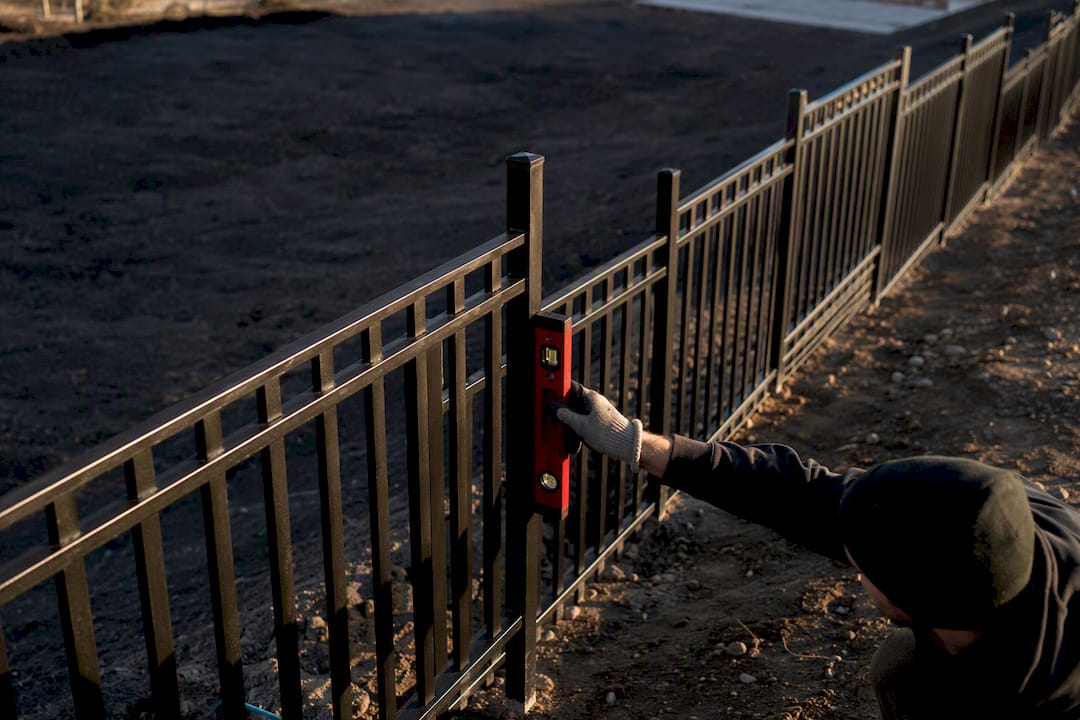
A short pre-installation survey saves real time later: check existing grade changes, confirm where surfacing will sit relative to footing depth, and flag any nearby drainage that could erode soil under the fence line within the first year.
Arkansas and Oklahoma climates put real stress on hardware. Summer humidity swells wood posts and gates; winter freeze-thaw cycles work concrete footings loose if they weren’t set deep enough the first time. Galvanized or powder-coated steel hardware holds up better than standard fasteners in this region, and it’s worth the marginal cost difference on any gate that gets daily use.
Pro Tip: Ask your installer for the footing depth in writing before pour day, not after. A verbal “it’ll be deep enough” isn’t something an inspector or a future contractor can verify six months later.
Accessibility Requirements for Children With Disabilities
A compliant fence height and gap tolerance don’t automatically make a play area accessible. Gate width matters as much as gate hardware; a latch set at the correct 48 inch release height still fails a wheelchair user if the gate opening itself is too narrow to pass through comfortably.
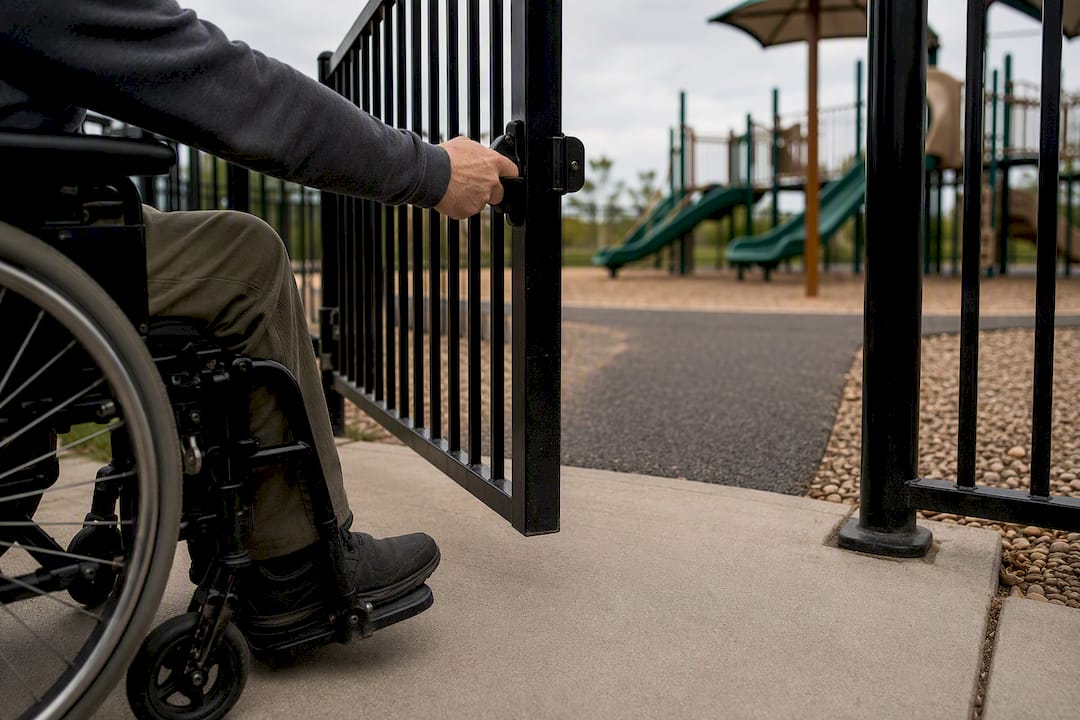
Accessible route planning generally calls for gate openings wide enough for wheelchair and mobility device clearance, with hardware operable using one hand and without requiring tight grasping, pinching, or wrist twisting, the same operability standard used for accessible door hardware elsewhere on a property. A self-latching gate mechanism that meets containment rules should still be checked against this operability standard, since some spring-tension latches that satisfy child-safety self-closing requirements are genuinely difficult for a person with limited hand strength to operate.
Surfacing near gates and along accessible routes into the play area needs a firm, stable, slip-resistant surface, which sometimes means a different material transition right at the fence line than the loose-fill surfacing used elsewhere in the play area. Facility managers designing new play areas should route accessible paths directly to at least one gate, not just to the fence line generally, so the path of travel actually connects to a usable entry point.
Lighting and Visibility Standards Around Playground Fencing
Fence design should support supervision sightlines, not work against them. Solid privacy panels look attractive on a property line, but a supervisor standing at one corner of a solid-panel enclosure loses the ability to see a child in distress on the opposite side. That’s why open-style fencing, picket, ornamental iron, or chain link, remains the more common choice around active play areas even when a business wants more visual screening elsewhere on the property.
Lighting matters most for facilities that operate before sunrise or after dusk, extended-hour daycare programs, or school playgrounds used for after-school programming into early evening. Adequate lighting along the fence perimeter and at every gate location helps supervisors spot hazards and helps staff confirm a gate has latched properly during a nighttime walkthrough. There’s no single ASTM lighting figure specific to playground fencing, but general site lighting practice calls for enough illumination at gate and entry points to read a latch mechanism clearly from several feet away.
Fence height and lighting placement interact in a way that’s easy to miss. A 6 foot fence near a roadway can cast a longer shadow across a gate area at dusk than a 4 foot fence would, which sometimes means a taller perimeter fence needs a supplemental fixture near the gate that a shorter fence line wouldn’t require.
Noise Reduction Considerations Where Applicable
Playground fencing isn’t typically installed as a noise control measure, and most containment fencing, chain link, open picket, ornamental iron, does little to attenuate sound in either direction. That’s worth knowing upfront if a neighboring property owner raises noise concerns during a permit review.
Solid privacy fencing or masonry walls do reduce sound transmission somewhat, and some facilities near residential property lines choose a solid wood or vinyl privacy fence section specifically to soften recess noise for adjacent homeowners. The tradeoff is the supervision sightline issue covered above, so facilities that go this route often use solid fencing only along the property line farthest from active play equipment, keeping open fencing along the sightlines supervisors actually need.
If noise is a genuine concern for your site, that’s a conversation for the design phase, not a fix layered onto a fence that’s already built to meet containment standards. Retrofitting sound-dampening material onto an existing chain link fence rarely produces a meaningful noise reduction and can interfere with the sightlines and airflow the original fence was designed around.
Material Durability and Weather Resistance Standards
Fence material choice affects how often you’re dealing with the maintenance-driven violations covered earlier, loose hardware, sagging gates, exposed footings, so durability is a compliance issue as much as a budget one.
Galvanized or vinyl-coated chain link resists corrosion well and handles freeze-thaw cycles common in Arkansas and Oklahoma winters without the joint failures that plain steel mesh eventually develops. Powder-coated ornamental iron holds up longer than painted iron, since the coating resists chipping that would otherwise expose bare metal to moisture. Vinyl fencing sidesteps rust entirely but can become brittle in extreme cold, a minor consideration in this region but worth knowing if a facility has any shaded, consistently cold section of its perimeter.
Wood fencing needs the most active maintenance of the common materials, since Ozark region humidity accelerates rot at ground contact points exactly where the 4 inch ground clearance rule already puts stress on the structure. Regular staining or sealing extends service life meaningfully and reduces the chance that a soft, rotted picket becomes an inspection failure years before the rest of the fence needs replacement.
Whatever material you choose, hardware grade matters more than most spec sheets acknowledge. Stainless or hot-dip galvanized fasteners cost more upfront but resist the corrosion that eventually causes bolts to protrude, seize, or shear, all conditions that turn into the protrusion and gate-function violations inspectors flag most often.
Impact Resistance and Safety of Fence Materials
Fence materials near active play equipment need to tolerate incidental contact without creating a new hazard. A child running into a fence line, misjudging distance during a game, isn’t a rare event, and material choice affects whether that contact is a non-event or an injury.
Chain link generally gives on contact and has no sharp edges when properly installed with the selvage turned away from the play side. Ornamental iron and other rigid metal fencing hold their shape on impact, which is fine structurally, but any pointed finial or decorative element needs to sit above 54 inches or use a blunted, rounded cap design instead of a sharp point, particularly on sections close to running paths.
Wood fencing carries its own impact consideration: splintering. Pressure-treated lumber that hasn’t been sanded or sealed properly can splinter on contact, and rough-cut cap boards are a common culprit. A quick hand-run along any wood cap rail during inspection catches this before it becomes a splinter injury during recess.
Vinyl fencing tends to flex rather than splinter or hold a sharp edge, which makes it a reasonably forgiving choice for sections directly bordering high-activity zones, though it can crack in a hard, direct impact rather than simply flexing back. None of these material-specific impact behaviors are covered by a specific ASTM numeric threshold the way height and spacing are, so this remains a design judgment call rather than a strict pass/fail inspection item, one more reason to place the highest-impact-risk fence sections away from the most active equipment where the site layout allows it.
What Actually Matters When Budgets Get Tight
Containment, entrapment avoidance, and supervision sightlines should win every budget argument before aesthetics get a vote. A facility manager choosing between an upgraded gate latch and a nicer-looking picket cap should choose the latch every time; nobody gets cited for an unattractive fence, but a failed self-latching mechanism will show up on every inspection report until it’s fixed.
Use the ASTM and CPSC baseline as the floor, not the ceiling, and treat any genuinely ambiguous site condition, a slope, a shared boundary with a road, an unusual gate configuration, as a reason to bring in a licensed installer rather than guess. The cost of a design consultation is small next to the cost of a failed inspection and a rebuild.
Questions about a specific site condition, a tricky slope, an odd gate configuration, an aging fence that needs a compliance retrofit, are worth a phone call before the permit drawings get finalized.
— mark
Get a Compliant Playground Fence Installed Without the Permit Guesswork
A crew with extensive fencing installation experience has likely already solved most of the sloped-lot, footing-depth, and gate-hardware problems covered in this article on real jobs, not in theory.
Facility managers and school administrators working through a playground fence project can request a site survey that checks grade changes, existing surfacing depth, and gate placement before drawings get finalized, the kind of pre-permit legwork that keeps plan reviewers from sending back comments. Experienced fencing contractors handle chain link, ornamental iron, wood, and vinyl installation, along with gate hardware sourcing and access control integration for facilities that need controlled entry alongside standard containment. Property managers juggling multiple sites also lean on scheduled maintenance plans to catch latch failures and settling gaps that cause most compliance citations before an inspector finds them.
Have your site plan, any existing licensing correspondence, and rough dimensions ready, and check the commercial perimeter fencing guide for the documentation a spec review typically requires. From there, request an estimate through Modernfence’s installation guide or contact the team directly to get a project timeline started.
Core Documents to Cite in Your Playground Fence Permit
Plan reviewers and licensing inspectors expect specific documents named on your drawings and in your permit submittal, not general references to “industry standards.”
- CPSC Public Playground Safety Handbook (Pub. No. 325) for overall safety guidance and gate/protrusion specifics.
- ASTM F2049 for fence and barrier construction specifications.
- ASTM F1292 for surfacing impact attenuation and critical height testing, referenced through the CPSC handbook’s surfacing guidance.
- Your state’s specific licensing guidance document, using Mississippi’s example as a model for the kind of language to expect.
Cite the document number and current edition year directly on elevation drawings, and attach the relevant excerpt pages to your permit application rather than assuming the reviewer already has them on hand. For ongoing compliance tracking across multiple sites, tools like the property management compliance resources at SurfaceOps can help standardize how these citations get documented across a portfolio.
Sources
- Public Playground Safety Handbook (CPSC Pub. No. 325)
- F2049 Standard Guide for Fences/Barriers for Public, Commercial, and Multi-Family Residential Use Outdoor Play Areas
- Mississippi State Department of Health Playground Safety (licensing guidance)
- Playground fencing operational requirements (example institutional guidance)
FAQ
What are the ASTM playground standards?
ASTM maintains several playground-related standards; the two most relevant to fencing are ASTM F2049 for fences and barriers, and ASTM F1292 for surfacing impact attenuation testing.
How tall should a playground fence be?
The baseline minimum is 48 inches (4 feet), per CPSC and ASTM F2049 guidance, rising to 6 feet when the play area sits near a road, parking lot, or water feature.
What is the ASTM F1487 standard?
ASTM F1292 covers surfacing impact attenuation and fall height requirements, a related standard to the fencing-specific F2049.
What type of fence is best for a playground?
Open-style fencing, chain link, picket, or ornamental iron, is generally preferred over solid panels because it preserves supervisor sightlines while still meeting containment, spacing, and protrusion requirements.
What is the maximum ground clearance allowed under a playground fence?
No more than 4 inches between the bottom of the fence and the ground at any point, including areas where soil has settled or surfacing has eroded.