
A commercial fence is often one of the first security decisions made for a new facility, expansion, storage yard, or active jobsite. This commercial fence compliance guide helps property owners, managers, and contractors identify the questions that need answers before posts are set: What does the local code allow? Where are the property lines and utilities? Which gate and fence design will support safe daily operations?
The right fence protects equipment, directs traffic, defines boundaries, and presents a professional appearance. But a fence that overlooks setbacks, visibility rules, gate safety, or permit requirements can create costly delays. A careful plan at the beginning helps keep the project moving and gives the finished perimeter a longer, more useful service life.
Start With the Rules That Apply to Your Site
Commercial fence requirements are not identical from one property to the next. Municipal ordinances, county rules, zoning classifications, subdivision standards, and project-specific approvals can all affect the design. A warehouse, school, medical office, retail center, industrial yard, and construction site may face different expectations even when they are in the same community.
Height is usually the first issue people consider. Many jurisdictions permit taller fencing in side and rear yards than along a street-facing frontage. There may also be limits on solid fencing near intersections, driveways, or entrances where drivers need a clear line of sight. A privacy fence that works well around a service yard may be restricted at the public edge of the property.
Before selecting a style, confirm the applicable zoning district and ask whether the project needs a permit, site-plan review, or approval from a property owner association. If the fence is part of a larger commercial build, it may need to coordinate with approved grading, drainage, landscaping, fire access, and parking plans. Treat compliance as a site-planning step, not a last-minute paperwork task.
Verify Property Lines Before Layout
Fence placement should be based on reliable property information, not an assumed boundary or an old row of posts. A survey is especially valuable when a fence will run near a neighboring business, easement, drainage channel, roadway, or utility corridor. Setting a fence on the wrong side of a line can lead to a difficult and expensive correction.
Also review recorded easements. Utility companies, municipalities, and neighboring parcels may have legal rights to access portions of the property. Fencing across an easement is sometimes allowed, but the design may need gates, removable sections, or specific clearance. The answer depends on the easement language and the agency or utility involved.
Call for Utility Locates and Review Site Conditions
Commercial sites often contain more underground infrastructure than owners expect. Electric, gas, water, sewer, communication, irrigation, and private utility lines can all be affected by fence post excavation. Request utility locates before digging, then account for marked lines in the layout and installation approach.
Public utility marking does not always identify every private line on a site. Service lines running from a building to a detached sign, light pole, gate operator, irrigation control, or outbuilding may be the property owner’s responsibility to locate. This is one reason experienced installers inspect the site before finalizing the proposal.
Ground conditions matter as well. Sloped terrain, loose fill, rock, standing water, and poor drainage can change post depth, footing needs, fence transitions, and material selection. A fence should follow the grade in a way that discourages gaps, weak points, and erosion without creating a barrier to drainage. For commercial properties in Western Arkansas and Eastern Oklahoma, changing terrain and weather exposure are practical concerns, not minor details.
Choose Materials for Security, Use, and Appearance
A compliant fence is not automatically the best fence for the property. The material and configuration should match the site’s actual risks, operating hours, traffic patterns, and maintenance expectations.
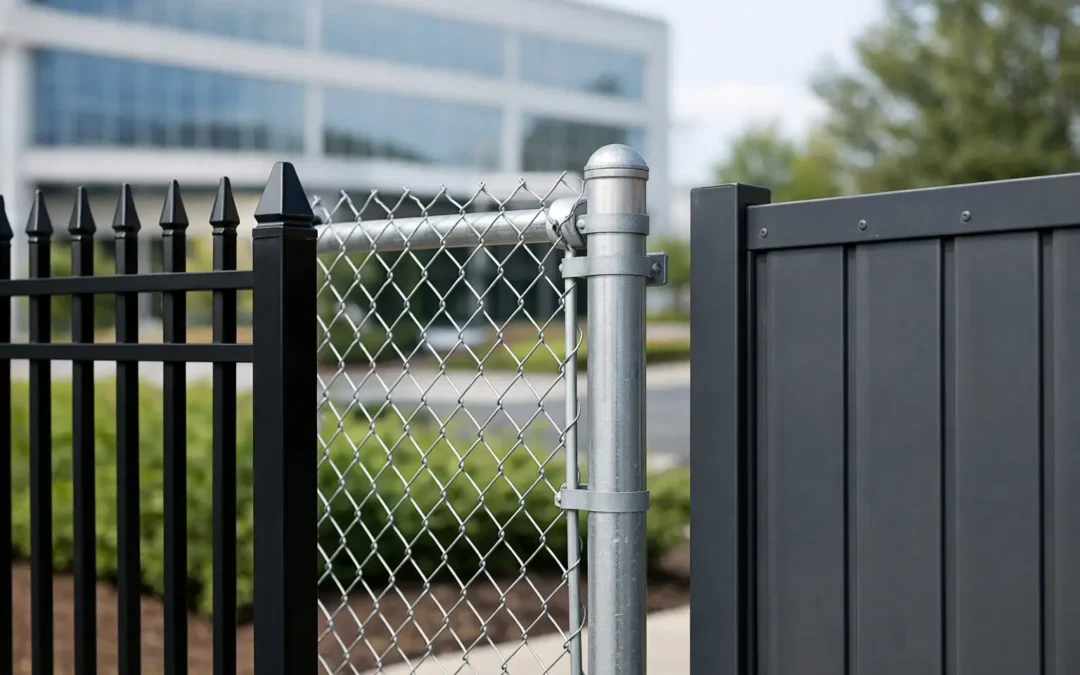
Chain link remains a practical choice for equipment yards, industrial facilities, utility areas, sports spaces, and temporary security needs. It provides visibility, handles daily use well, and can be fitted with privacy screening or security enhancements when permitted. For higher-security areas, the fence height, fabric gauge, framework, top treatment, and gate hardware should be selected as a complete system rather than as separate upgrades.
Ornamental iron fencing is often a strong fit for office campuses, retail fronts, apartment communities, and facilities that need controlled access without a closed-in appearance. Its open design can help preserve visibility around entrances and corners while creating a polished perimeter. Vinyl and wood can work for designated privacy applications, though commercial owners should consider wind exposure, long-term maintenance, and the possibility of impact damage before choosing a solid fence.
Custom metal fabrication can solve problems that standard panels cannot. A fabricated enclosure, railing, equipment screen, or specialized gate may be needed when a site has unusual dimensions or architectural requirements. The key is making sure the custom solution still meets the governing height, access, and safety standards.
Plan Gates Around How the Property Operates
Gates are where perimeter security meets daily operations. A gate that is too narrow, poorly placed, or difficult to operate can slow deliveries, encourage unsafe shortcuts, and frustrate employees and visitors. Plan vehicle and pedestrian access based on the largest vehicles that regularly use the site, including delivery trucks, emergency vehicles, maintenance equipment, and waste service.
Gate swings need adequate clearance and should not block public sidewalks, traffic lanes, or required fire access. Sliding gates need room to travel and a stable area for their track or cantilever system. Where access control is planned, allow for power, communication wiring, safety devices, vehicle detection, and manual operation during an outage.
Automated gates require special attention. Entrapment protection, warning signage, emergency release procedures, and proper controls are not optional details. A gate operator should be installed and maintained according to its intended use and applicable safety standards. An access system should make the property easier to manage, not introduce a new liability.
Do Not Overlook Fire, ADA, and Life-Safety Access
Security fencing must work alongside emergency response needs. Fire lanes, hydrants, standpipes, fire department connections, and emergency access routes should remain accessible. Depending on the property and local requirements, emergency personnel may need a lock box, approved access method, or clearly identified gate.
Pedestrian gates and routes also deserve attention. If a fence changes how people enter a building, parking area, or amenity, evaluate accessible routes, clear widths, surface conditions, and hardware. A narrow latch-side clearance or an inaccessible gate opening can create problems even when the fence itself appears properly built.
Facilities that serve the public, employ large teams, or operate around children may have additional concerns. Pool barriers, school perimeters, outdoor storage, hazardous materials, and industrial equipment areas can carry more specific rules. In these situations, the best approach is to coordinate the fence plan with the project architect, general contractor, facility manager, and local authorities before materials are ordered.
Document the Project and Plan for Maintenance
Keep copies of permits, surveys, approved drawings, product information, and warranty documents with the facility records. These documents help when the property changes hands, a gate operator needs service, or an insurer asks for information after an incident. They also make future additions easier to plan.
Once installed, inspect the fence routinely. Look for loose fittings, damaged fabric, corrosion, leaning posts, washouts beneath panels, worn hinges, and gate alignment issues. For automated access points, test safety features and keep operating areas clear of debris. Prompt repairs protect the investment and help maintain the security standard the fence was built to provide.
A well-planned commercial perimeter is more than a boundary line. It is a working part of the property that should support safety, access, security, and a professional appearance for years to come. When your project calls for local installation experience and careful workmanship, Modern Fence Company can help turn site requirements into a fence system that fits the way your business operates.