
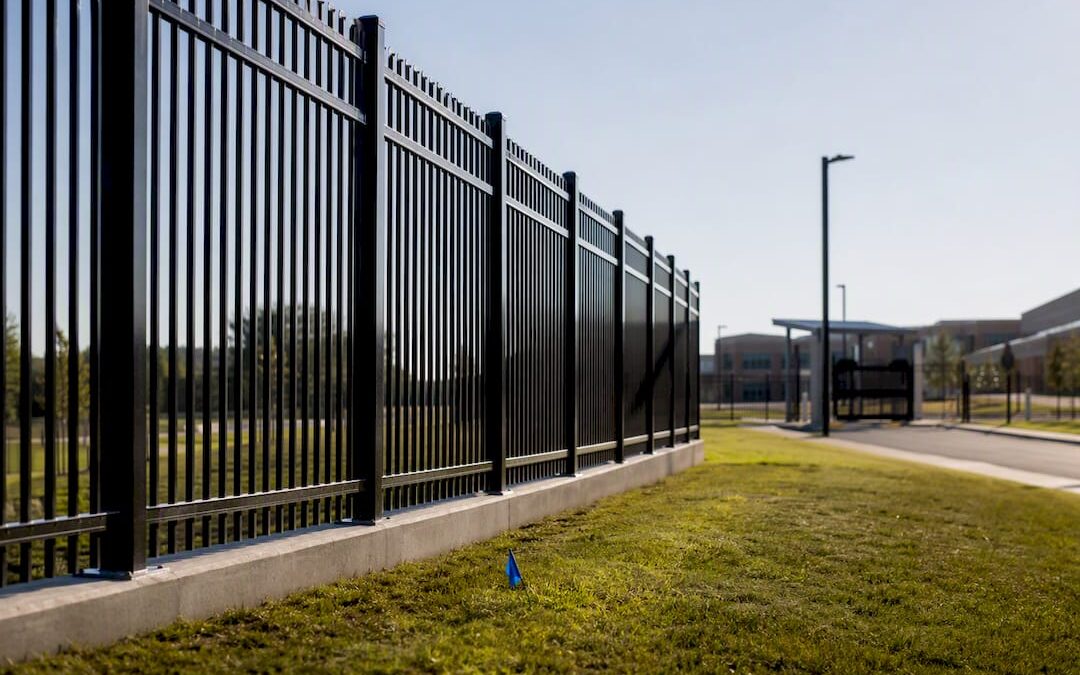
The right approach is layered: a secure, anti-climb perimeter fence, controlled and monitored gates, and playground-safe inner barriers that meet CPSC and ASTM F2049 guidance. In practice, that usually means welded mesh or steel picket around the property line, bowtop or picket fencing around playgrounds, and a design built on CPTED principles for sightlines and access control. Start with a site survey and write your specifications directly against those standards.
TL;DR:
- School fencing must meet specific standards such as a minimum height of 4 feet on playground sides, with gaps no larger than 4 inches to prevent passing small objects or children.
- Gates require special hardware like self-closing hinges and fail-safe electric systems, with placement verified to comply with local fire and egress regulations.
- A site survey, referencing standards like the CPSC Playground Handbook and ASTM F2049, helps define specifications and avoid costly site surprises.
- Contractors should be vetted for experience with anti-climb systems, licensed and insured, with clear written scopes and final inspections before project completion.
Table of Contents
- What Is School Perimeter Fencing, and Why Does It Matter?
- Which Fence Types Fit Each Part of a School Campus?
- What Safety Standards Should a School Fencing Spec Reference?
- How Tall Should a School Fence Be, and Where Do Gaps Cause Problems?
- What Should Gate Specs Cover for Pedestrian and Vehicle Access?
- How Does CPTED Shape a School Fencing Layout?
- What Does School Fencing Cost Over Its Full Lifecycle?
- How Do You Vet a Fencing Contractor for a School Project?
- Notes From the Field on School Fencing Projects
- A Straight Take on Layered School Security
- Get a Site Survey for Your School’s Perimeter Fencing
- Standards and Guidance Worth Bookmarking
- Sources
What Is School Perimeter Fencing, and Why Does It Matter?
School perimeter fencing is the physical boundary system that defines a campus edge, controls who and what enters, and channels foot and vehicle traffic toward monitored entry points. It differs from generic property fencing because it has to satisfy child-safety standards, support staff supervision sightlines, and hold up to daily contact from hundreds of students. Done right, it does three jobs at once: marks the legal property line, slows down unauthorized entry, and keeps kids inside designated play areas without blocking a teacher’s line of sight. Done poorly, it either looks like a fortress that alarms parents or leaves gaps that undermine the district safety guidance most schools are already expected to follow.
Which Fence Types Fit Each Part of a School Campus?
Different zones on a campus call for different fence systems, and treating the whole site the same way usually wastes budget in one area while under-protecting another.
- Perimeter boundary: Welded mesh or vertical bar/picket systems give administrators a good balance of visibility and climb resistance, since supervisors need to see through the fence, not just around it.
- Palisade fencing: Works well for back-of-house zones like loading docks or utility yards where appearance matters less than resistance to forced entry.
- Playground and internal barriers: Bowtop or picket fencing keeps play areas contained without blocking supervisor sightlines, satisfying the visibility expectations built into CPSC playground guidance.
- Sports fields: Chain link or mesh panel systems handle ball containment at a lower cost than solid screening. Our breakdown of chain link versus iron fencing covers the tradeoffs in more detail.
- Privacy zones: Reserve solid screening for mechanical yards or dumpster corrals, areas that don’t need adult supervision.
Pro Tip: Don’t default to the tallest, most solid fence available for the whole perimeter. A district that fences the front lawn like a prison yard usually gets more community pushback than one that reserves heavy security for actual vulnerability points.
What Safety Standards Should a School Fencing Spec Reference?
Your RFP should name specific standards, not just “code compliant” language, because inspectors and contractors need a shared baseline to bid against.
- CPSC Public Playground Safety Handbook: Sets a minimum fence height of 4 feet above grade on the side away from the play area, with a maximum ground clearance of about 4 inches to stop toys, balls, and small children from slipping underneath.
- ASTM F2049: The governing spec for fences and barriers around outdoor play areas, and the document most local codes point to when they require play-area fencing.
- Gate standards: ASTM F900, F1184, and F2200 cover ornamental, chain link, and automated gate hardware respectively. Confirm which applies to your gate type before finalizing hardware selection.
- Local building code and district approval: Requirements vary by jurisdiction, so verify height limits, setback rules, and permitting steps with your local building department before bidding goes out.
- CPTED guidance: Crime Prevention Through Environmental Design principles shape layout decisions around sightlines and defensible space, covered in more detail below.
How Tall Should a School Fence Be, and Where Do Gaps Cause Problems?
Perimeter fencing on most campuses is generally between six and eight feet, with taller barriers reserved for sites with documented security concerns or urban settings with higher foot traffic. Playground fencing has its own floor: a 4 foot minimum height measured on the outside face, with ground clearance capped at 4 inches.
- Vertical spacing between pickets should stay under about 1.75 inches to prevent climbing.
- Horizontal rails spaced less than about 45 inches apart create a ladder effect and belong on the side facing away from the play area, not the play side.
- Chain link mesh openings need to be appropriately sized to block footholds without turning the fence into a solid wall.
A 4 inch gap sounds small, but it’s the exact clearance a soccer ball, a toddler’s shoe, or a small dog can pass through, which is why the CPSC treats it as a hard limit rather than a suggestion.
What Should Gate Specs Cover for Pedestrian and Vehicle Access?
Gates are usually where perimeter security actually fails, not the fence panels themselves.
- Pedestrian gates need anti-lift hinges, self-closing hardware, and a latch height that keeps young children from operating it unsupervised.
- Vehicle gates require wider clearances for service and emergency vehicles, plus fail-safe egress so a power outage never traps anyone inside during an evacuation.
- Fire code and egress rules vary locally. Verify gate placement and swing direction with your fire marshal before installation, not after.
- Automated gates add convenience for drop-off and pickup but need backup manual release and photo-eye safety sensors to meet school-appropriate safety standards. Our guide to access control systems for gates walks through the hardware options in more depth.
How Does CPTED Shape a School Fencing Layout?
Crime Prevention Through Environmental Design treats sightlines as a security feature, not an afterthought, which is why solid privacy walls are the wrong choice for supervised zones.
- Keep clear sightlines across play areas and drop-off lanes so staff can see the entire zone from a single vantage point.
- Maintain roughly 1000 mm of clearance between fencing and climbable obstacles like trees, retaining walls, or HVAC units, since a nearby ledge can erase several feet of intended fence height.
- Use fence alignment to funnel visitors toward a single, staffed entry point instead of leaving multiple ambiguous access routes.
Pro Tip: Walk the fence line after installation and look for anything within arm’s reach that a determined teenager could use as a step. Landscaping crews add benches, planters, and shrubs years after the original design, and those additions quietly defeat anti-climb specs.
What Does School Fencing Cost Over Its Full Lifecycle?
- Materials and height drive most of the base price, with taller, heavier gauge steel costing more per linear foot than standard residential-grade fencing.
- Site preparation adds cost on sloped or uneven ground, since grading and stepped panel returns take extra labor.
- Gates and access control hardware, especially automated systems, often account for a disproportionate share of total project cost relative to their footprint.
- Finishes like powder coating extend service life; expect galvanized steel systems to last 20 years or more with proper care, according to guidance in our piece on commercial fencing solutions that last.
- Maintenance should include monthly hardware checks, annual coating inspections, and a walk-through after any major storm.
How Do You Vet a Fencing Contractor for a School Project?
- Ask for proof of license and insurance, plus references from other school or district projects, before reviewing any bid.
- Confirm the contractor can point to specific experience installing anti-climb systems that meet CPSC and ASTM requirements, not just generic commercial fencing.
- Request a written scope tied to measurable specs (heights, clearances, hardware) rather than vague language like “security fence.”
- Build in a final walk-through inspection tied to the written spec before signing off on payment. Our guide to commercial perimeter fencing has a fuller procurement checklist worth reviewing before you issue an RFP.
Notes From the Field on School Fencing Projects
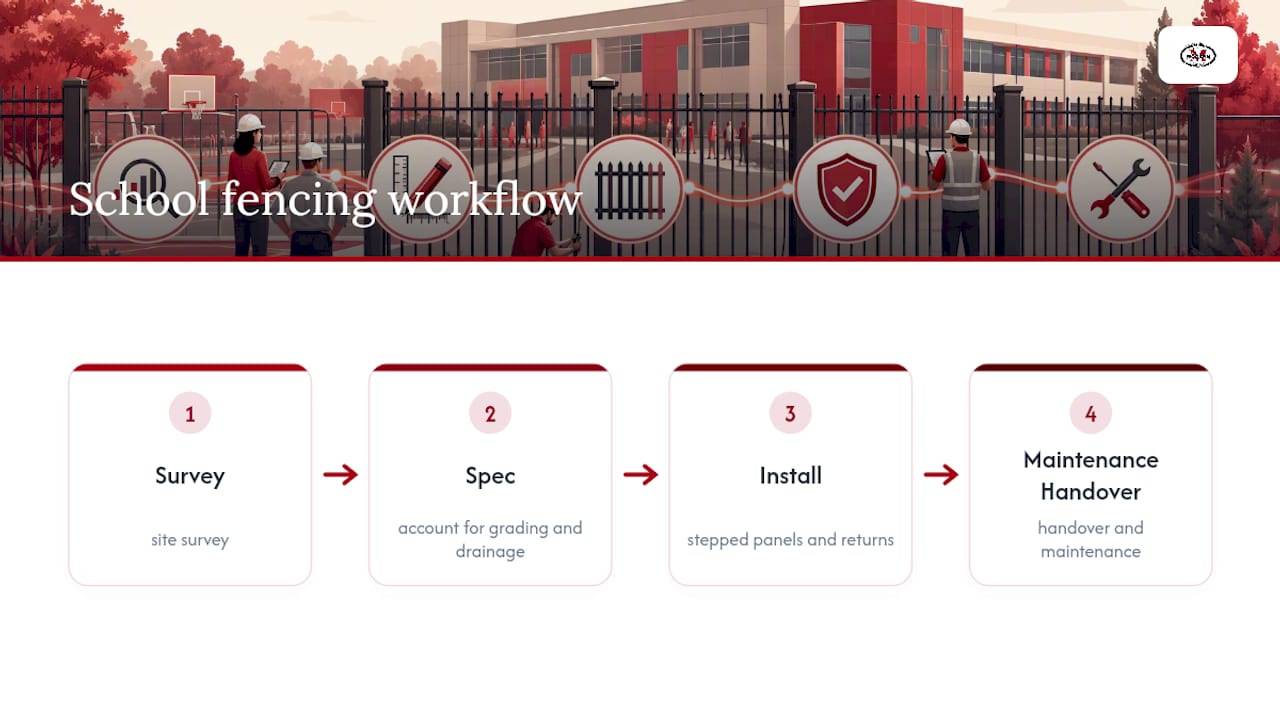
A local fencing company installs perimeter and security fencing for commercial clients, schools, and municipal properties in the region. Grading changes and drainage are the most common site surprises we run into. The fix is stepped panels and returns, not extra ground clearance. Our project rhythm runs survey, then spec, then install, then a maintenance handover.
A Straight Take on Layered School Security
Fortress walls make parents uneasy and rarely solve the actual problem, which is usually a gate left propped open or a sightline blocked by shrubs, not fence height. A layered system built around visibility and standards compliance holds up better over time than one designed purely to look imposing. Loop in your local officials and building department early, and build a maintenance plan before the fence goes up, not after the first complaint about a broken latch.
— mark
Get a Site Survey for Your School’s Perimeter Fencing
This company offers an alternative to piecing together a school fencing project from separate vendors for materials, gates, and access control. They provide perimeter systems, gate automation, and ongoing maintenance under one contract, which simplifies project management compared to multiple separate bids.
A site survey from this company typically includes a walk of your property line, a written specification referencing relevant standards, and a firm estimate suitable for budget discussions. If your district is scoping a new perimeter project or replacing aging fencing that no longer meets current guidance, review our security fencing services and request a survey to get a written spec in hand before your next budget cycle.
Standards and Guidance Worth Bookmarking
- Public Playground Safety Handbook (CPSC)
- ASTM F2049-11 play area fence standard
- U.S. Department of Education school safety report
- Mountain View–Whisman School District perimeter fencing Q&A
Sources
- Public Playground Safety Handbook (CPSC)
- ASTM F2049-11 (Standard safety performance specification for fences/barriers for outdoor play areas)
- U.S. Department of Education — School safety report
- Perimeter Fencing Concerns and Answers (Mountain View–Whisman School District)