

Most U.S. residential pools require a barrier, and the rules are more specific than most homeowners expect. The International Swimming Pool and Spa Code (ISPSC) sets the model framework that most jurisdictions adopt or adapt, covering five core areas: minimum fence height, maximum gap and opening sizes, climb-resistance design, self-closing and self-latching gate hardware, and permit/inspection requirements. ASTM standards govern removable mesh barriers specifically. And stricter states like California go further, with the California Health & Safety Code requiring 60-inch enclosures, outward-swinging self-latching gates, a maximum 2-inch bottom clearance, and a 4-inch sphere limit on openings.
Before you call an installer or buy materials, run through this quick checklist:
- Height: Is the barrier at least 48 inches tall from finished grade? (Some states require a higher minimum height.)
- Gate: Does it self-close and self-latch? Does it swing away from the pool?
- Latch height: Is the latch release mounted at or above 54 inches, or is it a keyed/self-locking mechanism?
- Gaps: Can a 4-inch sphere pass through any opening? (It should not be able to.)
- Bottom clearance: Is the gap between the fence and ground 2 inches or less?
- Climb-resistance: Are there horizontal rails, footholds, or vegetation that a child could use to climb over?
- Permit: Have you applied for a barrier permit with your local building department?
Every item on that list corresponds to a specific code requirement. The sections below explain each one in detail, show you how state rules vary, and give you the exact questions to ask your installer.
Key Takeaways
Most U.S. residential pools require a code-compliant barrier covering height, gate hardware, gap limits, and climb-resistance, and noncompliance creates both legal and insurance liability.
| Point | Details |
|---|---|
| Minimum height varies by state | Most codes require at least 48 inches; California and many cities require a taller barrier height measured from finished grade. |
| Gate hardware is the most-inspected detail | Gates must self-close, self-latch, and swing away from the pool; latch release is typically required at 54 inches when not self-locking. |
| Local code governs, not just state law | Check your city or county building department for the adopted ISPSC or IRC edition and any local amendments. |
| Permits are required before installation | Installing without a permit can result in fines, forced removal, and voided insurance coverage. |
| Modernfence handles the full process | Modernfence provides onsite measurement, code-matched barrier design, correct gate hardware, and permit support for Western Arkansas and Eastern Oklahoma homeowners. |
Table of Contents
- What pool fence requirements actually cover, technically
- How state rules vary and what patterns to expect
- How to find the exact rule that applies to your property
- Which barrier materials typically comply and what to watch for
- Permits, inspections, enforcement, and what installation costs
- What representative state statutes actually say
- A practical compliance checklist and questions to ask your installer
- What experienced installers actually see in the field
- Modernfence can help you get your pool barrier right the first time
- Sources
What pool fence requirements actually cover, technically
Pool barrier requirements break down into five measurable categories. Understanding each one lets you inspect your own property before a code officer does.
Height
The ISPSC and most state codes set a minimum barrier height of 48 inches (4 feet), measured from finished grade on the outside of the fence. That said, 48 inches is a floor, not a standard. California requires 60 inches in many configurations. Florida and Texas statutes set their own thresholds, and local amendments frequently push requirements higher than the state minimum. Always measure from the ground on the side a child would approach, not from the pool deck.
Openings and gap limits
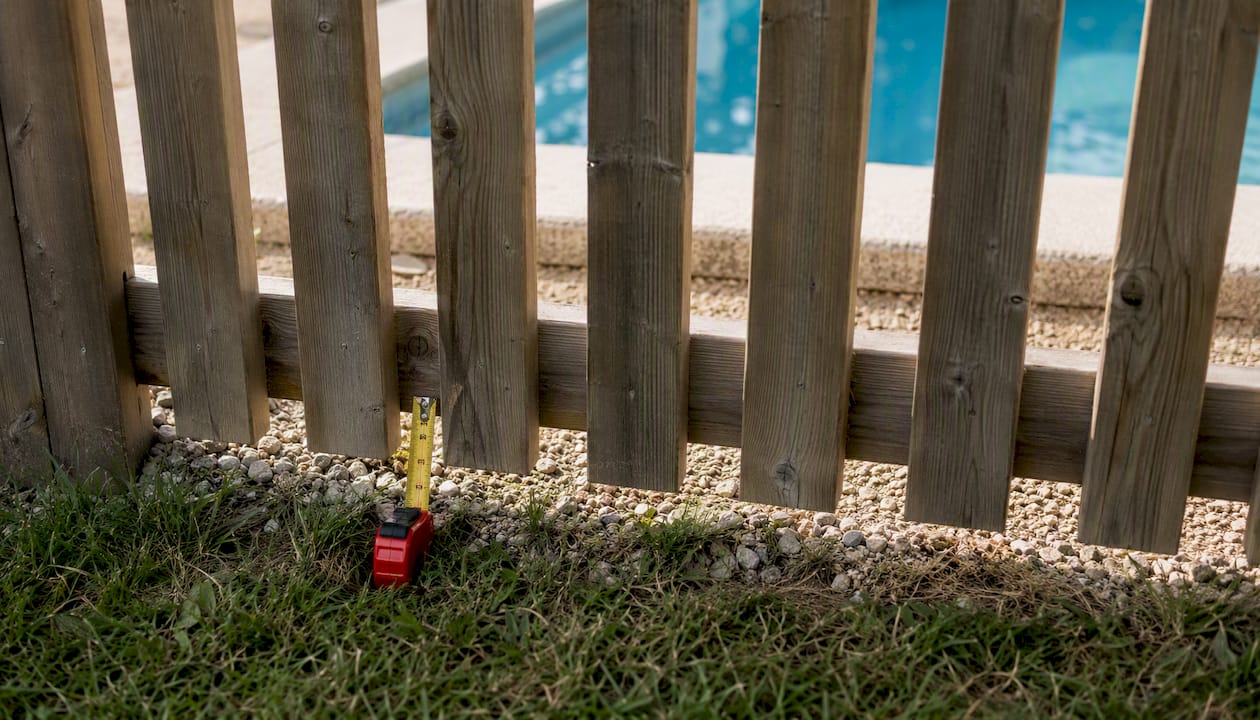
No opening in the barrier should allow a 4-inch sphere to pass through. That rule applies to picket spacing, rail gaps, and any decorative cutouts. The bottom clearance between the fence and the ground must stay at or below 2 inches. Horizontal gaps between rails are evaluated the same way: if a child’s foot or hand can find purchase, the opening is too wide.
Climb-resistance
Inspectors look for anything that functions as a foothold or handhold on the outside of the fence. Horizontal rails are the most common failure point. A fence with three horizontal rails spaced evenly up the outside face is essentially a ladder. Most codes require that horizontal structural members either face inward (toward the pool) or be spaced so they cannot be used for climbing. Vegetation planted close to the fence line is also flagged because overgrown shrubs can reduce effective fence height or provide a boost.
Gate requirements
The 2021 ISPSC requires pool gates to be self-closing and self-latching, to swing away from the pool (outswing), and to have latch-release hardware positioned so that small children cannot reach it from the outside. When the latch is not a keyed or electronic self-locking mechanism, the release point must typically be mounted at approximately 54 inches above finished grade, or the latch must be shielded by a cover that prevents reach-through access.
The ISPSC 2021 Section 305.4 is the model most jurisdictions reference for these hardware rules. A gate that swings inward toward the pool fails because a child pushing on it from outside could open it. A gate that does not fully latch after being released from any angle also fails.
Alarms and pool covers as alternatives
Some jurisdictions allow a pool alarm or an approved safety cover as a secondary layer or, in limited cases, as an alternative to a full barrier. These alternatives are narrowly defined. A pool alarm alone rarely satisfies the barrier requirement under the ISPSC or most state statutes. Pool covers must meet ASTM F1346 performance standards to qualify. Check your local code before relying on either as a substitute for a physical barrier.
How state rules vary and what patterns to expect
Most states either adopt the ISPSC or IRC language directly or write their own statute that mirrors the same core requirements. The differences show up in specific measurements, latch-height rules, and whether the yard fence can double as the pool barrier.
Common patterns across most jurisdictions:
- Minimum 48-inch barrier height (measured from outside finished grade)
- Self-closing, self-latching gates with outswing
- Maximum 4-inch sphere test for openings
- Maximum 2-inch bottom clearance
- Permit required before installation
States with stricter or statute-specific rules:
- California: The California Health & Safety Code sets detailed enclosure requirements for new and remodeled private pools, including a 60-inch minimum height in many configurations, specific outswing gate rules, and a 2-inch bottom clearance limit.
- Florida: Florida Statute 515.29 requires the barrier to be separate from any yard fence unless the yard fence section meets all barrier standards. This is a common source of confusion for homeowners who assume their existing perimeter fence qualifies.
- Texas: Texas Health & Safety Code Chapter 757 sets residential pool barrier requirements that local jurisdictions build on. The Texas DFPS child drowning data underscores why these requirements exist: drowning remains a leading cause of accidental death for young children in the state.
Local amendments to watch for:
- City-level height increases above the state minimum (some cities require 60 inches even where the state requires only 48)
- Permit-first rules that prohibit installation before a plan review is approved
- HOA requirements that add restrictions on top of local code (HOA rules do not replace code; both apply)
- Allowance for keyed or electronic self-locking hardware at lower mounting heights, where the AHJ (Authority Having Jurisdiction) has adopted that interpretation
How to find the exact rule that applies to your property
The rule that governs your pool is the one your local AHJ enforces, which may be the county, the city, or in some cases a special district. Here is a reliable search path:
- Start with your city or county building department website. Search “[your city] pool barrier permit” or “[your county] swimming pool fence code.” Most departments publish a permit application page that lists the adopted code edition (e.g., “2021 ISPSC as amended”).
- Identify the adopted code edition. Local code adoption pages often show which edition of the ISPSC or IRC a jurisdiction enforces. Hardware and measurement rules changed in the 2021 ISPSC, so knowing the adopted edition matters. The ISPSC 2021 Section 305.4 is a useful reference point for gate hardware rules.
- Check your state statute. States like California, Florida, and Texas publish their pool barrier statutes online. Even if your city has adopted the ISPSC, the state statute may add requirements on top of it.
- Take measurements at your property. Before calling anyone, record: fence height from finished grade (outside face), latch release height from finished grade, bottom clearance at the lowest point, and the widest gap between pickets or rails. A tape measure and a 4-inch PVC coupling (as a sphere proxy) are all you need.
- Call the building department directly. When you call, say: “I have a residential pool at [address]. I want to confirm which code edition governs pool barrier requirements, whether a permit is required for a new barrier, and whether there are any local amendments to the state or model code.” Read back the measurements you took and ask whether they meet the current standard.
Pro Tip: If your property is in an HOA, request the HOA’s fence standards in writing before you apply for a building permit. HOA rules and local code are both enforceable, and they sometimes conflict on height or material. You need to satisfy both.
County-level guidance documents, like the Houston County, GA pool fence guidance, are good models for what a local inspection checklist looks like. City permit pages, such as the City of Minnetonka residential pool permit guidance, show the practical steps and measurement documentation homeowners need to prepare.
Which barrier materials typically comply and what to watch for
The material you choose affects both compliance and long-term maintenance. Each type has specific inspection pitfalls.
Removable mesh fencing
Removable mesh barriers must meet ASTM F1346 performance standards to qualify as a compliant pool barrier. The standard covers tensile strength, post spacing, and mesh opening size. The most common inspection failure with mesh systems is post anchoring: if a post can be pulled out of its sleeve without a tool, the barrier does not meet the standard. Mesh systems are popular for seasonal pools because they can be removed and reinstalled, but every reinstallation should be checked for post integrity and mesh tension.
Metal picket (iron and aluminum)
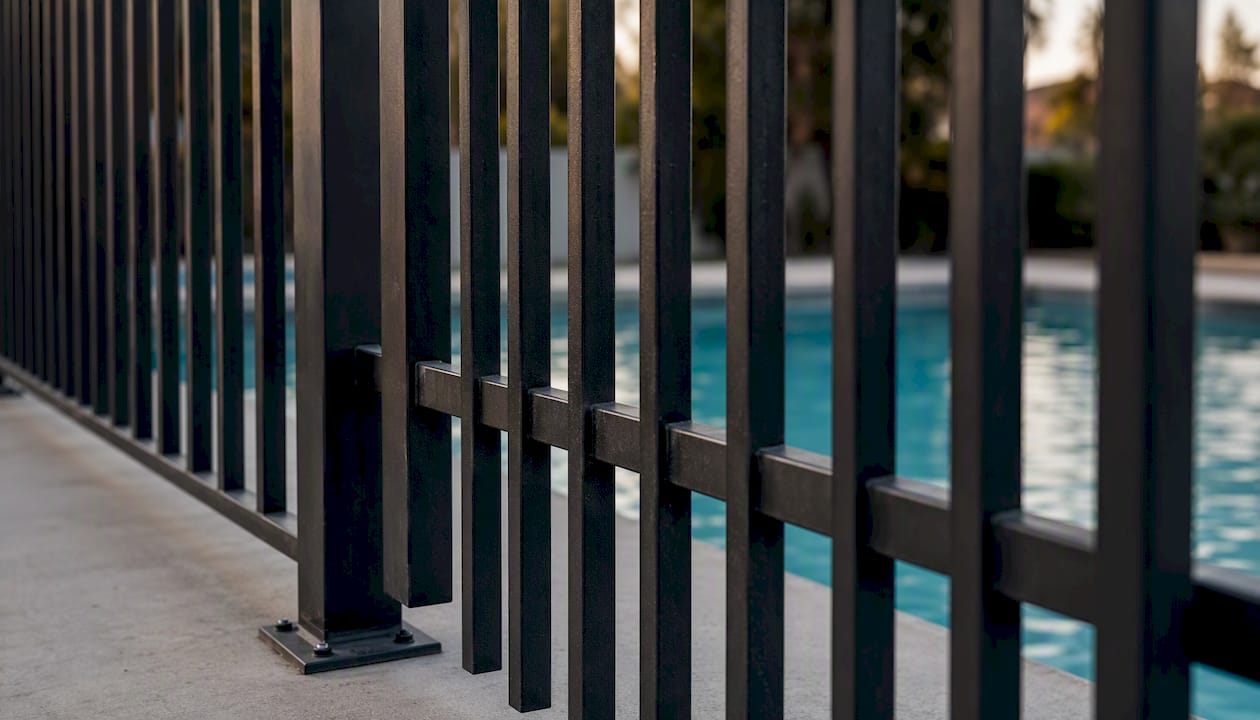
Metal picket fences, including wrought iron and aluminum, are among the most code-friendly options when designed correctly. Picket spacing must pass the 4-inch sphere test. The critical design issue is rail placement: rails on the outside face of the fence create footholds. Iron fence installations that place horizontal rails on the pool-facing side and use tight picket spacing typically pass inspection without modification. Aluminum is lighter and resists corrosion, which matters in humid climates.
Wood and privacy fences
A wood privacy fence can double as a pool barrier when it meets height, gap, and climb-resistance requirements. The typical failure points are bottom clearance (wood posts set in soil can shift, creating gaps over time), picket spacing that widens as wood dries and shrinks, and horizontal rails on the outside face. Privacy fencing that uses a board-on-board design with inward-facing rails and a concrete footing system tends to hold its dimensions better over time. Under Florida Statute 515.29, a yard fence used as a pool barrier must meet all barrier standards, not just general fence code.
Glass panels
Glass panel barriers offer visibility and a clean aesthetic, but they require specific mounting hardware and regular maintenance. Tempered or laminated safety glass is required. Mounting posts must be set in concrete and checked periodically for movement. Glass surfaces near the pool accumulate mineral deposits that can obscure visibility and, more practically, make it harder to spot a child in the water. Cleaning frequency is higher than with metal or wood.
Design caveats that commonly fail inspections
- Horizontal rails on the exterior face (most common failure)
- Picket spacing wider than 4 inches (especially on older wood fences that have dried)
- Bottom clearance exceeding 2 inches due to grade changes or erosion
- Vegetation growing against or over the fence, reducing effective height
- Gate hardware that does not fully latch when the gate swings shut at low speed
Permits, inspections, enforcement, and what installation costs
When permits are required
A permit is typically required any time you install a new pool barrier or make a structural modification to an existing one. The permit is issued by your city or county building department. Some jurisdictions also require a permit when you replace a gate or change hardware. Applying before installation is not optional: building without a permit can result in a stop-work order, a requirement to remove and reinstall the fence, and fines.
What inspectors check
Inspectors typically verify:
- Fence height from finished grade (outside face)
- Bottom clearance at the lowest point along the entire perimeter
- Picket or opening spacing (4-inch sphere test)
- Gate self-closing function (opened and released from multiple angles)
- Gate self-latching function (confirmed at low and high swing speeds)
- Latch release height from finished grade
- Gate swing direction (must swing away from pool)
- Climb-resistance (no accessible horizontal rails or footholds on exterior)
Enforcement and liability
A barrier that fails inspection generates a correction notice with a reinspection deadline. Repeated failures can result in fines. The more significant exposure is civil liability: if a child drowns in a pool without a compliant barrier, the property owner faces serious legal and insurance consequences. Most homeowner insurance policies require code-compliant pool barriers, and a noncompliant barrier can void coverage or result in a denied claim.
Typical cost and timeline
Installation costs vary by material, perimeter length, gate count, and local permit fees. A professional fence installation for a pool barrier typically runs from a few hundred dollars for a small mesh system to several thousand for a full iron or aluminum perimeter with multiple gates. Permit fees vary by jurisdiction but are generally modest relative to installation cost. The timeline from permit application to final inspection is commonly two to four weeks for straightforward residential projects, though plan review times vary by municipality. Prepare for a longer timeline if your project requires a variance or if the building department has a backlog.
What representative state statutes actually say
Seeing the statutory language directly removes ambiguity. Here are three representative examples.
California
California Health & Safety Code Article 2.5 requires that enclosures for private single-family pools meet specific characteristics: the barrier must be at least 60 inches in height in many configurations, gates must be self-closing and self-latching with the latch on the pool side or at a height that prevents child access, the maximum clearance at the bottom of the barrier is 2 inches, and no opening may allow passage of a 4-inch sphere.
The full statutory text is available at the California Health & Safety Code pool barrier provisions. California’s rules apply to new construction and remodels, and local jurisdictions may add requirements on top of the state code.
Florida
Florida Statute 515.29 is notable for one specific requirement that surprises many homeowners:
The barrier must be separate from any yard fence unless the yard fence portion meets all of the barrier requirements set out in the statute.
This means your existing perimeter fence does not automatically qualify as a pool barrier. The section of yard fence adjacent to the pool must independently meet height, gap, gate, and climb-resistance standards. For official bill language and amendments, the Florida House of Representatives legislative resources page is the primary source.
Texas
Texas Health & Safety Code Chapter 757 sets the baseline for residential pool barriers in the state. Local jurisdictions build on this language with their own amendments. The Texas DFPS child drowning prevention resources document the safety rationale behind these requirements and are worth reviewing if you want context for why the rules are written the way they are.
Key points common across these three statutes:
- Barriers must be designed to prevent unsupervised child access
- Gates must be self-closing and self-latching
- Latch hardware must be positioned or shielded to prevent child operation
- Local amendments may be stricter than the state baseline
A practical compliance checklist and questions to ask your installer
Compliance checklist
Use this before your final inspection. Bring a tape measure, a camera, and your permit paperwork.
- Measure fence height at three or more points along each side (record the lowest reading).
- Measure bottom clearance at the lowest point along the entire perimeter.
- Test all openings with a 4-inch object (a PVC coupling works well).
- Open each gate and release it; confirm it closes and latches fully from a 90-degree open position and a 45-degree open position.
- Measure latch release height from finished grade.
- Confirm gate swings away from the pool on all gates.
- Walk the exterior face and check for horizontal rails, footholds, or vegetation within reach.
- Photograph each gate latch, the bottom clearance at the lowest point, and any area where the fence meets a wall or structure.
- Confirm your permit is posted or available for the inspector.
- Have the installer’s spec sheets for gate hardware (self-latching vs. self-locking) ready to present.
Questions to ask any installer
- Which code edition are you designing to, and have you confirmed the adopted edition with our local building department?
- Is the gate hardware self-latching or self-locking? What is the manufacturer’s spec sheet for the latch mechanism?
- At what height will the latch release be mounted, and why?
- Will the gate swing away from the pool on all gates?
- Are horizontal rails on the exterior face of the fence? If so, how does the design address climb-resistance?
- Will you handle the permit application, or is that my responsibility?
- What documentation will you provide after installation (photos, measurements, permit submission confirmation)?
A useful reference when preparing for this conversation is the residential fence contractor checklist for homeowners, which covers the broader set of questions to ask before signing any installation contract.
Red flags in contractor proposals
- No mention of permits or a statement that “permits aren’t required for fences” (pool barriers almost always require a permit)
- Vague hardware specs (“standard latch” with no manufacturer reference)
- Inability to name the local code edition or AHJ contact
- No post-installation documentation offered
Pro Tip: Hardware mounting height depends on whether the gate uses a self-locking (keyed or electronic) mechanism or a standard self-latching latch. When the latch is not self-locking, most jurisdictions require the release point at approximately 54 inches above finished grade. When it is self-locking, some AHJs allow a lower mounting height. Ask your installer to document the latch category in writing and provide the manufacturer spec sheet before installation begins. This single document prevents the most common latch-height inspection disputes.
For guidance on childproof pool gate installation and hardware specifics, that resource covers the gate side of compliance in practical detail.
What experienced installers actually see in the field
The most common reason a pool fence fails its first inspection is not the fence itself. It is the gate. Specifically, it is a gate that was installed plumb and latching correctly on day one but has since sagged on its hinges. A sagging gate misaligns the latch strike, so the gate no longer latches reliably. The fix is almost always a hinge adjustment, not a new gate. But the homeowner still gets a correction notice and a reinspection fee.
The second most common failure is latch height. Not because the installer set it wrong, but because the grade changed. A contractor pours a concrete apron, raises the finished grade by three inches, and suddenly the latch that was mounted at 54 inches is now effectively at 51 inches. Inspectors measure from current finished grade, not from the original installation grade.
Vegetation is the third failure that surprises homeowners. A shrub planted two feet from the fence line grows over three seasons and now provides a step-up that reduces the effective barrier height. Inspectors are trained to look for this, and they will flag it.
The practical fixes are straightforward: check hinge tension twice a year, re-measure latch height after any grade work, and keep a three-foot clear zone on the exterior face of the fence. Professional installers who document their work, including photos of latch heights and bottom clearances taken on installation day, give homeowners a baseline to compare against during future inspections. That documentation also speeds up reinspection when a correction is needed, because you can show the inspector exactly what changed.
Modernfence can help you get your pool barrier right the first time
Getting a pool barrier installed correctly means more than buying the right materials. It means knowing your local code, specifying the right gate hardware, and having documentation ready for the inspector. That is where Modernfence brings real value.
Modernfence has been installing residential and commercial fences across Western Arkansas and Eastern Oklahoma for more than 70 years. For pool barrier projects, that means an onsite measurement visit to confirm your existing grade, a barrier design that meets your local AHJ’s adopted code edition, gate hardware specified to the correct self-latching or self-locking standard for your jurisdiction, and permit support so the paperwork is handled before a single post goes in the ground. Every installation comes with documented measurements and hardware spec sheets, the exact records you need when the inspector arrives.
If you are ready to get a compliant barrier installed without the guesswork, request a free estimate from Modernfence. Our team will walk your property, confirm your local pool fence code requirements, and give you a clear timeline from permit to final inspection. See what a professional fence installation looks like from start to finish.
Sources
The sources below are the primary references for pool barrier requirements in the United States. Use them to verify the adopted code for your jurisdiction and to read the controlling statutory language.
- California Health & Safety Code (pool barrier provisions)
- Chapter 515 Section 29 – 2011 Florida Statutes
- Texas statutes — provisions related to pool safety
- Texas DFPS — Child drownings (2024 resources)
To find the rule that applies to your property, start with your city or county building department’s permit page, identify the adopted code edition, and then read the corresponding section of the ISPSC or your state statute. When those two sources conflict, the stricter requirement applies. For a broader look at how to install a pool safety fence, that resource covers the installation process from the homeowner’s perspective.
This article is general information, not a substitute for advice from a qualified lawyer. Consult a qualified legal professional about your own circumstances before acting on anything here.