
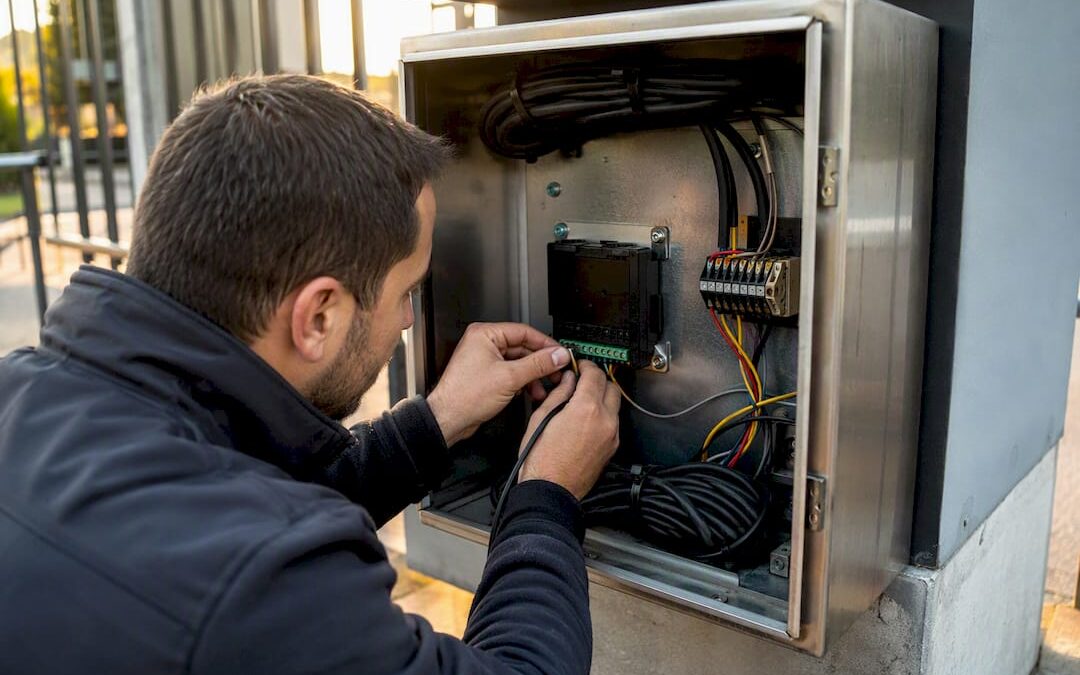
A loop detector for gates is the electronic module that reads a buried wire coil in the driveway and tells the gate operator whether a vehicle is present. If you’re shopping right now, three categories cover most jobs: the LiftMaster LOOPDETLM (a plug-in, battery-friendly module), the DoorKing 9410 series (a self-tuning module with diagnostic LEDs), and generic universal detector modules sold on retail marketplaces. Before you buy anything, check two things on your existing operator board.
- Does it have a dedicated plug-in loop detector slot, or does it require a hardwired standalone unit?
- Do you need single-channel (one loop) or dual-channel (two loops, common on reversing or shadow setups)?
Pro Tip: Snap a photo of your operator board’s model number and existing detector slot before you shop. Mismatched pinouts are the number one reason DIY installers end up returning a module.
Key Takeaways
Reliable gate detection depends more on correctly matched hardware and sound loop installation than on any single brand of detector module.
| Point | Details |
|---|---|
| Match the operator first | Confirm plug-in slot versus hardwired input before buying any detector module. |
| Pick channels by loop layout | Use single-channel for basic exit/interrupt, dual-channel for shadow or reversing setups. |
| Diagnose before replacing | Use TEST mode and LED codes to isolate loop wire faults from electronics failures. |
| Pavement causes most failures | Water intrusion and cracked sealant, not detector modules, cause most intermittent faults. |
| Call a pro for site issues | Modern Fence Company inspects loop continuity, sealant, and operator compatibility on-site. |
Table of Contents
- What Is a Loop Detector and How Does It Work?
- What Are the Different Types of Gate Loops?
- How Do You Choose the Right Loop Detector for Your Gate?
- What Installation Mistakes Cause the Most Loop Failures?
- How Do You Test and Troubleshoot a Loop Detector?
- When Should You Use Something Other Than an In-Ground Loop?
- LiftMaster, DoorKing, and Universal Detectors Compared
- When Should You Call a Professional for Loop Issues?
- Step-by-Step Installation Tips for Different Site Conditions
- Maintenance Habits That Keep Loop Detectors Working for Years
- What Does a Loop Detector and Installation Actually Cost?
- Frequently Asked Questions
- Sources
What Is a Loop Detector and How Does It Work?
A loop detector works on a simple principle: inductance. The buried loop coil, connected through a lead-in cable to the electronics module, creates a magnetic field. When a vehicle’s metal mass enters that field, it changes the coil’s inductance, and the detector’s circuitry registers the shift as a vehicle present signal. FHWA’s technical guidance confirms that inductive loops remain the most widely used vehicle detection method in traffic and access control applications, largely because the physics are reliable and the hardware is cheap to replace.
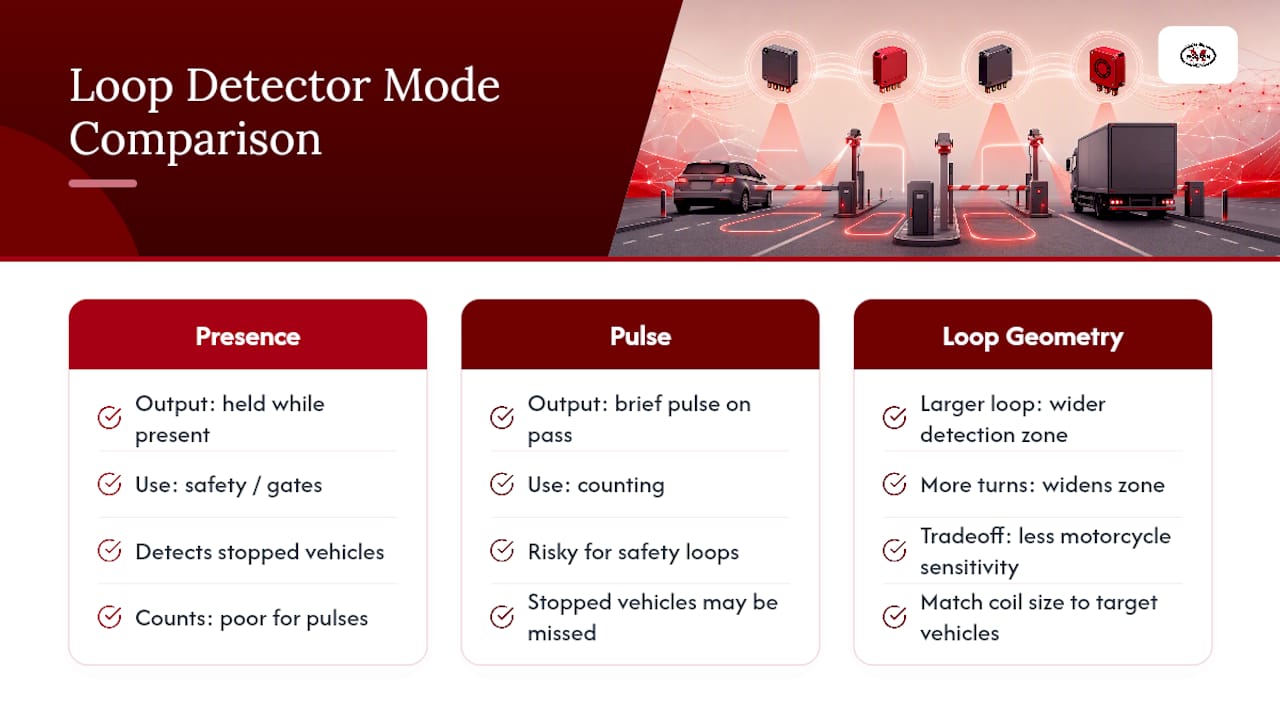
Detectors run in one of two logic modes. Presence mode holds the output active as long as a vehicle sits over the loop, which is what keeps a gate from closing on a stopped car. Pulse or passage mode fires briefly as a vehicle crosses, useful for counting but risky for safety loops. Loop geometry matters too: a larger loop or more wire turns widens the detection zone but can also dull sensitivity to smaller vehicles like motorcycles, so the coil size should match what actually needs to be detected.
What Are the Different Types of Gate Loops?
Not every loop does the same job, and mixing them up is a common source of gates that swing shut on people. Four configurations cover almost every driveway:
- Exit loop. Placed on the inside of the gate, it triggers the gate to open when a vehicle approaches from within the property.
- Interrupt (safety) loop. Positioned in the gate’s path of travel, it reopens a closing gate the instant it senses a vehicle, functioning as a core safety feature.
- Shadow loop. Used with swing gates, it ignores the gate’s own metal arc as it swings, so the operator doesn’t misread the gate itself as a vehicle.
- Reversing loop. Common on slide gates, it reverses travel direction when something enters the detection zone.
LiftMaster’s LOOPDETLM documentation defines these same exit, shadow, and interrupt roles as the backbone of its detection logic. Single-channel detectors handle one loop and suit basic exit/interrupt setups; dual-channel units are worth the extra cost the moment shadow or reversing logic enters the picture. As a placement rule, keep loops clear of the gate’s swing arc unless you’re deliberately using shadow logic to compensate.
How Do You Choose the Right Loop Detector for Your Gate?
Start with compatibility, not features. Pull up your operator’s board and confirm whether it accepts a plug-in module or needs a standalone hardwired detector wired into terminal blocks. Board revisions matter here. Older boards sometimes lack the connector pinout that newer plug-in modules like the LOOPDETLM expect, so cross-check the manual before ordering.
Channel count comes next. A single gate with one exit loop and one interrupt loop can often run on two single-channel detectors or one dual-channel unit, depending on your board’s input count. Reversing slide gates and swing gates using shadow logic generally need dual-channel hardware from the start.
From there, prioritize:
- Self-tuning circuitry that recalibrates automatically as pavement and temperature shift, reducing false calls over time, as detailed in the role of sensors in door security explained.
- LED diagnostics and frequency switching, which let you confirm a working loop without extra test equipment, a feature DoorKing’s manual highlights as a major time-saver for field technicians.
- Adjustable sensitivity, so you can dial detection up for motorcycles or down to avoid picking up traffic on an adjacent lane.
- UL 325 compliance and power draw specs, especially if the gate runs on battery or solar backup power.
Pro Tip: If your site has two loops close together, buy detectors with selectable frequencies. Running both loops on the same default frequency is the most common cause of crosstalk false triggers.
What Installation Mistakes Cause the Most Loop Failures?
Most loop problems trace back to the concrete, not the electronics. Getting the sawcut and wiring right the first time saves years of service calls.
- Cut clean geometry. Round the corners of your sawcut pattern per the manufacturer’s diagram; sharp corners stress the wire and crack under pavement flex.
- Twist the lead-in pair. Run twisted lead-in wire through conduit to a sealed pull box, keeping splices out of the sawcut itself.
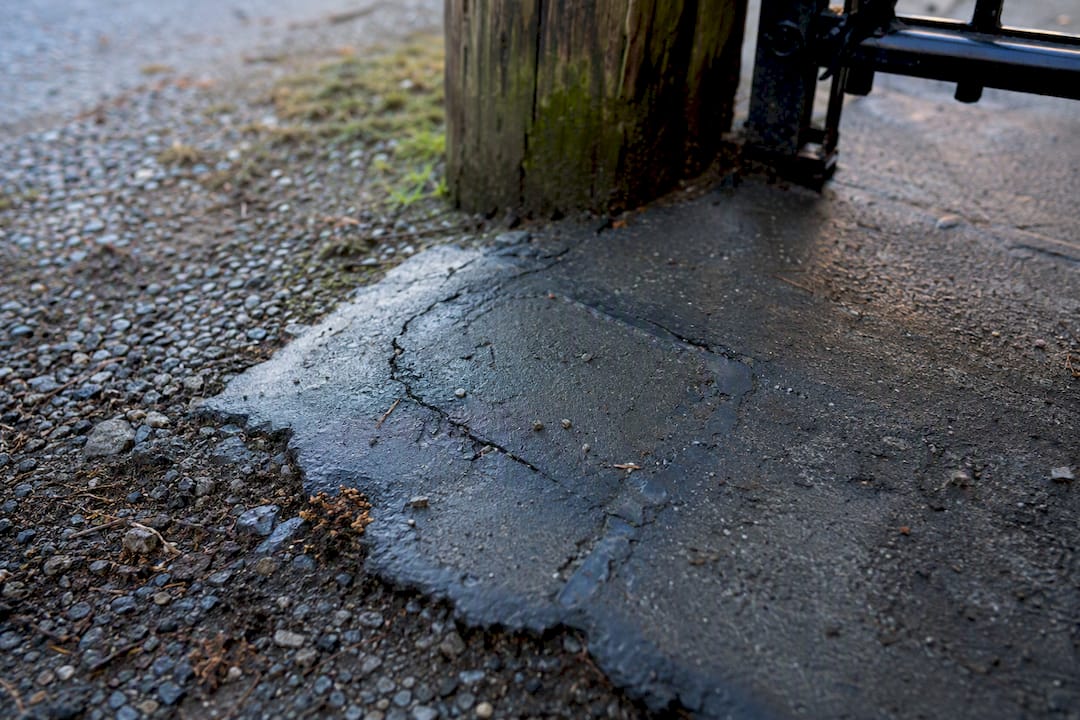
- Seal against water. Use a loop sealant rated for the pavement type, since degraded pavement and water intrusion cause most loop failures, not detector electronics.
- Manage crosstalk. Physically separate adjacent loops where possible and stagger their frequencies. DoorKing’s own field guidance recommends biasing frequency by loop length, running longer loops at lower frequencies and keeping neighboring loops as far apart in frequency as the detector allows.
Pro Tip: Never cut a loop into fresh or unstable pavement. Concrete that hasn’t fully cured will crack around the sawcut within a season, and you’ll be back out there redoing the whole job.
Avoid these traps: cutting into pavement that’s already shifting, using generic caulk instead of loop sealant, and leaving wire splices exposed inside the cut where moisture collects.
How Do You Test and Troubleshoot a Loop Detector?
Work from the electronics outward before you dig anything up. Most detector modules include a TEST mode that simulates a vehicle presence signal, letting you confirm the operator logic and detector output are functioning even before you’ve checked the buried loop itself.
- Put the detector in TEST mode and watch the LED: a solid active light with proper gate response means the electronics and operator wiring are fine.
- Check the frequency counter reading against the loop’s expected range; a wildly off reading points to loop tuning or wire trouble.
- A steady flashing LED, according to DoorKing’s diagnostic guide, specifically signals a physical loop problem, not a bad detector.
- Run a continuity and insulation resistance test on the lead-in cable before assuming the electronics are shot.
- Inspect the sawcut and sealant visually for cracking, especially after freeze-thaw cycles or heavy rain.
Intermittent faults that worsen in wet weather are a strong tell that water has reached the loop wire or a splice. In that case, replacing the detector module won’t fix anything. The loop itself needs attention.
When Should You Use Something Other Than an In-Ground Loop?
Loops aren’t always practical. Deteriorated pavement, historic surfaces you can’t cut into, or gates on shared civil infrastructure can all rule out sawcutting. In those cases, a few alternatives fill the gap:
- Wireless magnetometers detect vehicle presence without buried wire, making them a strong retrofit option where cutting pavement isn’t allowed.
- Radar or video-based virtual loops cover wide areas and can replace multiple physical loops, though they trade some of the loop’s simplicity for more complex setup.
- Hybrid detection, pairing a magnetometer with existing safety sensors, works well on sites where presence sensors need to cover irregular gate paths.
Each of these carries its own cost and maintenance profile, and none matches a well-installed loop’s decades of field-proven reliability on a stable driveway surface.
LiftMaster, DoorKing, and Universal Detectors Compared
The LOOPDETLM’s appeal is simplicity: no wiring beyond plugging it into a compatible LiftMaster board, low current draw that suits solar and battery backup gates, and built-in test mode with frequency switching to dodge crosstalk. The DoorKing 9410 series leans into field diagnostics, with a frequency counter and self-tuning circuitry that reduces the time installers spend chasing tuning issues. Generic retail modules can save money upfront, but specs vary wildly by listing. Before buying one, confirm channel count, whether it has any LED diagnostics at all, and whether the seller states UL compliance in writing. When in doubt, match the module to your operator brand first and treat price as the tiebreaker, not the starting point.
When Should You Call a Professional for Loop Issues?
Some jobs are worth handing off. If your gate shows intermittent faults after rain, if the pavement around the loop is visibly cracked, or if you’re not confident reading operator-board diagnostics, bring in a pro.
- Surface and sawcut condition assessment
- Operator-board and wiring inspection
- Loop continuity and insulation testing
- Loop replacement, resealing, and pavement prep recommendations
Modern Fence Company’s technicians handle this diagnostic work directly, including access control system compatibility checks for gates across Western Arkansas and Eastern Oklahoma.
Step-by-Step Installation Tips for Different Site Conditions
Loop performance depends as much on the site as the hardware. A loop cut into fresh asphalt behaves differently than one in decades-old concrete, and installers who treat every driveway the same end up with callbacks.

On new asphalt, wait for full cure before sawcutting. Fresh asphalt continues settling for weeks, and a loop cut too early will crack loose from the surrounding pavement as it stabilizes. On older concrete, check for existing expansion joints first. Cutting a loop pattern that crosses a joint invites water intrusion at the seam, so route the sawcut to stay within a single slab section wherever the layout allows.
In cold climates, factor in freeze-thaw cycling. Water that seeps into a poorly sealed sawcut expands when it freezes, widening the crack every winter until the wire fails. Use a sealant rated for temperature swings, not a generic patch compound, and reseal proactively every couple of years rather than waiting for a fault.
In high water table or flood-prone areas, run lead-in cable through conduit with sealed, elevated pull boxes rather than at grade, since standing water around a splice point is one of the fastest ways to lose a loop.
For gravel or unstable subgrade, consider whether sawcutting is even the right call. If the base isn’t compacted well, a loop will move independently of the pavement above it and break its own leads within a season. A wireless magnetometer often makes more sense on marginal subgrade than fighting the ground with a buried coil.
Every environment shares one rule: match the sealant, conduit, and cure time to the site, not to the fastest install.
Maintenance Habits That Keep Loop Detectors Working for Years
Loop systems are largely maintenance-free until the pavement around them starts to move, which is exactly why most owners never think about them until a gate stops working. A short annual check prevents most emergency calls.
Walk the sawcut line once a year, ideally after winter, and look for hairline cracks in the sealant. Small cracks are cheap to reseal and expensive to ignore. Once water gets past a compromised seal, it works into the lead-in insulation and causes the intermittent, weather-linked faults that frustrate owners and confound anyone trying to diagnose them from the operator board alone.
Keep the detector’s TEST mode in your routine toolkit. Running a quick test cycle during seasonal gate service confirms the electronics and loop are still communicating correctly, catching a failing loop before it strands a vehicle at a closed gate.
If your property uses dual-channel or shadow-loop setups, periodically verify sensitivity settings haven’t drifted, especially after nearby construction or repaving work that could shift grounding conditions. Self-tuning detectors handle minor drift automatically, but a major change in surrounding pavement sometimes calls for a manual recalibration.
Finally, keep a simple log of any false calls or gate hesitations. A pattern of faults appearing only in wet weather is one of the clearest signals available that the loop wire or sealant, not the detector module, needs attention.
What Does a Loop Detector and Installation Actually Cost?
Detector modules themselves are the smallest line item in most loop projects. A plug-in unit like the LOOPDETLM or a DoorKing 9410 module sits at the low end of gate hardware pricing, while generic retail modules can undercut both, though often with fewer diagnostic features and less certain warranty support.
The real cost driver is the civil work: sawcutting, wire, conduit, sealant, and labor to cut and seal the pavement correctly. A straightforward single-loop install on existing, stable asphalt costs far less than a dual-loop, reversing-gate setup that requires trenching for conduit runs to a distant pull box. Pavement condition swings the price too. Cutting into cracked or unstable asphalt often means patch repairs before the loop work can even start, adding to the bill before the detector is ever plugged in.
Site access and existing infrastructure matter as well. A gate operator with a spare plug-in detector slot keeps costs down, while a board that needs new hardwired terminals or a full control panel upgrade adds both parts and labor. Emergency repairs, especially loop replacement after water damage, typically cost more than planned maintenance because of the added diagnostic time needed to isolate the fault before starting the sawcut.
Budgeting for periodic resealing and an occasional loop replacement over the system’s life is more realistic than assuming a one-time install lasts indefinitely. Getting an on-site estimate remains the only reliable way to price a specific driveway, since pavement age, loop count, and access all shift the number.
A Technician’s Take on Loop Maintenance
Most of the loop failures we see start in the pavement, not the control box. Owners often replace a perfectly good detector before anyone checks the sawcut sealant. Build a habit of inspecting the seal and lead-in condition every season. The electronics in a plug-in module frequently outlive the buried wire underneath them.
Get Your Gate’s Loop System Checked by Modern Fence Company
A mismatched detector or a cracked sawcut seal costs you a service call every time it rains, and swapping electronics without checking the buried loop first just delays the real fix. Modern Fence Company inspects loop continuity, operator-board compatibility, and pavement condition together, so you replace only what’s actually failed.

Our technicians handle the full range: loop replacement, resealing, operator compatibility checks, and pavement prep before recutting, across Western Arkansas and Eastern Oklahoma. We also install and service access control systems for properties adding gates for the first time, and can pair loop work with broader security fencing upgrades if your perimeter needs more than a working gate. If your gate is acting up or you’re planning a new installation, request an estimate through Modern Fence Company and we’ll schedule an on-site diagnostic before you spend money on parts you might not need.
Frequently Asked Questions
What is a loop detector for gates?
It’s an electronic module connected to a buried wire coil that senses metal vehicle mass through inductance and tells the gate operator when a car is present.
Can I install a loop detector myself?
Sawcutting and sealing require care, but a plug-in module like the LOOPDETLM is straightforward if your operator board already supports it. Complex layouts with shadow or reversing loops are better left to an installer.
How do I know if my loop detector or the buried loop is bad?
Run the detector’s TEST mode first. If the operator responds correctly in TEST mode but not with a real vehicle, the loop wire or its seal is the likely culprit, not the electronics.
Do all gate operators support plug-in loop detectors?
No. Some boards only accept hardwired standalone detectors, so check your operator’s manual or board layout before buying a plug-in module.
How long do buried gate loops typically last?
A well-sealed loop on stable pavement can last many years, but pavement movement and water intrusion shorten that lifespan considerably compared to the detector electronics themselves.
Sources
- Single-Channel Loop Detector (DoorKing 9410 series) manual
- FHWA inductive-loop detector technical report
- How vehicle detection loops work and why they fail
- LOOPDETLM LiftMaster plug-in loop detector