
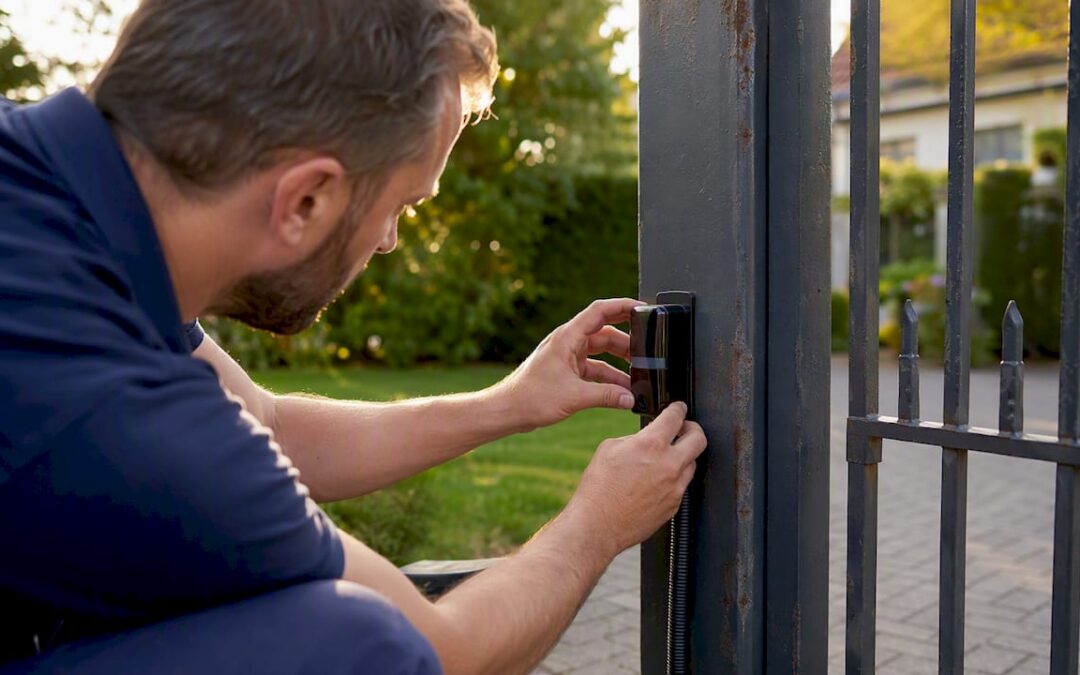
For most residential and light-commercial gates, the minimum safe setup is a non-contact photoelectric sensor pair plus a monitored safety edge on the leading edge of the gate, with a loop detector added wherever vehicles need to be detected. That combination gives you two independent ways to stop a gate before it closes on a person, vehicle, or pet, which is exactly what U.S. entrapment-protection standards expect from an automated gate system.
The reasoning is straightforward: a single sensor type leaves one blind spot. Photoelectric beams can miss something below or above the beam line, and a safety edge alone won’t stop a gate before contact happens. Layering both, and choosing monitored versions where your operator supports them, closes that gap and satisfies the intent behind UL 325 entrapment protection requirements.
- Non-contact photoelectric pair (through-beam preferred) at the gate opening
- Monitored safety edge along the leading and trailing edges
- Loop detector or monitored vehicle sensor where cars enter or exit regularly
- A documented risk assessment before any device gets mounted
Pro Tip: Before you buy anything, walk your gate and mark every pinch point, hinge gap, and closing edge on paper. That sketch becomes your risk assessment and tells an installer exactly where sensors need to go.
Key Takeaways
The safest gate systems pair non-contact photoelectric sensors with monitored safety edges and follow UL 325 entrapment-protection expectations rather than relying on any single device.
| Point | Details |
|---|---|
| Layer your sensors | Combine a photoelectric pair with a monitored safety edge; add loop detection for vehicle traffic. |
| Choose monitored wiring | Supervised circuits flag faults immediately instead of failing silently until an incident occurs. |
| Verify placement, not just presence | Photocell height, alignment, and full-length edges on sliding gates matter as much as the device itself. |
| Fix physical design first | Reducing entrapment gaps through hinge geometry and screening prevents hazards sensors alone can’t catch. |
| Work with a licensed installer | Modernfence provides risk assessment, procurement, installation, and maintenance contracts across the region. |
Table of Contents
- What Types of Gate Safety Sensors Are Available?
- How Are Gate Sensors Installed and Positioned Correctly?
- Why Do Monitored Sensors Matter for Compliance?
- How Do You Choose Sensors or Vet an Installer?
- What Do Gate Sensors and Installation Typically Cost?
- How Should You Maintain and Troubleshoot Gate Sensors?
- What Sensor Products Should You Look for in the U.S. Market?
- Why Physical Gate Design Matters as Much as Sensors
- What Do Real Sensor Failures Teach Property Owners?
- Get Your Gate Sensor System Assessed and Installed Right
- Frequently Asked Questions
- Sources
What Types of Gate Safety Sensors Are Available?
Gate safety sensors fall into a handful of families, and each one solves a different piece of the entrapment puzzle. Knowing which is which keeps you from buying redundant hardware or, worse, leaving a real gap uncovered.
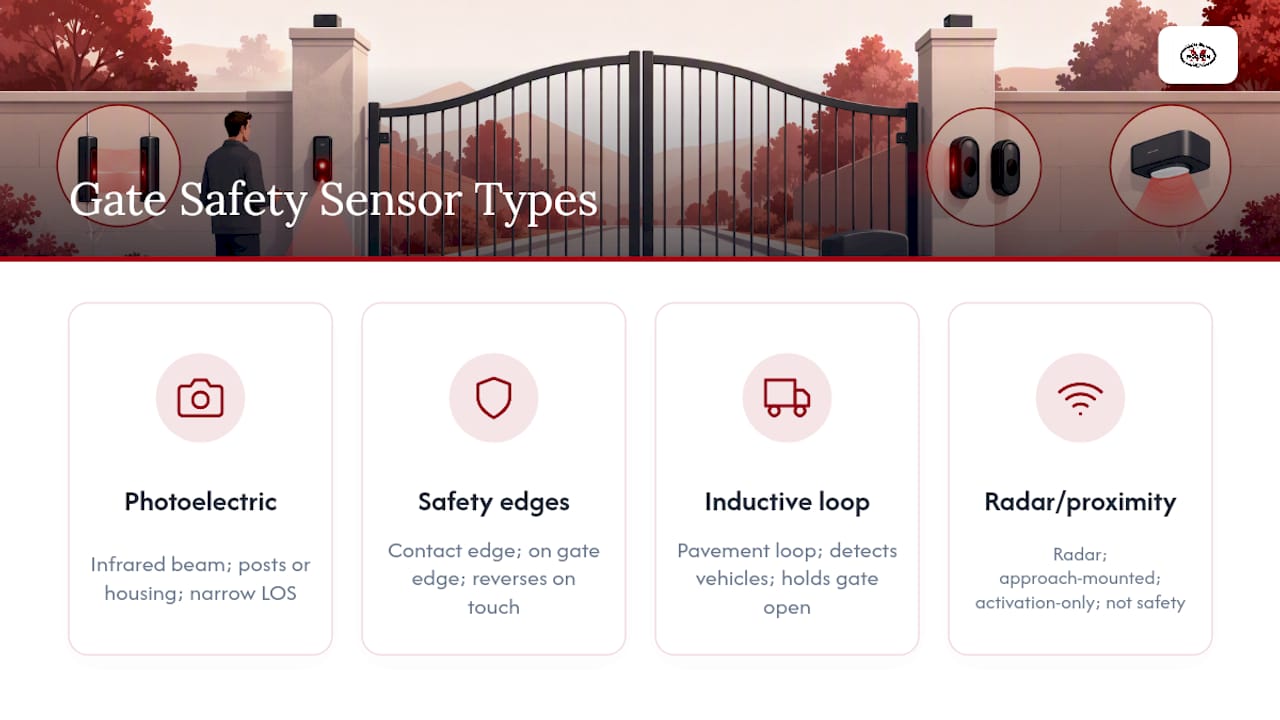
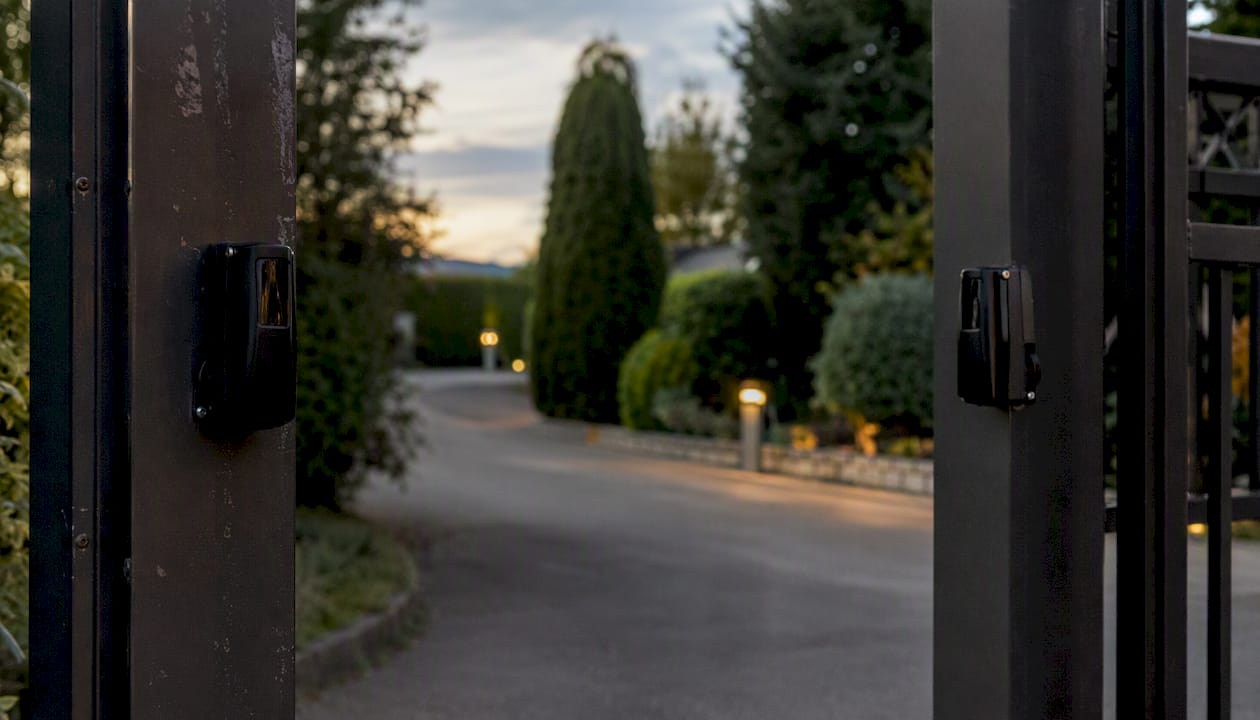
Photoelectric sensors (photoeyes) are the workhorse of automatic gate safety. A through-beam pair mounts a transmitter on one gate post and a receiver on the other, so anything crossing the infrared beam breaks the circuit and stops the gate. Retro-reflective versions put the transmitter and receiver in one housing and bounce the beam off a reflector, which simplifies wiring but is more sensitive to misalignment. Reflective (diffuse) sensors detect an object directly without a separate reflector, useful in tight spaces where running a beam across the opening isn’t practical. All three types share one weakness: dirt, spider webs, fog, and vegetation can block or scatter the beam, which is a leading cause of gates that mysteriously refuse to close, according to Gate Auto’s breakdown of common gate sensor issues.
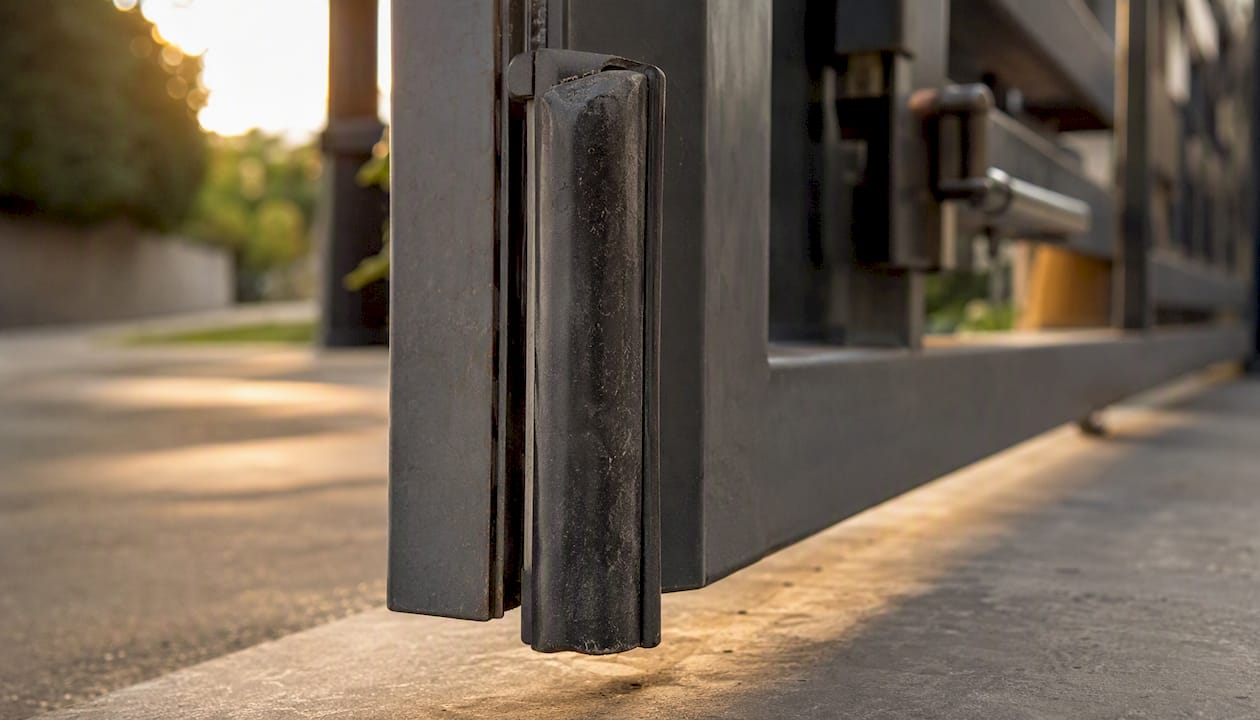
Safety edges are contact devices, meaning they only activate once something is actually touching the gate. They mount along the leading edge (and often the trailing edge and top rail on sliding gates) and reverse the gate the instant they sense pressure. Gate Safe’s installer guidance treats these as a required layer, not optional backup, and calls for weekly visual checks since a damaged edge that fails silently defeats the entire safety concept.
Inductive loop detectors solve a different problem: vehicle presence. A wire loop embedded in the pavement detects the metal mass of a car and holds the gate open (or prevents closing) until the vehicle clears. These matter most for commercial and high-traffic driveways where a car idling in the gate’s path needs continuous detection, not a one-time beam break.
Proximity, magnetic, and radar sensors typically handle activation rather than pure safety. A radar sensor can trigger a gate to open as a vehicle approaches, but relying on it as your only safety device is a mistake. Pressure mats and infrared array sensors serve niche, higher-cost applications, such as pedestrian gates in high-liability commercial settings, and LiDAR-based array sensors are starting to show up in industrial and high-security installs where a wider detection field justifies the added expense.
How Are Gate Sensors Installed and Positioned Correctly?
Placement mistakes cause more nuisance calls than defective hardware. If you’re reviewing a quote or inspecting finished work, these are the details that separate a compliant install from a liability.
Photocells generally mount around 600 millimeters from the ground, a height that catches most pedestrians and vehicles while avoiding constant false trips from small animals or blowing debris, per Gate Auto’s mounting guidance. Alignment matters as much as height. Transmitter and receiver need a clear, unobstructed line of sight, and even a slight settling of a gate post over time can throw a through-beam pair out of alignment.
Safety edges follow different rules depending on gate type. Swing gates typically need edges on the leading edge where the gate meets the post or opposing panel. Sliding gates need full-length vertical edges, because the entire leading face of a sliding gate is a potential pinch point as it travels, not just the endpoint.
Loop detectors require trenching, and read-head placement inside that loop affects sensitivity. Cut too shallow or too close to the gate track, and you get false triggers from the gate’s own hardware. Wiring should always follow the operator manufacturer’s datasheet and diagram since controller inputs vary by voltage (commonly 12 or 24 volt DC, sometimes AC) and by whether the input supports supervised (monitored) circuits.
- Confirm photocell height and clear sightline, not just power to the unit
- Check that sliding gate edges run the full vertical length, not just the leading corner
- Verify loop wire depth and read-head placement match the loop detector’s spec sheet
- Ask whether wiring runs in conduit, since exposed cable degrades faster from weather and rodents
- Ask for the manufacturer wiring diagram used for the install, not just a verbal description
Pro Tip: If an installer can’t hand you the wiring diagram for your specific controller model, that’s a signal to pause and ask more questions before signing off.
Why Do Monitored Sensors Matter for Compliance?
A monitored (supervised) sensor doesn’t just detect an obstruction. It continuously reports its own operating status back to the gate controller, so a cut wire, a dead battery, or a failed circuit gets flagged as a fault instead of failing silently. A non-monitored sensor can stop working and give you no warning at all until someone gets hurt.
This distinction sits at the center of U.S. compliance expectations. DASMA’s installer guidelines call for a total system design using ANSI/CAN/UL 325 listed equipment, combining multiple safety features rather than treating any single device as sufficient protection. UL 325 is the governing U.S. standard for entrapment protection on automated gate operators, and it’s the baseline most manufacturers, installers, and insurers will reference when evaluating whether a gate system is safe to operate. Gate Safe’s guidance for installers goes further, recommending a full risk assessment before installation and at least two different types of safety devices on every automated gate.
When you’re comparing quotes, ask specifically whether the proposed devices are UL 325 listed, whether wiring is supervised, and whether the installer will provide manufacturer datasheets alongside the wiring diagram used on your system. A written handover package should include:
- UL 325 listing documentation for the operator and safety devices
- Confirmation of monitored versus non-monitored wiring for each device
- Visible warning labels and signage at the gate
- A documented manual release/disconnect procedure
- A written maintenance and testing schedule
Local permitting and fire-access rules can layer on top of these baseline expectations, particularly for commercial and gated-community installs, so it’s worth checking with your local planning department and fire authority before finalizing a design.
How Do You Choose Sensors or Vet an Installer?
Start with the gate itself, not the sensor catalog. A residential swing gate on a quiet driveway has different needs than a commercial sliding gate cycling hundreds of times a day.
- Assess gate type and traffic volume. Swing versus sliding gates require different edge configurations, and high-cycle commercial gates justify monitored loop detection that a low-traffic residential driveway may not need.
- Identify who uses the gate. Gates serving children, elderly residents, or pedestrians alongside vehicles need broader photocell coverage and lower mounting tolerances.
- Account for environment and expected lifespan. Coastal humidity, dust from gravel roads, or heavy snow all shorten sensor life and change what IP rating you should require.
- Get a written risk assessment, not a verbal walkthrough, before any device gets specified.
When interviewing installers, ask these questions directly:
- Will you perform a documented risk assessment before quoting devices?
- Are the proposed sensors UL 325 listed and monitored?
- What’s your testing protocol after installation, and how often should the system be retested?
- Do you offer a maintenance contract, and what does it cover?
Red flags include a quote listing only a single safety device, no mention of supervision or monitoring, no testing plan after commissioning, and warranty language that’s vague about what’s actually covered. DIY installation can be reasonable for a simple residential photocell replacement on an existing, already-compliant system. Anything involving new wiring, loop detectors, controller integration, or a gate serving a business or shared community strongly favors a licensed, insured installer who can document the work. Modernfence’s access control services cover exactly this kind of assessment for property owners across the region.
What Do Gate Sensors and Installation Typically Cost?
Costs vary by gate type, site conditions, and how much of the system you’re replacing versus building new. Typical parts and labor costs for U.S. residential and light-commercial installs can differ significantly based on site access and wiring condition. Trenching for loop detectors, running new conduit, and integrating multiple devices into an existing controller add labor time and cost. A straightforward photocell retrofit on an existing operator can often be completed in a single visit, while a new install involving loops, monitored edges, and controller programming may take several days from quote to commissioning, particularly if trenching or foundation work is involved. Ask any quote to itemize site access requirements, conduit runs, and control cabinet weatherproofing separately, as these line items often cause divergent estimates.
- Get itemized pricing for parts versus labor, not a single bundled number
- Ask whether trenching and conduit are included or billed separately
- Confirm whether the quote includes post-install testing and documentation
How Should You Maintain and Troubleshoot Gate Sensors?
A basic maintenance rhythm catches most failures before they become safety incidents. Weekly visual checks of photocells and safety edges, monthly functional tests of the full stop-and-reverse cycle, and an annual full system inspection by a trained technician cover the bases that Gate Safe recommends for contact edge devices specifically.
- Check photocell alignment and clean the lenses of dust, cobwebs, and pollen, since obstructed beams are a top cause of gates sticking open, per Gate Auto’s troubleshooting notes.
- Inspect safety edges for cracks, tears, or loose mounting along the entire length, not just the endpoints.
- Test loop detector sensitivity periodically, especially after nearby pavement work or utility digging.
- If a gate sticks open, check for beam obstruction first before assuming an electrical fault.
- If you get intermittent supervision faults, check wiring connections and moisture intrusion at junction boxes before replacing the sensor.
Pro Tip: Keep wiring diagrams, test logs, and device serial numbers together with your maintenance contract. When something fails at year six, that paperwork saves a technician hours of guesswork.
What Sensor Products Should You Look for in the U.S. Market?
You’ll typically encounter a handful of product families across U.S. supply channels: photocell kits (transmitter/receiver pairs sold as matched sets), monitored safety edges sold by length and profile, loop detector controller cards paired with wire loop kits, and increasingly, LiDAR or infrared array units for higher-end commercial installs. Brands like LiftMaster, Nice, FAAC, Viking, EMX, and USAutomatic all manufacture components in these categories, and retailers such as Elite Gates, GateCrafters, and the PSS Store carry them alongside compatible controllers.
When you’re reading a datasheet, check the IP rating for weatherproofing, whether the device explicitly supports monitored/supervised wiring, and whether a wiring diagram is published for your specific controller. Matching brand and model to your existing operator matters more than picking a “top” brand, since a mismatched voltage or input type simply won’t work regardless of the sensor’s specs. Specs on paper never substitute for an installer’s risk assessment and a documented system test after commissioning.
Why Physical Gate Design Matters as Much as Sensors
Sensors catch what physical design fails to prevent, but they shouldn’t be the only line of defense. Industry guidance is direct about this.
Entrapment zones are the most dangerous hazards on an automated gate. Reducing or removing hazardous gaps through physical design, including screening, appropriate gap sizing, and shrouded hinges, is often safer than relying on sensors alone to catch every scenario.
That guidance comes from Gate Safe’s installer training materials, and it reflects a hard truth: a sensor is a backup for a hazard that shouldn’t exist in the first place. A well-designed gate with tight hinge geometry and no exposed pinch points needs sensors as a second layer, not a first defense. Reviewing gate design alongside sensor placement, something Modernfence covers when choosing estate gate hardware, catches problems no photocell will ever fix.
Pro Tip: Ask your installer to document, in writing, how sensor placement and any physical modifications work together to eliminate entrapment risk, not just where the sensors are mounted.
What Do Real Sensor Failures Teach Property Owners?
Most gate sensor failures trace back to the same handful of causes, and they’re almost all preventable with better installation or maintenance habits.
A common scenario: a photocell pair mounted at the correct height initially, but a fence post settles over a season of freeze-thaw cycles, throwing the beam a few degrees off target. The gate starts closing without detecting a car waiting in its path, because the beam no longer crosses the opening where it should. Nobody notices until a bumper gets clipped.
Another frequent failure involves safety edges that were installed on the leading edge of a sliding gate but not run the full vertical length. The gate detects contact near the bottom, where the edge exists, but not at shoulder height, where a person’s arm or shoulder might actually make contact. The device technically works. It just doesn’t cover the zone where the injury happens.
A third pattern: non-monitored wiring on a safety edge that gets nicked during landscaping work. The edge stops functioning, but because nothing supervises the circuit, the gate keeps operating normally with no fault indication, until someone tests it or gets hurt. Monitored wiring would have flagged that break immediately.
Each of these traces back to the same fix: full risk assessment, correct placement documented in writing, and monitored circuits wherever the operator supports them.
Why This Guidance Comes From Field Experience
Modernfence focuses on safe, code-aware installations because a gate that looks finished but fails on the details creates liability nobody wants to discover after an incident.
- Over 70 years operating as a family-owned fencing and access control contractor
- Licensed, insured, and serving Western Arkansas and Eastern Oklahoma
Get Your Gate Sensor System Assessed and Installed Right
Modernfence handles the full scope this guide just walked through: a site risk assessment, sourcing the right combination of photocells, monitored edges, and loop detectors for your specific gate, licensed installation, and commissioning with proper testing documentation. That’s a meaningfully different experience than piecing together parts from a catalog and hoping the wiring matches your controller.

Modernfence serves both homeowners and businesses across Western Arkansas and Eastern Oklahoma, so whether you’re upgrading a single residential driveway gate or specifying a full access control system for a commercial property with high daily traffic, the assessment and installation process scales to fit. Maintenance contracts are available too, which matters given how much of gate safety comes down to catching a misaligned photocell or a damaged edge before it becomes a real incident.
If your gate’s current sensor setup hasn’t been assessed in a while, or you’re planning a new install and want it done to UL 325 expectations from day one, request a quote from Modernfence and get a site visit scheduled.
Frequently Asked Questions
What are gate safety sensors, and do I need more than one type?
Gate safety sensors detect obstructions or people in a gate’s path and stop or reverse motion before contact happens. Most systems need at least two types, typically a non-contact photoelectric pair plus a contact safety edge, since Gate Safe’s guidance calls for multiple device types rather than a single sensor covering every hazard.
How do gate sensors work with my existing operator?
Sensors wire into your gate operator’s controller inputs, which are commonly rated at 12 or 24 volt DC. Compatibility depends on whether your controller supports monitored (supervised) inputs, so checking the manufacturer’s wiring diagram before buying components is essential.
Are monitored sensors required by law?
UL 325 sets the entrapment-protection standard most U.S. manufacturers and installers follow, and it favors systems that can detect their own faults. Monitored sensors aren’t universally mandated by name, but installers increasingly treat supervised circuits as the practical baseline for compliance.
Can I install gate safety sensors myself?
Simple replacements on an already-compliant residential system can be a reasonable DIY project. New wiring, loop detectors, or any commercial installation should go to a licensed installer who can document the risk assessment and post-install testing.
What causes gate sensors to fail most often?
Misalignment from settling posts, debris blocking photocell beams, and damaged or non-monitored safety edges are the most common failure points, based on field guidance from Gate Auto and Gate Safe’s installer training materials.
Sources
- Automatic Vehicular Gate Operating Systems: Guidelines for Specifiers, Designers, Dealers, Installers and End Users
- Safety edges explained – Gate Safe
- Important things to know about electric gate sensors | Gate Auto