
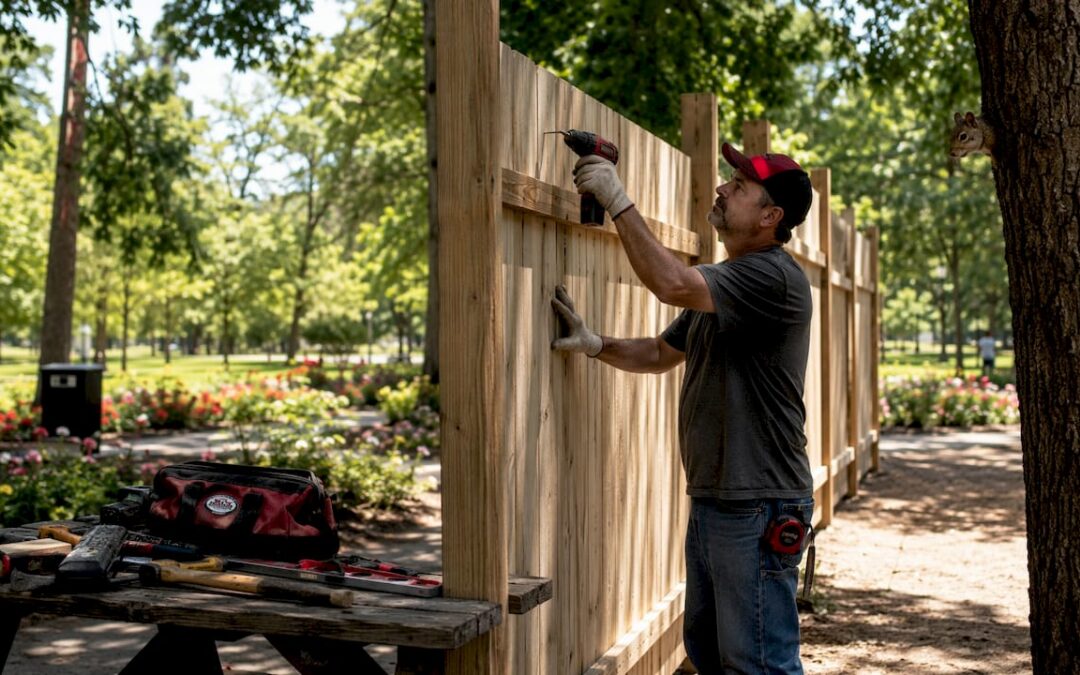
The cheapest effective privacy solutions include bamboo roll screening attached to existing chain link, pallet fences with minimal material costs, and DIY board-and-stringer cedar panels with moderate investment. For a faster permanent fix, pre-fabricated 6×8 panels run $40–$230 per panel depending on material. Your fastest next step depends on your situation:
- Overnight fix (renter-friendly): Zip-tie bamboo or reed rolls to an existing chain-link fence. Reversible, no tools required, Beginner difficulty.
- Weekend DIY: Build board-and-stringer cedar sections or install pre-fab panels. Intermediate difficulty.
- Living screen (seasonal): Plant potted arborvitae or boxwood in planters along the fence line. Beginner difficulty. Full coverage may take growing seasons.
- Pre-fab panel install: Pre-fabricated panels save significant labor time and deliver consistent results. Intermediate difficulty.
- Professional install: Contact Modernfence for a free estimate. With extensive experience, licensed and insured service, and crews across Western Arkansas and Eastern Oklahoma, they handle permits, post setting, and gate alignment so you don’t have to.
Landscape designer Kevin Lenhart recommends keeping residential privacy fences at or near 6 feet tall, then adding 12–18 inches of lattice at the top if you need extra height without the boxed-in feeling. That standard covers most sightline problems without triggering permit requirements in most Arkansas municipalities.
Table of Contents
- What are the best inexpensive privacy fence ideas?
- How do upfront costs compare to lifetime costs by material?
- What structural details keep a cheap fence from failing early?
- How can you cut costs without cutting corners?
- When does it make sense to hire a professional?
- Key Takeaways
- A straight answer from someone who has seen a lot of fences
- Modernfence can handle the project when you’re ready
- Useful sources and further reading
What are the best inexpensive privacy fence ideas?
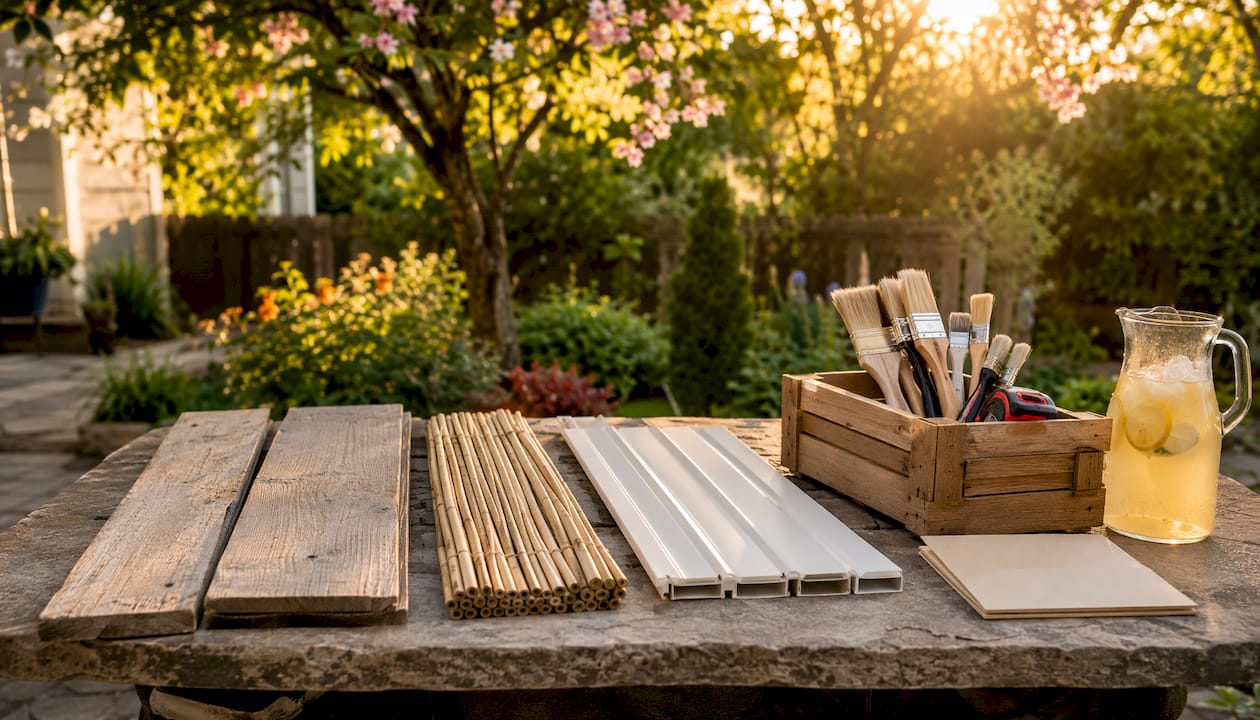
Below are ten budget-friendly options ranked roughly from lowest to highest material cost. Each includes a cost range, DIY difficulty, expected lifespan, and the key trade-off for budget buyers.
| Fence Idea | Approx. Cost | DIY Difficulty | Lifespan | Best For |
|---|---|---|---|---|
| Recycled pallet fence | Very low material cost | Beginner | 5–10 yrs | Rustic yards, zero budget |
| Bamboo/reed roll on chain link | $30–$80 per 20-ft run | Beginner | 5–10 yrs | Renters, quick fix |
| Privacy slats for chain link | $3–$8 / linear ft | Beginner | 10–15 yrs | Existing chain-link owners |
| Trellis + climbing vines | $50–$150 panel | Beginner | 15 years | Soft, natural look |
| Planter-based evergreen screen | — | Beginner | Indefinite | Renters, patios, decks |
| Pressure-treated pine panels | $15–$30 / linear ft | Intermediate | 15 years | Permanent, low upfront |
| Board-and-stringer cedar (DIY) | ~$175 per 8-ft section (materials only) | Intermediate | 20 years | Mid-term durability |
| Pre-fab 6×8 panels | $40–$230 / panel | Intermediate | 15 years | Faster DIY install |
| Shadowbox/staggered board | — | Intermediate | 20 years | Neighbor-friendly look |
| Corrugated metal + wood posts | — | Intermediate | 30+ yrs | Modern aesthetic |
Renter-friendly or reversible options: bamboo rolls, planter screens, and zip-tied privacy slats. All three can be removed without damaging the underlying structure.
A few notes worth knowing before you pick:
- Pallet fences are nearly free on materials but require inspection for structural soundness and nail removal before use.
- Bamboo rolls are the fastest install of any option. Zip-ties hold them to chain link in an afternoon, and they come down just as fast.
- Shadowbox (board-on-board) patterns use slightly more lumber than a flat board fence but look the same from both sides, which matters if you share a property line.
- Corrugated metal pairs well with horizontal wood posts and suits the modern farmhouse aesthetic common across Arkansas.
How do upfront costs compare to lifetime costs by material?
The cheapest fence to buy is rarely the cheapest fence to own. Wood costs less upfront but demands periodic sealing or staining to prevent rot. Vinyl and composite cost more at purchase but clean up with a garden hose and rarely need refinishing.
| Material | Upfront Cost (installed) | Annual Maintenance | Typical Lifespan |
|---|---|---|---|
| Pressure-treated pine | $15–$30 / linear ft | Stain every 3–5 yrs | 15 years |
| Cedar | — | Stain every 5 years | 20 years |
| Vinyl | $10–$40 / linear ft | Wash annually | 25 years |
| Composite | — | Wash annually | 25 years |
| Chain link (with slats) | $8–$30 / linear ft | Minimal | 20 years |
| Living hedge | — | Seasonal trimming | Indefinite |
Landscape architect Janice Parker points out that living fences — dense shrubs or trees planted in a row — create a softer aesthetic than any synthetic material and function as a carbon sink over time. For Arkansas homeowners with a longer planning horizon, a row of Leyland cypress or arborvitae planted along the property line can reach full privacy height in three to five years at a fraction of the installed cost of a wood fence. If you’re preparing a bed for new plantings, clearing old stumps first makes a real difference; stump removal before planting prevents root competition and gives new shrubs a cleaner start.
From a low-maintenance materials standpoint, vinyl resists rot, insects, and UV without painting. Composite goes further, resisting mold as well. Both cost more per linear foot than wood but eliminate the staining cycle entirely. For a homeowner planning to stay in place for 15-plus years, that trade-off often favors vinyl or composite on a total-cost basis.
Eco note: Recycled composite uses reclaimed wood fiber and plastic, reducing landfill waste. Pallet and reclaimed-wood fences repurpose material that would otherwise be discarded. Both are reasonable choices if environmental impact is part of your decision.
What structural details keep a cheap fence from failing early?
The infill boards are not what make a fence last. Post size and installation depth matter far more than the boards between them. A fence built on undersized or shallow posts will rack, lean, or blow down regardless of how good the panels look.
Key installation points to get right:
- Post size: Use 4×4 posts for standard 6-foot privacy fences; step up to 6×6 for taller runs or high-wind areas in Western Arkansas.
- Set depth: Bury at least one-third of the post length in the ground. A 9-foot post needs 3 feet below grade.
- Footings in soft soil: Bell out the bottom of the footing (wider at the base than the top) to resist frost heave and lateral movement.
- Post spacing: 6–8 feet on center is standard. Tighten spacing in exposed or windy locations.
- Height: A 6-foot fence blocks most ground-level views. If you need more, add 12–18 inches of lattice at the top rather than building an 8-foot solid fence, which can feel oppressive and may require a permit.
- Sloped terrain: On a grade, rack panels to follow the slope rather than stepping them. Stepping creates triangular gaps at the bottom of each section that undermine privacy unless you add custom trim boards.
- Gate reinforcement: Gates fail faster than fence runs. Use heavy-duty hinges rated for the gate weight, set the hinge post in concrete, and add a diagonal brace from the top hinge corner to the bottom latch corner.
Pro Tip: Seal the end grain on every cut board before installation. End grain absorbs moisture faster than face grain and is where rot starts. A $10 can of end-grain sealer adds years to a wood fence at almost no cost.
How can you cut costs without cutting corners?
Phasing a fence project is the single most effective way to manage budget without sacrificing quality. Start with the sightlines that matter most — the stretch facing a neighbor’s window or the street — and add sections as budget allows.
- Week 1: Set all posts for the full planned run. Post setting is the hardest part; doing it all at once saves repeated tool rental and keeps the layout consistent.
- Week 2: Install panels on the priority sections. Use pre-fab panels where the run is straight to save cutting time.
- Month 1 onward: Fill remaining sections with lower-cost options (bamboo rolls, trellis panels) while budget builds for permanent boards.
- Season 1 plantings: Add potted evergreens or climbing vines along the fence line. Strategic pruning of existing trees and shrubs can close gaps without any new material cost.
- Rent, don’t buy: A post-hole digger rental runs $50–$80 per day at most Arkansas equipment dealers. A rented concrete mixer handles footings faster than hand-mixing bags.
Always call 811 before you dig. Arkansas law requires it, and hitting a buried utility line turns a weekend project into an emergency.
Pro Tip: Use post caps on every post. They shed water off the end grain, cost under $2 each, and can add years to the post’s life. It’s one of the cheapest longevity upgrades on any wood fence.
Reclaimed materials — pallets, barn wood, salvaged boards — can cut material costs to near zero, but inspect every piece before use. Check for structural soundness, embedded nails, and any markings that indicate chemical treatment (MB-marked pallets have been methyl bromide treated and should not be used in residential settings).
When does it make sense to hire a professional?
DIY works well for straightforward runs on flat ground with no permit requirements. A professional installation makes more sense when any of these apply:
- The property has significant slope or irregular terrain.
- The run exceeds 150 linear feet (layout errors compound over distance).
- Local permits are required (most Arkansas cities require a permit for fences over 6 feet).
- You need gate alignment that has to be precise (driveways, pool enclosures).
- You want a warranty on labor and materials.
What a professional installation includes that DIY often misses:
- Site measurement and layout to avoid encroaching on property lines or easements.
- Permit pulling and code compliance review.
- Correctly sized posts set to proper depth in concrete footings.
- Gate alignment and hardware rated for long-term use.
- Warranty coverage and liability insurance protecting you if something goes wrong.
Questions to ask any fence installer before signing: Are you licensed and insured? Can you provide references from similar projects in this area? What does the estimate include, and what triggers a change order? What is your timeline from permit to completion?
Red flags: no proof of insurance, a vague or verbal-only timeline, pressure to pay the full amount upfront, and no written warranty.
Modernfence has served Western Arkansas and Eastern Oklahoma for over 70 years as a licensed and insured contractor. Their privacy fencing services cover wood, vinyl, chain link, and iron, and their estimates include permit guidance and phased-build options for budget-conscious homeowners.
Key Takeaways
The most cost-effective privacy fence strategy combines a fast low-cost fix now (bamboo rolls or privacy slats) with a phased permanent build using pressure-treated pine or cedar panels set on properly sized, concrete-footed posts.
| Point | Details |
|---|---|
| Cheapest immediate fix | Bamboo rolls or vinyl slats on existing chain link cost $3–$80 and install in hours with no tools. |
| Best permanent low-cost option | Pressure-treated pine at $15–$30 per linear foot installed offers the lowest upfront cost for a lasting fence. |
| Post depth beats panel quality | Set posts at least one-third of their length in concrete; this matters more than which boards you choose. |
| Living fences save long-term | Dense shrubs or evergreen planters grow indefinitely with seasonal trimming. |
| Modernfence for complex installs | For sloped lots, permits, or runs over 150 feet, Modernfence’s licensed team in Western Arkansas handles the full project. |
A straight answer from someone who has seen a lot of fences
Most budget fence mistakes come down to one thing: spending money on visible materials and skimping on the structure underneath. A beautiful cedar board fence set on 4-inch posts buried 18 inches deep will lean within two years in Arkansas clay soil. The same boards on properly set 4×4 posts in concrete footings will still be standing in fifteen.
The other pattern worth flagging is the all-or-nothing approach. Homeowners either try to fence the entire property at once and run out of budget halfway through, or they put off the project entirely because the full cost feels out of reach. Phasing works. Start with the 30 feet that face the street or the neighbor’s back porch, do it right structurally, and add sections as budget allows. A partial fence done correctly is more useful than a full fence done poorly.
For renters or anyone not ready to commit to a permanent structure, bamboo rolls and planter-based screens are genuinely good solutions, not just stopgaps. They provide real privacy, cost very little, and leave no trace when you move.
Modernfence can handle the project when you’re ready
Modernfence brings over 70 years of licensed, insured fencing experience to homeowners and property owners across Western Arkansas and Eastern Oklahoma. Whether you need wood, vinyl, chain link, or iron installed to spec, or you want fence staining, cleaning, or a temporary rental fence while a permanent solution goes in, the team handles it all under one roof.
Getting an estimate is straightforward. Call or submit a contact form, and a Modernfence representative will schedule a site visit, measure the run, review local permit requirements, and walk you through phased-build options if budget is a consideration. There’s no pressure and no guesswork on scope. Read through the fence installation guide to see exactly what a professional install involves, then reach out to Modernfence for a free estimate tailored to your property.
Useful sources and further reading
The cost ranges, material comparisons, and installation guidance in this article draw from the following sources:
- Privacy Fence Ideas, The Spruce — material maintenance trade-offs and vinyl/composite comparisons
- 61 Privacy Fence Ideas, Architectural Digest — expert quotes from Kevin Lenhart and Janice Parker on height and living fences
- Choosing the Best High Privacy Fence, Perimtec — post sizing, set depth, and slope guidance
- DIY Privacy Fence on a Budget, Sleep Shacks — cost estimates for cedar sections, bamboo rolls, and pre-fab panels
- Types of Fences and How to Choose One, The Spruce — per-linear-foot cost ranges by material
- Privacy Fence Installation Cost, Modernfence — local cost context and professional estimate components
Local permit reminder: Most Arkansas municipalities require a permit for fences over 6 feet. Check with your city or county planning office before breaking ground. Height limits and setback rules vary by zoning district. Call 811 at least three business days before digging to have underground utilities marked at no cost.