
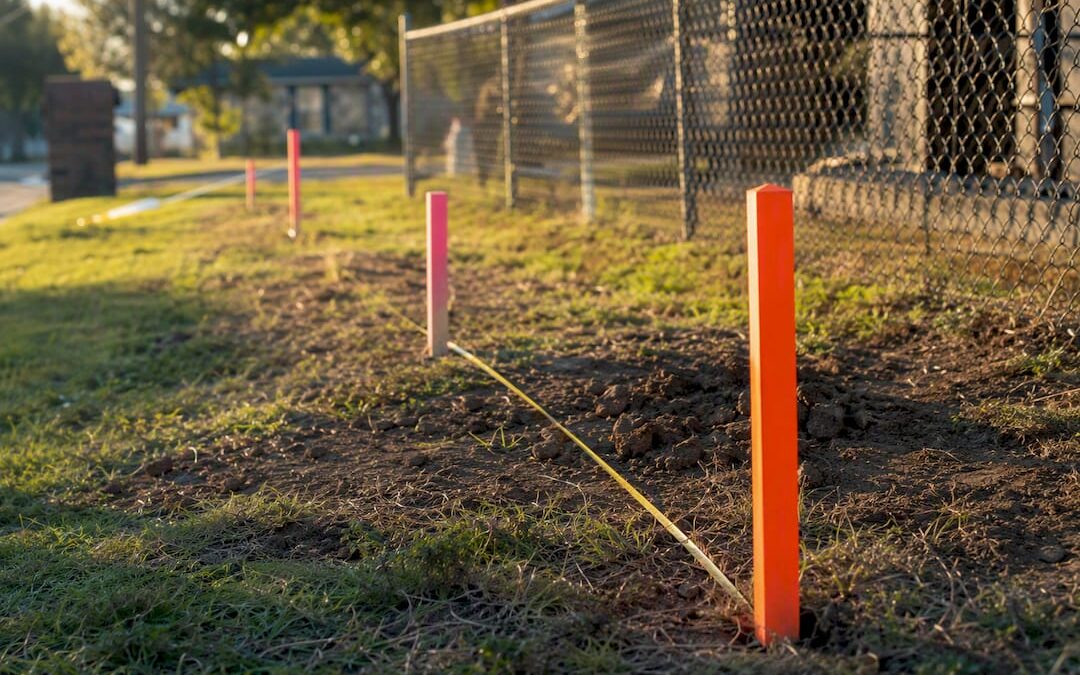
You can build a fence on your property line in Fort Smith if it’s your land and the fence meets city code, but any fence taller than the city permit thresholds needs a permit first. Skip the guesswork and order a boundary survey before you dig a single post hole, then bring in a licensed local contractor like Modernfence to confirm the site plan. Fort Smith doesn’t require your neighbor’s sign off, but boundary disputes still fall under Arkansas civil law, not city code.
TL;DR:
- Ordering a boundary survey before building a fence is essential, as old fence lines rarely prove legal property boundaries in Arkansas.
- Fence permits are only required for structures exceeding specific heights or masonry over four feet, but zoning rules still apply regardless of permit status.
- A written, current survey and clear documentation are critical to resolving boundary disputes and avoiding costly legal conflicts later.
- Material choices impact permit requirements, with wood and iron fences over six feet needing permits, and other restrictions applying based on local codes.
- Property maintenance responsibilities depend on who paid for the fence, with shared fences often requiring written agreements for repairs and liability.
Table of Contents
- Fort Smith Fence Rules: Permits, Materials, and Setbacks
- Property Line vs. Fence Line: What a Survey Actually Proves
- How Do You Prepare Before Building a Boundary Fence?
- Which Fence Material Fits Your Fort Smith Property?
- What Does a Fort Smith Fence Project Actually Cost?
- Why Modern Fence Company Handles Boundary Projects Right
- Who Is Responsible for Maintaining a Boundary Fence?
- Do HOAs in Fort Smith Add Extra Fence Rules?
- How to Resolve a Fence Dispute Before It Reaches Court
- An Editorial Take on Fort Smith’s Fence Rules
- Ready for Your On-Site Estimate?
- Sources
Fort Smith Fence Rules: Permits, Materials, and Setbacks
Fort Smith’s permit threshold requires a building permit for fences above a certain height and masonry walls above a certain height. Applications go through the Building Safety Division, located at 623 Garrison Avenue. You’ll need to submit a site plan showing the fence’s location, height, materials, and setbacks.
Fort Smith City Code § 14-56 approves these materials:
- Wood
- Metal tubing and wrought iron
- Stone and masonry
- Chain link
The ordinance prohibits barbed wire outside limited agricultural parcels, along with chicken wire and corrugated metal panels. If your project falls outside the standard rules, a variance process exists through the Property Owners Appeals Board, though you’ll need to show real hardship, and appeals to court are available within 30 days.
Even a 4-foot picket fence has to follow zoning rules. Height, materials, setbacks, and corner sight triangle requirements apply whether or not you need a permit, and Fort Smith’s zoning code doesn’t waive those rules just because your fence sits under the permit threshold.
Skip these steps and you risk a stop work order, an after the fact permit application, a citation, or in the worst case, an order to remove what you just built. That’s an expensive way to learn the code.
Property Line vs. Fence Line: What a Survey Actually Proves
A fence tells you where someone put a fence. It doesn’t tell you where your property actually ends, and treating an old fence line as the legal boundary is the single most common mistake Franklin County homeowners make before a project goes sideways. A professional boundary survey is the only reliable way to confirm where your land stops and your neighbor’s starts.
This matters more in Arkansas than most people assume, because of what’s often called the “seven year fence law.” Adverse possession here requires continuous, hostile, open, and notorious possession for seven years, and proving all four elements is a high bar that usually requires a court case, not just a long standing fence. Relying on an old fence as proof of ownership is a bet most owners lose.
If you suspect an encroachment, take these steps in order:
- Order a current boundary survey before doing anything else
- Photograph and date the existing fence line and any disputed area
- Send a written notice to your neighbor documenting the issue
- Consult a real estate attorney before taking physical action
Boundary disputes in Franklin County ultimately land in Sebastian County Circuit Court under Arkansas statute A.C.A. 18-11-101 et seq.
Pro Tip: A survey costs a few hundred dollars. Moving an encroaching fence after the fact costs a lot more, and it can strain a neighbor relationship you’ll have for decades.
How Do You Prepare Before Building a Boundary Fence?
Getting the order of operations right saves you from rework, permit headaches, and awkward conversations with the people next door.
- Pull your deed and plat map. Confirm what you actually own before you plan anything.
- Hire a licensed surveyor. This locks down your actual property line, not just where an old fence happens to sit.
- Check Fort Smith’s permit rules for your planned height and material. A quick call to the Building Safety Division clears this up fast.
- Get on-site estimates from licensed contractors. Compare more than price, look at how they handle documentation.
- Finalize your site plan and file a permit application if your project requires one.
At the on-site estimate, ask direct questions: Can they show proof of license and insurance? Do they handle the permit paperwork or leave that to you? What does the warranty actually cover? Get everything in writing, including a detailed contract and a realistic start and finish window.
Keep these documents together in one file: the survey map, your permit, the signed contract with site plan attached, photos of existing conditions before construction starts, and any written agreement with a neighbor about cost sharing or the fence line itself.
Pro Tip: If a neighbor pushes back on your fence plan or threatens to remove it themselves, stop and call an attorney before you call anyone else. A disputed boundary is not something to resolve with a shovel.
Which Fence Material Fits Your Fort Smith Property?
Your material choice shapes both what Fort Smith requires and how the fence performs over time.
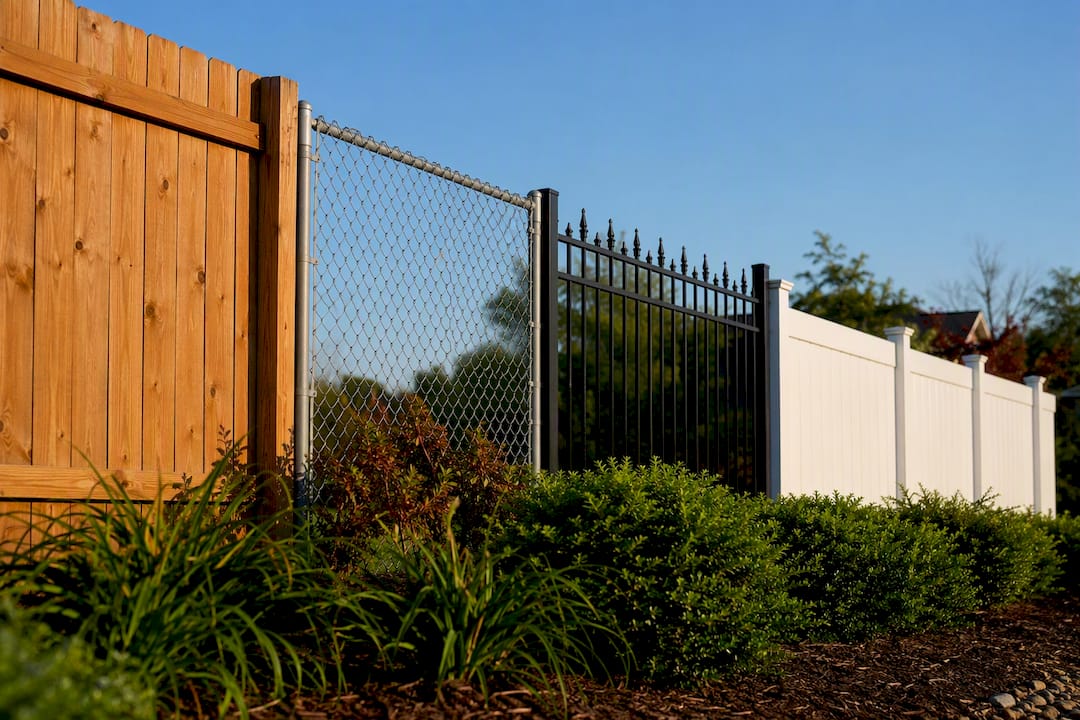
- Wood delivers privacy and a warm, traditional look, and it takes stain well, which matters in a climate that swings from humid summers to freezing winter weeks.
- Vinyl asks almost nothing of you after installation. No staining, no rot, and it holds up against Arkansas humidity better than most owners expect.
- Chain link wins on budget and pet containment, and it’s the fastest material to install when you just need a functional boundary marker.
- Iron brings security and curb appeal together, often for front yards or commercial properties where appearance matters as much as function.
Material choice also interacts directly with Fort Smith’s code. A wood or iron fence pushing past 6 feet triggers the same permit requirement regardless of how good it looks, and any masonry component over 4 feet does too.
Modernfence works across all four materials, plus fence staining, fence cleaning, and custom metal fabrication for owners who want ironwork built to a specific look rather than pulled off a shelf. If you’re leaning toward wood, the maintenance conversation is worth having before installation, not after the first hot summer.
What Does a Fort Smith Fence Project Actually Cost?
Bids vary for real reasons, and understanding them helps you compare quotes without just picking the lowest number.
The main cost drivers on a typical project:
- Total linear footage of fence line
- Material selection (chain link runs cheaper than iron or custom wood)
- Site prep, including grading and removing trees or roots along the line
- Gates and any access control hardware
- Custom metalwork or fabrication
- Permit fees where applicable
A straightforward residential job can move from estimate to finished installation in a matter of weeks, but permit review, custom fabrication, and material lead times can each add days or weeks to that window. Budget accordingly if you’re planning around a specific date.
When comparing bids, look for whether a contractor includes survey coordination and permit handling as line items, not afterthoughts. A quote that skips the survey question or tells you “no permit needed” without checking your exact height and material is a red flag, since Fort Smith’s zoning rules apply below the permit threshold too. Ask about warranty coverage, cleanup responsibility, and proof of insurance before you sign anything.
Why Modern Fence Company Handles Boundary Projects Right
Modernfence has operated in this region for more than 70 years, which means we’ve watched Fort Smith’s codes evolve and we’ve handled more boundary line projects than most contractors see in a career. We’re licensed, insured, and family owned, and that combination matters most on exactly the kind of project this article covers, where a mistake isn’t just cosmetic, it’s legal.
Our services cover wood, chain link, iron, and vinyl installation, access control systems, fence staining, fence cleaning, rental fences for temporary needs, and custom metal fabrication. On boundary risk projects specifically, we coordinate with surveyors, prepare permit ready site plans, handle the permit paperwork directly with the city, and back every job with a written contract and warranty.
Who Is Responsible for Maintaining a Boundary Fence?
Maintenance responsibility on a shared boundary fence usually depends on who paid for it, unless a written agreement says otherwise. If you built the fence entirely on your own property and covered the full cost, you generally own the maintenance obligation and the liability that comes with it. Rot, leaning posts, or a sagging gate on your side are your problem to fix.
Shared or “partition” fences get murkier. When both neighbors use and benefit from a fence sitting on the line, informal custom in Arkansas often expects both parties to split repair costs, but nothing forces that split unless you’ve put it in writing. A written cost sharing agreement signed before construction, or soon after, protects both sides if a tree falls on the fence or a storm knocks over a section five years later.
Liability runs the other direction too. If your fence fails and causes damage, a falling panel that hits a neighbor’s car, a gate that swings open and lets a dog into traffic, you’re the one exposed, not the neighbor who never touched the project. Regular inspection matters as much as the initial install. A fence that’s leaning, rotting, or missing hardware is a liability sitting in your yard until you address it.
Do HOAs in Fort Smith Add Extra Fence Rules?
City code sets the floor, but your homeowner association can set a higher bar, and plenty of Franklin County developments do exactly that. An HOA can restrict fence height below the city’s 6 foot permit threshold, limit you to specific materials like wood or wrought iron only, dictate paint or stain colors, or require board approval before you submit anything to the city.
This creates a real trap for owners who check city code, confirm they’re under the permit threshold, and start building, only to get a violation notice from their HOA weeks later. Fort Smith’s building permit and your HOA’s architectural approval are two separate hurdles, and clearing one says nothing about the other.
Before you finalize a site plan, pull your HOA’s covenants and check the fence section specifically. Some associations require a written application with a sketch or survey attached, and a few charge a small review fee. If your development doesn’t have an active HOA, or you’re outside a covenant controlled subdivision, city code is your only governing rule, which simplifies things considerably. Either way, confirm this before you order materials, not after they’ve been delivered.
How to Resolve a Fence Dispute Before It Reaches Court
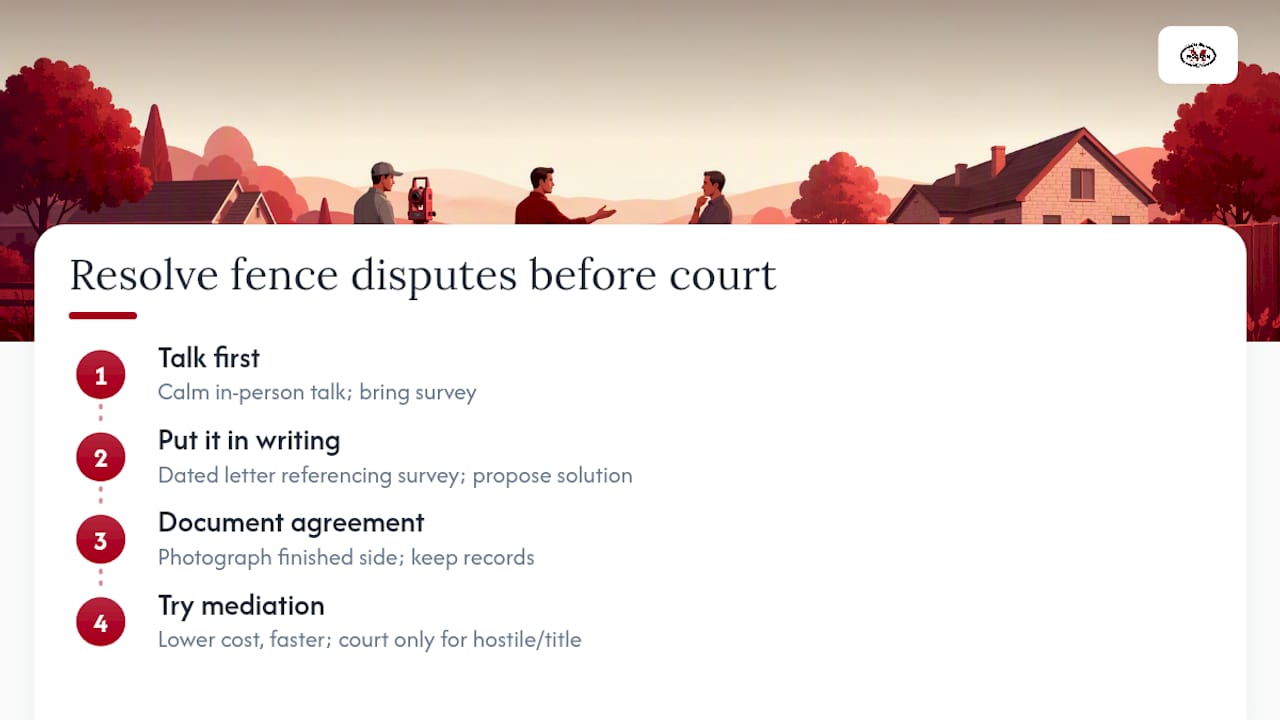
Most boundary fence disputes never need a judge, and skipping straight to legal threats usually makes a solvable problem worse. Start with a direct, calm conversation with your neighbor, ideally in person, and bring your survey if you have one. A surprising number of disputes come from genuine confusion about where the line actually sits, not bad faith.
If that conversation doesn’t resolve things, put your position in writing. A dated letter describing the issue, referencing your survey, and proposing a specific resolution creates a paper trail you may need later, and it often prompts a neighbor to take the issue more seriously than a verbal exchange did. Documenting the finished side of the fence and any related agreements protects you if the disagreement resurfaces years down the line.
Mediation is worth considering before litigation. Sebastian County has mediation resources that cost far less than a lawsuit and tend to move faster, and a neutral third party can often find a compromise, like a shared cost agreement or a slight adjustment to the fence line, that both sides can live with. Reserve an attorney and Sebastian County Circuit Court for cases involving a hostile neighbor, a threatened removal, or a genuine title dispute that mediation can’t touch.
An Editorial Take on Fort Smith’s Fence Rules
The conventional advice on this topic treats permits as the main risk. They’re not. The permit threshold is clear, six feet, easy to check, easy to comply with. The real risk sits in the assumption that an existing fence line equals a property line, and that assumption is what turns a $400 survey into a $15,000 legal dispute.
Arkansas’s adverse possession rules get treated online like a countdown clock, as if seven years of an old fence automatically transfers ownership. It doesn’t. The four part test behind it, continuous, hostile, open, and notorious possession, is genuinely hard to prove, and most homeowners citing it have never actually checked whether their situation qualifies.
If there’s one thing this research supports clearly, it’s this: order the survey first, every time, regardless of how confident you feel about where the line sits. Everything else, material choice, permit paperwork, HOA approval, is a solvable logistics problem. A wrong boundary assumption is the one mistake that’s expensive to undo.
— mark
Ready for Your On-Site Estimate?
Modernfence makes the first step easy, and it costs you nothing but a phone call or a form. Before your estimate, gather what you have: your deed or plat map if you can find it, a few photos of the area, a rough idea of where you want the fence line to run, and your preferred height and material.
We show up with a plan, not just a price. That means a site plan ready for permit submission if your project needs one, straight answers on Fort Smith’s code requirements for your specific height and material, a written quote with a real timeline, and a warranty backing the work. No guessing on whether a permit applies to your project, we check before we quote.
If you’re still researching the installation process itself, our fence installation guide walks through what to expect from first call to final walkthrough. When you’re ready to move, request your estimate directly through Modernfence and we’ll get a crew scheduled to walk your property line with you.
Sources
- Building Safety FAQ | Fort Smith, AR
- Fort Smith code of ordinances (fencing sections) — Municode
- Permit Requirements in Fort Smith, AR (2026) | CityRuleLookup
- Adverse possession entry — Encyclopedia of Arkansas
- Why a fence property survey matters — James River Surveying