
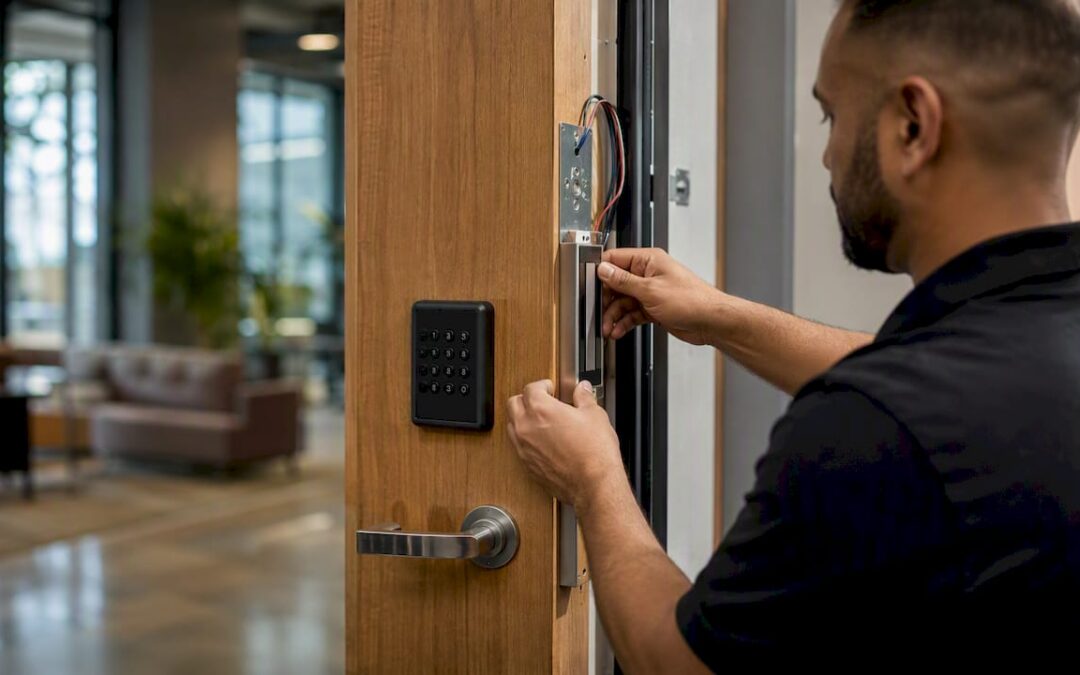
Commercial access control systems typically cost $500 to $8,000+ per door installed, with most complete commercial deployments landing between $3,000 and $5,000 per door once hardware, labor, and first-year licensing are factored in. That range covers a standard card reader, an electrified lock or strike, a door controller, wiring, and basic installation labor. It does not cover ongoing cloud subscriptions, credential replacements, or any electrical panel upgrades your building may need.
Five variables move that number more than anything else:
- Door type: Exterior doors with weatherproofing and heavy-duty hardware cost more than interior office doors.
- Credential type: Keypads sit at the low end; biometrics push toward the ceiling.
- Cloud vs. on-premises: Cloud systems lower upfront costs but add monthly per-door fees for the life of the system.
- Wiring and retrofit complexity: Finished walls, fire-rated doors, and long cable runs all add labor hours.
- Number of doors: Per-door costs drop as volume increases, but multi-controller deployments add infrastructure costs.
Per-door averages become misleading for high-security facilities, multi-site campuses, or buildings requiring significant electrical work. A single biometric reader at a data center entry point can exceed $10,000 installed. A 60-door warehouse campus with a shared server and bulk wiring may come in well under $2,000 per door. Use the ranges below as a starting framework, then refine with a site survey.
Key Takeaways
Most commercial access control projects cost $1,500–$5,000 per door installed, with hardware, labor, and first-year licensing as the three largest line items, and cloud subscription fees as the cost that compounds most significantly over time.
| Point | Details |
|---|---|
| Per-door installed cost | Most commercial deployments run $1,500–$5,000 per door; biometrics and enterprise systems go higher. |
| Biggest cost drivers | Labor, controller capacity, and cloud licensing fees often exceed hardware costs on multi-year budgets. |
| Cloud vs. on-premises | Cloud lowers upfront cost but adds $3.50–$15+/door/month; on-prem costs more upfront with lower recurring fees. |
| Three questions for every quote | Ask what the controller capacity is, whether power is included, and what the per-door fee is after year one. |
| Modernfence | Provides commercial access control installation with gate integration across Western Arkansas and Eastern Oklahoma. |
Table of Contents
- How much does access control cost per door? Ranges and sample project budgets
- What actually drives access control pricing?
- How your system choice changes the price
- Installation realities that change your labor estimate
- What ongoing costs look like over time
- How to get accurate quotes and avoid budget surprises
- Licensing, software, and cloud subscription fees explained
- Cost comparison across system tiers and product categories
- How Modernfence approaches access control projects
- Modernfence can help you budget and plan your access control project
- Sources
How much does access control cost per door? Ranges and sample project budgets
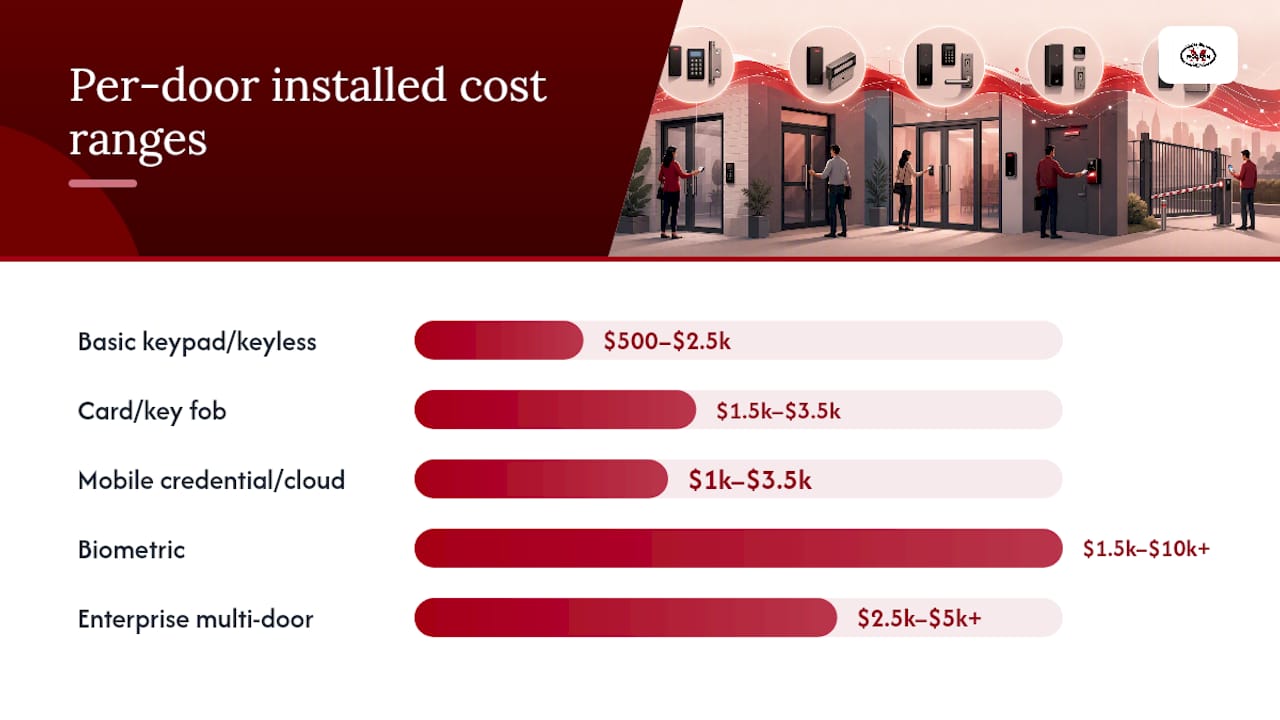
The table below shows typical per-door cost ranges by technology tier. Each range assumes a single-door installation with standard wiring; multi-door projects with shared controllers will reduce the per-door figure.
| System Tier | Per-Door Installed Cost | What’s Typically Included |
|---|---|---|
| Basic keypad/keyless | $500–$2,500 | Keypad reader, electric strike or magnetic lock, basic controller, standard wiring |
| Card/key fob | $1,500–$3,500 | Proximity or smart card reader, electrified lock, controller, credentials |
| Mobile credential/cloud | $1,000–$3,500 | Mobile-enabled reader, cloud controller, first-year licensing, app setup |
| Biometric | $1,500–$10,000+ | Fingerprint or facial reader, heavy-duty lock hardware, controller, enrollment |
| Enterprise multi-door | $2,500–$5,000+ | Shared server or cloud platform, multi-door controllers, integration with cameras/alarms |
Three sample project budgets give you a more grounded sense of what real projects cost. All three assume wired interior doors in a commercial building with standard wall construction, local labor rates in the mid-South region, and card/fob credentials unless noted.
Small office, 5 doors: Card readers ($400 each), electric strikes ($300 each), a 4-door controller plus one single-door unit ($900 total), wiring and conduit ($600), installation labor ($2,500), and first-year cloud licensing ($600). Estimated total: on the order of several thousand dollars, or roughly in the low-thousand range per door at this scale.
Mid-size office, 20 doors: Card readers ($350 each average with volume), electric strikes and magnetic locks mixed ($280 each average), two 8-door controllers ($2,400), wiring and conduit ($4,000), installation labor ($14,000), first-year cloud licensing ($2,400). Estimated total: tens of thousands of dollars, or approximately in the mid-thousand range per door.
Warehouse campus, 60 doors: A mix of exterior and interior doors, weatherproof readers on perimeter entries, a shared on-premises server ($3,500), eight 8-door controllers ($9,600), readers ($280 average), heavy-duty locks on exterior doors ($400 average), wiring and conduit ($18,000), installation labor ($36,000). Estimated total: low six-figure amounts, or roughly in the mid-thousand range per door at volume.
These figures assume no major electrical upgrades, no fire-rated door modifications, and no integration with existing camera or alarm systems. A per-door cost calculator that separates equipment, installation, setup, and monthly service fees is a practical tool for stress-testing these numbers against your specific door count and credential choice before you request quotes.
What actually drives access control pricing?
Hardware is the most visible line item, but labor and software often account for more of the final bill than buyers expect. Here is what each component typically costs and where budget surprises tend to hide.
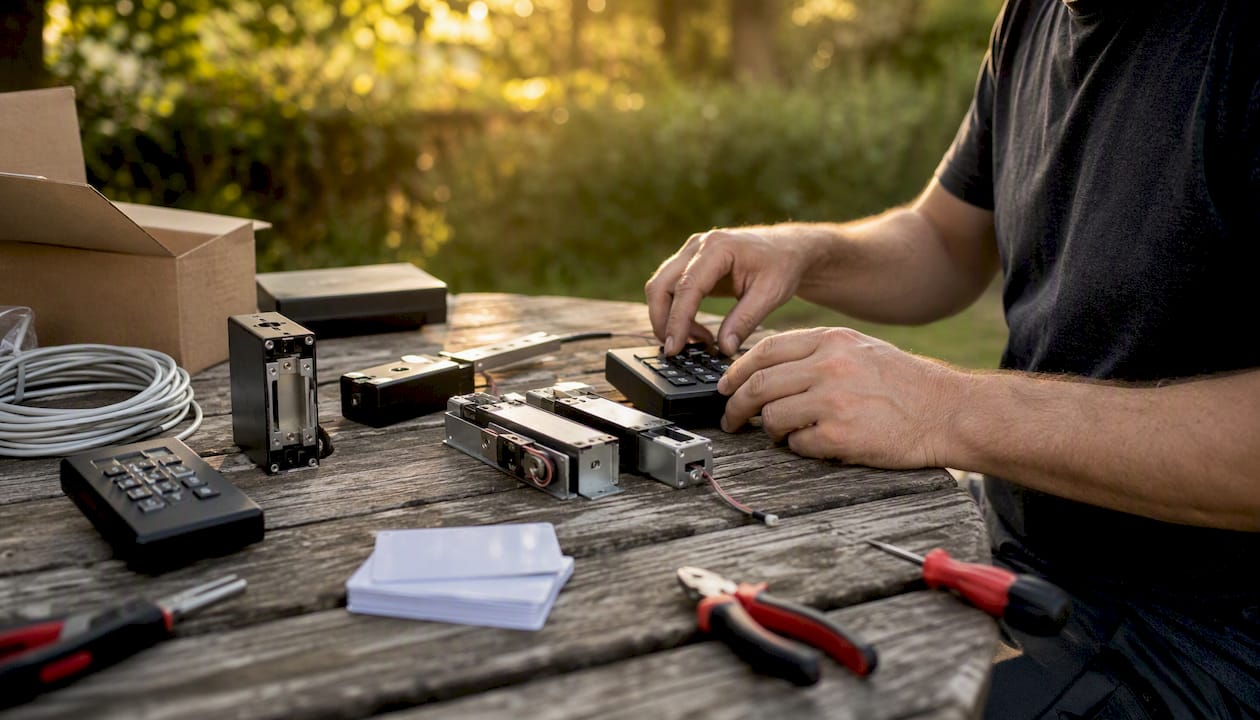
A single-door line-item example shows how these stack up in practice. A standard interior office door with a card reader, electric strike, shared controller allocation, standard wiring, and two hours of installation labor typically breaks down like this: reader ($350), electric strike ($250), controller share ($300), wiring materials ($250), labor ($600). That puts the door at roughly $1,750 before any software or licensing fees.
Three quote red flags to watch for:
- No power supply line item. Every electrified lock needs a dedicated power supply or UPS. If it is not in the quote, ask where it is.
- Controller capacity not specified. A 4-door controller installed on a 5-door project means a second controller is coming, and that cost is not in your quote.
- “Installation included” with no labor breakdown. Lump-sum installation figures hide scope assumptions. Ask for hours and rate separately.
Retrofit complexity is the single biggest source of budget surprises. Running wire through finished drywall, navigating fire-rated door assemblies, or pulling cable across a large warehouse floor can add several hundred to several thousand dollars per door compared with new construction.
How your system choice changes the price
The access method you choose shapes both what you pay upfront and what you pay every month for years afterward.
Keypad systems are the lowest-cost entry point, typically $500–$2,500 per door installed. They work well for low-traffic interior doors where PIN sharing is not a security concern. The tradeoff is that rekeying means changing PINs across the system rather than deactivating a single credential.
Card and key fob systems are the most common choice for commercial properties, running $1,500–$3,500 per door. They offer individual credential management, audit trails, and straightforward integration with HR systems for onboarding and offboarding. The keypad vs. card reader decision usually comes down to whether you need per-user accountability.
Mobile credential systems use smartphones as the credential, typically in the same $1,000–$3,500 per-door range. Upfront hardware costs can be slightly lower because some mobile readers are less expensive than traditional smart card readers, but cloud subscription fees are built into the model from day one.
Biometric systems start at $1,500 per door and can exceed $10,000 for high-security applications with facial recognition or multi-factor enrollment. They eliminate credential replacement costs but add enrollment management and, in some jurisdictions, compliance considerations around biometric data storage.
Cloud vs. on-premises: where the real cost difference lives
Cloud-based systems generally lower the upfront capital outlay and shift spending to a monthly recurring fee. On-premises systems require a larger initial investment in servers and software licenses but carry lower ongoing costs once the infrastructure is in place.
Over a five-year horizon, cloud systems tend to run $2,000–$3,500 per door in total cost of ownership, while on-premises deployments can reach $8,000–$12,000 per door when server hardware, software maintenance, and IT support are included. That gap narrows for large deployments where the on-premises server cost is spread across many doors.
For multi-site businesses, cloud-managed platforms have a practical advantage beyond cost: they eliminate the need for a local server and per-site software patching at each location. Small-business sites with fewer than 32 doors may find flat annual site-level licensing more predictable than per-door monthly fees, since the total does not grow with every door you add.
Pro Tip: Specify open-architecture readers that support OSDP (Open Supervised Device Protocol) or multi-technology credentials. These readers work with multiple controller platforms, so you can switch software vendors or upgrade hardware without replacing every reader on the property. That flexibility can save thousands on future upgrades.
Installation realities that change your labor estimate
Most budget surprises in access control projects come from installation, not hardware. Understanding what drives labor costs lets you ask better questions before signing a contract.
-
Retrofit through finished walls. Running low-voltage cable through insulated drywall or concrete block takes significantly more time than open-stud new construction. Expect to add $200–$600 per door in labor for standard retrofit conditions, more for masonry or historic buildings.
-
Fire-rated door assemblies. Fire-rated doors require UL-listed electrified hardware and specific installation methods. Using the wrong hardware voids the door’s fire rating. Specialty hardware and the extra time to verify compliance add cost to every fire-rated opening.
-
Exterior and weatherproof doors. Outdoor readers need weatherproof enclosures, and exterior electrified hardware must be rated for temperature extremes. Gate installations add conduit runs, gate operators, and sometimes solar or battery backup power.
-
Long cable runs. Access control wiring has distance limits. Runs beyond 500 feet may require signal repeaters or a shift to IP-based readers, both of which add material and labor cost.
-
Electrician work and panel capacity. Electrified locks and controllers need dedicated low-voltage circuits. If your panel is at capacity or your building lacks adequate conduit pathways, an electrician’s work becomes a project-level expense, often $500–$2,000 depending on scope.
-
Permitting. Most commercial access control installations in the U.S. require a low-voltage permit. Permit fees vary by municipality but typically run $50–$300. Some jurisdictions also require a licensed electrical contractor for any work connected to building power.
-
Timelines by project type. A simple 3–5 door retrofit in an office with accessible walls typically takes 1–2 days. A medium-complexity retrofit of 15–25 doors with some masonry or fire-rated openings runs 3–5 days. A new-build deployment of 40+ doors coordinated with the general contractor can span 2–4 weeks depending on construction schedule.
What ongoing costs look like over time
Upfront installation is only part of the budget. A realistic multi-year plan accounts for cloud licensing, maintenance, credential turnover, and support.
| Ongoing Cost Item | Typical Annual Cost (Per Door) | Notes |
|---|---|---|
| Cloud platform licensing | $50–$300 | Based on $3.50–$15+/door/month for basic to mid-tier |
| Annual maintenance contract | $50–$300 | Covers firmware updates, remote diagnostics |
| Credential replacement | $15–$60 | Assumes 10–20% annual card/fob loss rate |
| Battery replacement (wireless locks) | $20–$50 | Wireless locks require annual or biannual battery service |
| Support SLA / help desk | $250–$600 | Varies by vendor and response-time tier |
Cloud licensing is the line item that compounds most visibly. At $8 per door per month, a 20-door office pays $1,920 per year in platform fees alone. Over five years, that is $9,600 in licensing on top of the original installation cost. The math shifts for on-premises systems: higher upfront server and software costs, but annual fees limited to maintenance and support contracts rather than per-door subscriptions.
Hardware purchase price is only the first number to check; processing or recurring fees, lease terms, and contract conditions often matter more to total cost over time. Ask every vendor for a 3-year and 5-year cost projection, not just an installation quote.
A practical 5-year TCO estimate for a 20-door cloud system: $38,000 installation + $9,600 licensing + $3,000 maintenance + $1,200 credentials = roughly $52,000 over five years, or about $2,600 per door. An on-premises equivalent might run $50,000 installation + $6,000 maintenance + $1,200 credentials = $57,200, with no per-door monthly fee but a larger initial outlay and IT overhead. Neither model is universally cheaper; the right choice depends on your IT resources, door count, and how long you plan to stay on the same platform.
How to get accurate quotes and avoid budget surprises
The most common reason access control projects run over budget is that the initial quote and the final scope describe different projects. A structured approach to requesting and reviewing quotes fixes that.
Sample budget template (adapt for your door count):
Building this template before you call vendors gives you a framework for comparing quotes line by line rather than total to total. Tracking these line items in a structured job-cost format also helps you catch scope changes before they become change orders.
Installer quote checklist — exact questions to ask:
- What is the controller’s door capacity, and how many controllers does this quote include?
- Is power supply and UPS included for every controller and lock?
- Does the quote include all wiring, conduit, and terminations, or is rough-in assumed to be complete?
- What software or cloud platform is included, and what does the license cover in year one vs. year two?
- What are the per-door monthly fees after the first year, and are they locked in or subject to increase?
- What credentials are included, and what is the per-unit cost for replacements?
- What is the warranty on hardware, and what does the service agreement cover?
- Who handles firmware updates and remote monitoring, and is that included or billed separately?
- What is the acceptance process at project completion, and is a punch-list walkthrough included?
Pro Tip: Require the quote to include an explicit “power included” line, a controller-to-door mapping diagram, and a written punch-list acceptance process. These three items prevent the three most common post-installation disputes: missing power infrastructure, controllers at capacity on day one, and disagreements about what “complete” means.
Licensing, software, and cloud subscription fees explained
Software licensing is where access control pricing gets least transparent. Most vendors offer three models, and the one you choose affects your budget for the entire system lifespan.
Per-door monthly subscriptions are the standard cloud model. Fees typically run $3.50–$15+ per door per month for basic to mid-tier platforms, with enterprise tiers priced higher based on feature sets and user counts. At the low end, a 10-door office pays $420–$1,800 per year. At the high end of mid-tier pricing, a 50-door facility pays $9,000 per year in licensing alone.
Flat site-level annual fees are offered by some small-business-focused platforms, covering all doors at a site up to a defined cap (often 8–32 doors). This model is more predictable for small installations because the annual cost does not grow with each door you add.
Perpetual on-premises licenses require a larger upfront purchase but carry no recurring per-door fee. This model favors organizations with in-house IT staff and stable, long-term infrastructure plans.
One detail that catches buyers off guard: some vendors bundle mobile app access, visitor management, or video integration into higher license tiers. If those features matter to your operation, confirm exactly which tier includes them before comparing quotes from different vendors.
Cost comparison across system tiers and product categories
Access control products fall into three broad tiers, and the price differences between them reflect real differences in capability, scalability, and long-term flexibility.
Entry-level systems (typically $500–$2,000 per door installed) are designed for small businesses with 1–10 doors and straightforward credential needs. These systems often use proprietary readers and controllers, which keeps initial cost low but can limit future upgrade paths. Flat-fee or low-cost annual licensing is common at this tier.
Mid-market systems ($2,000–$5,000 per door installed) cover the majority of commercial office, retail, and light industrial deployments. Readers at this tier commonly support multiple credential formats, including cards, fobs, and mobile. Controllers are typically IP-based and integrate with cloud platforms. Per-door monthly licensing is standard, and most platforms at this tier offer open APIs for camera and alarm integration.
Enterprise systems ($4,000–$8,000+ per door installed) are built for multi-site organizations, high-security facilities, or environments requiring advanced features like anti-passback, elevator control, or biometric multi-factor authentication. Licensing at this tier is often negotiated as an enterprise agreement rather than a per-door monthly rate, which can make large deployments more cost-effective than the per-door math suggests.
The practical difference between tiers is not just features. Mid-market and enterprise systems built on open-architecture platforms that support OSDP readers give you the ability to swap controllers or software without replacing the reader hardware. Entry-level proprietary systems do not. That distinction matters most when you are planning a phased expansion or expect to change platforms within five years.
For gate and perimeter access control, the cost structure shifts again. Gate operators, vehicle loop detectors, and weatherproof enclosures add $1,500–$8,000 per gate entry point on top of the standard per-door reader and controller costs.
How Modernfence approaches access control projects
When we walk a commercial property for an access control estimate, the first thing we assess is not the hardware. It is the perimeter. Where are the natural entry points? Which doors carry the highest traffic? Are there gates or vehicle entries that need to integrate with the door system? That site-level view shapes every recommendation we make, and it is why we combine access control with fencing and gate work rather than treating them as separate projects.
Our process starts with a site visit, a door inventory, and a conversation about your security goals and budget. From there, we develop a phased scope when the full project exceeds what makes sense to do at once, and we coordinate the electrical, low-voltage, and gate automation work so you are not managing three separate contractors. We serve businesses across Western Arkansas and Eastern Oklahoma, which means we understand local permitting requirements, regional labor rates, and the specific conditions that affect installation timelines in this part of the country.
When you hire any access control installer locally, verify that they carry a valid contractor’s license, general liability insurance, and low-voltage certification. Ask for references from commercial projects of similar scope. Those credentials protect you if something goes wrong during or after installation.
Modernfence can help you budget and plan your access control project
Getting access control right on a commercial property means more than picking a reader and a lock. It means understanding how the system integrates with your gates, your fencing, and your building’s existing electrical infrastructure before a single hole is drilled.
Modernfence provides access control installation for commercial properties across Western Arkansas and Eastern Oklahoma, including gate integration, perimeter fencing, and custom hardware for facilities that need more than an off-the-shelf solution. Our estimates include a site walk, a door inventory, and a preliminary budget breakdown so you know what you are committing to before the project starts. We also handle the fencing and gate work in the same project, which simplifies scheduling and keeps your perimeter security consistent from the fence line to the front door.
To get a quote, contact Modernfence directly. We will schedule a site visit, assess your doors and entry points, and deliver a written estimate with line-item detail. Reach us at Modernfence or call to speak with someone about your project.
Sources
- Access Control Systems Cost: Full Pricing Guide (2026)
- How Much Does a Commercial Access Control System Cost in 2026?
- Access Control System Cost Calculator – Price Security Systems
- Access Control System Cost: Pricing Breakdown & Installation Fees
- Access Control Systems for Small Business | Simple Access Control
- Card reader and payment hardware pricing guidance (2026)