
Hire a local, licensed fabricator that offers shop fabrication, on-site measurement, code compliance, and a written workmanship warranty. That is the short answer. The best next step is to request a measured site visit and an itemized quote before committing to any design or material.
Before you call or submit a quote form, gather the following:
- Site measurements: linear footage, number of steps, post locations, and any grade changes
- Material preference: mild steel, stainless steel, aluminum, or ornamental iron
- Finish preference: powder coat color, galvanized, or painted
- Timeline constraints: permit lead times, contractor schedules, or move-in dates
- Budget range: a realistic figure helps the fabricator prioritize design options
- Photos: existing architecture, stair profile, and any inspiration images
Modernfence serves homeowners and commercial property owners across Western Arkansas and Eastern Oklahoma. You can request a site visit or an online quote directly through Modernfence.
Key Takeaways
Hiring a licensed, shop-fabricating fabricator with a written warranty is the single most reliable way to get custom metal railings that pass inspection, hold up outdoors, and stay within budget.
| Point | Details |
|---|---|
| Hire a licensed, insured fabricator | Verify license, insurance, in-house shop, and written warranty before signing any contract. |
| Match metal to environment | Stainless steel suits low-maintenance outdoor use; powder-coated mild steel offers the best cost-to-finish flexibility. |
| Code compliance is non-negotiable | IBC/IRC sets guard height, 4-inch sphere spacing, and load requirements; confirm your fabricator pulls permits. |
| Get an itemized quote | Verify weld type, finish prep, fastener grade, and whether installation is included or subcontracted. |
| Modernfence | In-house fabrication, licensed and insured crew, and workmanship warranty across Western Arkansas and Eastern Oklahoma. |
Table of Contents
- What metal works best for custom metal railings?
- Which railing style fits your property and use case?
- What does the process look like from quote to finished install?
- What drives the cost of a custom railing project?
- Do metal railings need to meet building codes?
- Which finish lasts longest, and how do you maintain it?
- How do you evaluate and choose a fabricator?
- Why Modernfence is a practical choice for custom railings
- A contractor’s perspective on what actually matters in the field
- Get a quote from Modernfence for your railing project
- Sources
What metal works best for custom metal railings?
The four metals you will encounter most often are mild steel, stainless steel, aluminum, and ornamental (wrought) iron. Each has a distinct trade-off between cost, strength, maintenance, and appearance.
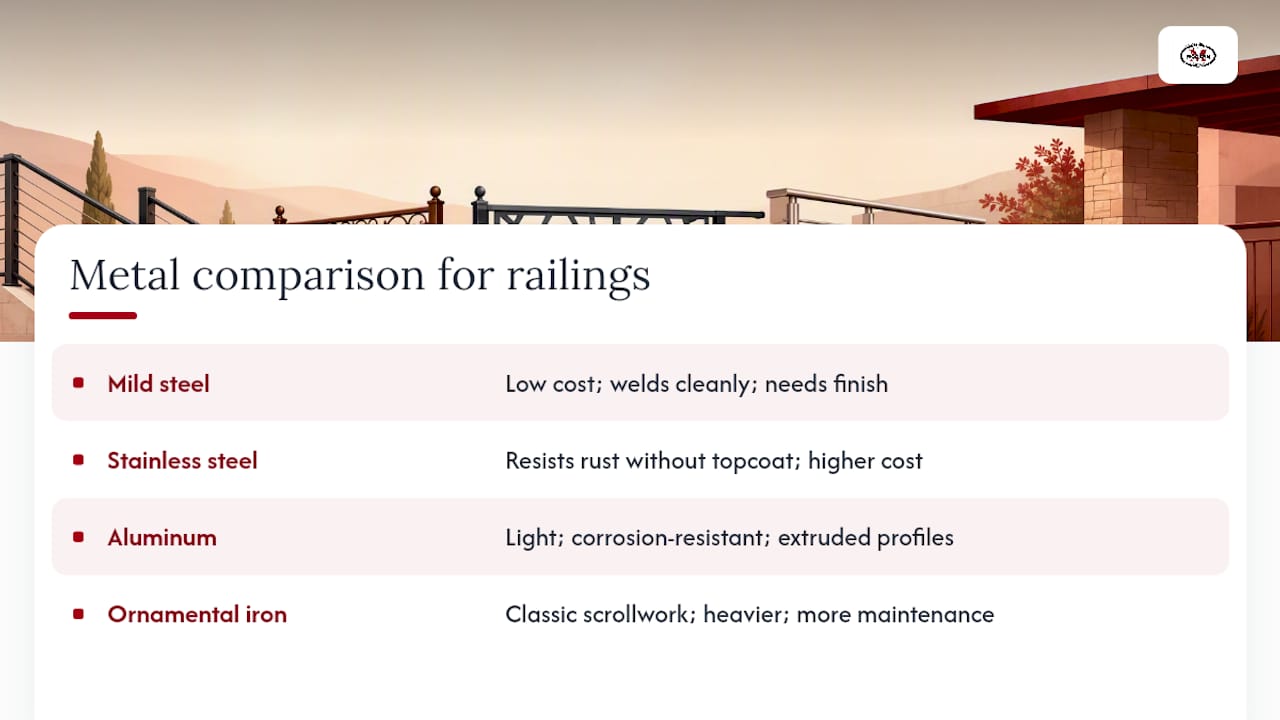
Mild steel is the workhorse of the industry. It welds cleanly, holds complex shapes, and costs less per linear foot than stainless. The catch is corrosion: mild steel needs a quality primer, powder coat, or galvanized finish to survive outdoor exposure. Properly finished, it lasts decades. For a deeper look at ornamental iron options specifically, the ornamental iron fence review from Modernfence covers the pros and cons in detail.
Stainless steel (typically 304 or 316 grade) resists rust without a topcoat, which is why design experts recommend it for modern, low-maintenance outdoor railings, especially near pools or in humid climates. It costs more upfront but reduces long-term maintenance. Grade 316 is the right call near saltwater or high-moisture environments.
Aluminum is lighter than steel, naturally corrosion-resistant, and available in extruded profiles that speed fabrication. It does not weld as cleanly as steel for intricate custom work, and it dents more easily under impact. For residential balconies and pool fences where weight and rust resistance matter more than raw strength, aluminum is a practical choice.
Ornamental iron (a term used interchangeably with wrought iron in the trade, though most modern fabrication uses mild steel with a traditional profile) delivers the classic scrollwork and baluster look. It is heavier, requires more finish maintenance than stainless, and suits traditional or historic architecture well.
Construction method matters as much as metal type. Welded connections are stronger and cleaner-looking than mechanical (bolted) connections. Post spacing, picket attachment method, and whether the rail runs continuously or in segmented panels all affect both structural performance and code compliance. Shop fabrication, where sections are built in a controlled environment and then installed on-site, produces tighter tolerances and better finish adhesion than field fabrication.
Pro Tip: When pairing materials, match the infill to the frame: stainless cable or glass panels pair naturally with stainless or powder-coated steel frames. Mixing metals without a finish barrier can cause galvanic corrosion at contact points, particularly outdoors.
Which railing style fits your property and use case?
Style choice comes down to three things: the architecture of the building, the function of the space, and how much maintenance you are willing to do.
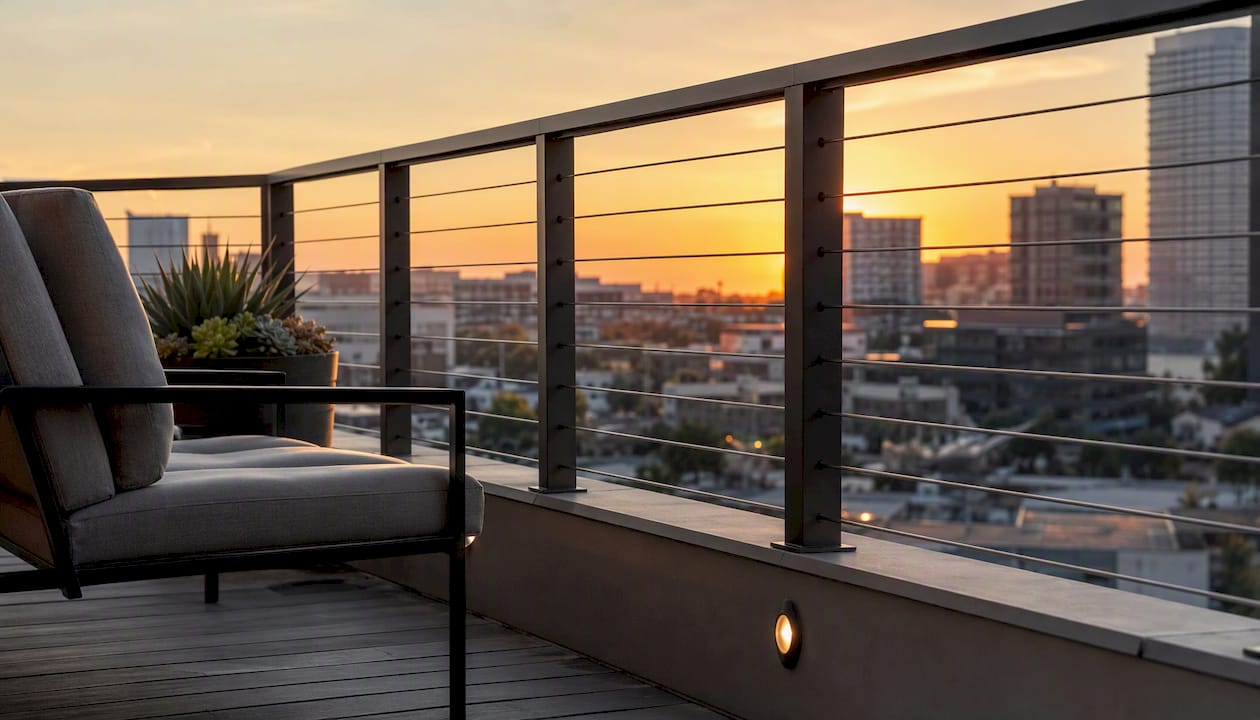
Modern horizontal railings use flat bars or cables running parallel to the ground. They suit contemporary homes, rooftop decks, and commercial corridors where open sightlines matter. Cable infill, in particular, is popular for decks with views because the cables nearly disappear at distance. The trade-off is that horizontal members can act as a ladder for small children, which some local codes restrict.
Vertical balusters are the most common residential choice. They work on interior stairs, exterior steps, balconies, and pool fences. Spacing must comply with the 4-inch sphere rule (no opening large enough for a 4-inch sphere to pass through), which governs both child safety and code approval. Traditional picket profiles give a classic look; flat bar or round bar profiles read more modern.
Ornamental panels with scrollwork, basket weave, or laser-cut patterns add visual weight and a decorative focal point. They cost more than plain balusters because of the additional fabrication time, but they are often the right choice for entryways, staircases in historic buildings, and commercial lobbies. For current design trends in the region, Modernfence’s fence design trends 2026 article is worth a look.
Glass infill (tempered or laminated panels in a steel or aluminum frame) is the cleanest option for pool enclosures and high-end interior stairs. It maximizes light and sightlines but requires regular cleaning and careful frame detailing to prevent water intrusion at the base.
Use this checklist when preparing your style preferences before a quote:
- Where is the railing: interior stair, exterior deck, balcony, commercial corridor, or pool fence?
- Do you need to preserve a view or sightline?
- Are children or pets present? (affects infill spacing and horizontal member restrictions)
- What is the architectural style: contemporary, traditional, industrial, or historic?
- What is your maintenance tolerance: low (stainless, aluminum, powder coat), medium (painted steel), or high (bare iron with annual touch-ups)?
- Do you have inspiration photos or a design reference?
Pro Tip: Dark powder-coat finishes (matte black, dark bronze) tend to recede visually and preserve sightlines better than bright or light finishes. If you want the railing to disappear into the background, color matters as much as infill style.
What does the process look like from quote to finished install?
A well-run custom railing project follows a predictable sequence. Knowing the stages helps you avoid surprises on timeline and cost.
- Initial inquiry: You contact the fabricator with photos, rough measurements, and a description of the project. The fabricator confirms scope and schedules a site visit.
- Site visit and measurement: A technician measures the actual site, checks substrate conditions (concrete, wood framing, masonry), notes grade changes, and photographs the space. This is the most important step for accuracy.
- Shop drawings and approval: The fabricator produces detailed drawings showing dimensions, post locations, infill pattern, and connection details. You review and approve before fabrication begins. Changes after approval add cost and time.
- Fabrication: Sections are built in the shop. Welding, grinding, and any bending or rolling happen here. Quality fabricators use certified welders and inspect welds before finishing.
- Finish application: Powder coating, galvanizing, or paint is applied in the shop before delivery. Shop-applied finishes adhere better and cover welds more uniformly than field-applied coatings.
- Site installation: The crew installs the pre-finished sections, sets posts in concrete or anchors to substrate, and makes any field adjustments for plumb and level.
- Punch list and warranty handoff: The fabricator walks the site with you, documents any touch-ups, and provides written warranty terms.
| Stage | Owner Input Required | Typical Duration |
|---|---|---|
| Initial inquiry | Photos, rough measurements, budget | 1–2 days |
| Site visit and measurement | Access to site, decisions on post locations | 1 day |
| Shop drawings and approval | Written sign-off on drawings | 3–7 days |
| Fabrication | Finish color confirmation | 2–6 weeks (complexity-dependent) |
| Finish application | None | 3–5 days |
| Site installation | Site access, substrate prep | 1–3 days |
| Punch list and warranty | Walk-through attendance | Same day |
Common causes of delay include late shop-drawing approvals, permit lead times, substrate conditions discovered during installation, and finish color changes after fabrication has started. Permitting adds time in most commercial projects and some residential ones; ask your fabricator whether a permit is required before the site visit.
What drives the cost of a custom railing project?
Price varies widely because every project is different. The primary cost drivers are metal type, design complexity, linear footage, mounting conditions, finish, and local labor and permit costs.
| Cost Driver | Lower-End Factor | Higher-End Factor |
|---|---|---|
| Metal type | Mild steel | Stainless steel (304/316) |
| Design complexity | Plain vertical balusters | Ornamental scrollwork, laser-cut panels |
| Linear footage | Short run, simple stair | Long commercial corridor, multiple levels |
| Mounting | Surface-mount to wood | Core-drill into concrete or masonry |
| Finish | Single-color powder coat | Hot-dip galvanize plus topcoat |
| Permitting | Residential, no permit required | Commercial, engineered drawings required |
Ballpark ranges in the U.S. market vary significantly by region, complexity, and material. Plain powder-coated mild steel balusters for a residential stair typically cost less per linear foot than ornamental panels or stainless cable systems. Commercial projects with engineered drawings, hot-dip galvanizing, and core-drilled post anchors sit at the high end of the range.
What to verify in any itemized quote: weld type (full-penetration vs. tack), fastener grade and material, finish prep method (sandblast vs. grind), primer coat, warranty scope, and whether installation is included or subcontracted.
Watch for low-ball quotes that omit finish prep, use mechanical connections instead of welds, or exclude permitting costs.
- Confirm the fabricator uses in-house welders, not subcontracted labor.
- Ask whether the finish is shop-applied or field-applied.
- Verify that the quote includes all hardware: post anchors, base plates, and fasteners.
- Get a line-item breakdown, not a single lump-sum number.
Do metal railings need to meet building codes?
Yes. Most residential and all commercial railing installations in the U.S. are governed by model codes published by the International Code Council (IBC for commercial, IRC for residential), which most jurisdictions adopt with local amendments.
The core checkpoints that affect design and cost:
- Guard height: 36 inches minimum for residential guards (42 inches for commercial guards above certain heights).
- 4-inch sphere rule: No opening in the infill large enough for a 4-inch sphere to pass through. This governs baluster spacing and cable tension.
- Handrail continuity: Handrails on stairs must be graspable along their full length. Stairways provides detailed guidance on grip geometry and continuity requirements that complement the base code.
- Load requirements: Guards must resist a 200-pound concentrated load applied at the top rail (IBC/IRC). Commercial applications may require higher loads and engineered calculations.
- ADA considerations: Commercial projects accessible to the public must meet ADA handrail requirements for height, projection, and graspability.
Code note: Local jurisdictions often add requirements on top of the model code. A fabricator who pulls permits regularly will know the local interpretations that affect your project.
Commercial projects and any residential project with nonstandard loads or spans typically require stamped engineering drawings. Verify compliance by requesting permit records, proof of engineering, and installation photos from the fabricator.
Pro Tip: Ask your fabricator whether your project requires a permit before the site visit. If it does, factor 2–6 weeks of permit lead time into your schedule. Skipping a required permit can result in forced removal of the installed railing.
The National Association of Home Builders (Nahb) also publishes practical guidance on residential guard requirements and common retrofit considerations that homeowners evaluating quotes will find useful.
Which finish lasts longest, and how do you maintain it?
Finish choice affects both appearance and how much work you do over the life of the railing. The U.S. Green Building Council notes that material longevity and finish durability directly reduce life-cycle cost, even when upfront cost is higher.
Powder coat is the most common finish for custom steel railings. It bonds electrostatically and cures in an oven, producing a hard, uniform surface that resists chipping better than liquid paint. Color selection is broad. Exterior powder coat on properly prepped steel typically lasts many years before needing touch-up in most U.S. climates.
Hot-dip galvanizing submerges the steel in molten zinc, coating every surface including welds and interior cavities. It is the most durable base protection for outdoor steel and is often used as a primer coat under powder coat for maximum corrosion resistance. It adds cost but extends service life significantly in harsh or coastal environments.
Paint and enamel are lower-cost options that suit interior applications or projects where color-matching to existing architecture matters. Exterior paint requires more frequent touch-up than powder coat.
Clear coat and patina finishes suit stainless steel and aluminum, where the goal is to preserve the natural metal appearance while protecting against oxidation and fingerprints.
Routine maintenance checklist for metal railings:
- Annually: Inspect all welds and joints for rust spots or cracking. Touch up bare metal immediately with a matching primer and topcoat.
- Twice yearly: Clean the finish with mild soap and water. Remove dirt, salt deposits, and organic buildup that hold moisture against the metal.
- After installation and annually: Check all fasteners, base plates, and post anchors for tightness and corrosion.
- As needed: Re-apply clear coat on stainless or aluminum if the finish dulls or shows water spotting.
For a full maintenance schedule adapted to Arkansas and Oklahoma climates, Modernfence’s guide to fence maintenance schedules is a practical reference.
| Finish | Best Use | Maintenance Frequency | Relative Upfront Cost |
|---|---|---|---|
| Powder coat | Exterior and interior steel | Annual touch-up | Moderate |
| Hot-dip galvanize + powder coat | Harsh outdoor, coastal | Every 5 years | Higher |
| Paint/enamel | Interior, color-match applications | Every 2–3 years | Lower |
| Clear coat | Stainless, aluminum | Every 3–5 years | Moderate |
How do you evaluate and choose a fabricator?
Price is the easiest thing to compare and the least reliable predictor of quality. Use this checklist to evaluate fabricators on criteria that actually matter.
Vendor checklist:
- Portfolio of similar work (residential stairs, commercial guards, ornamental panels) with photos
- In-house shop with employed welders, not subcontracted labor
- Licensed and insured (general liability and workers’ compensation)
- Written workmanship warranty with clear scope and duration
- References from recent projects of similar scale
- Shop drawings provided before fabrication begins
- Clear timeline commitment in writing
Questions to ask:
- Will you perform a site visit before finalizing the quote?
- What metal grade and wall thickness do you specify for this application?
- How do you prep the surface before finishing?
- Is installation performed by your crew or subcontracted?
- What is your change-order policy after shop drawings are approved?
- What does your warranty cover and for how long?
Red flags to watch for:
- Vague warranty language (“we stand behind our work”) with no written scope
- No proof of insurance or license on request
- No shop photos or portfolio of fabricated work
- Unwillingness to provide an itemized quote
- “Kit” or catalog solutions presented as custom work
- No shop drawing step in the process
The Better Business Bureau maintains complaint histories and accreditation records for local contractors. Checking a fabricator’s BBB profile takes five minutes and can surface patterns of post-installation disputes or unresolved complaints.
Pro Tip: Ask to see a photo of a completed weld before it was finished. A quality weld is smooth, consistent, and fully fused at the joint. Visible porosity, undercut edges, or heavy grinding marks covering poor fusion are signs of substandard work that no powder coat will fix.
Why Modernfence is a practical choice for custom railings
Modernfence has served homeowners and commercial property owners across Western Arkansas and Eastern Oklahoma for more than 70 years. The company fabricates railings in-house, installs with its own licensed and insured crew, and handles residential and commercial projects from a single stair railing to full commercial corridor guards.
Key trust signals:
- USA-made fabrication: All metalwork is fabricated in-house, not sourced from catalog kits or offshore suppliers.
- Licensed and insured: General liability and workers’ compensation coverage on every project.
- Full-service scope: Quote, site measurement, shop drawings, fabrication, finish, installation, and punch list handled by one team.
- Residential and commercial capability: Portfolio spans interior stairs, exterior guards, ornamental iron, and commercial-grade systems.
- Workmanship warranty: Written warranty provided at project handoff.
At quote time, Modernfence asks for project photos, rough measurements, preferred material and finish, and your timeline. The more detail you provide upfront, the more accurate the initial estimate.
Pro Tip: Bring at least two or three inspiration photos to your site visit. A fabricator can match a profile, replicate a baluster pattern, or adapt a design from a photo far more accurately than from a verbal description alone.
To review Modernfence’s fabrication capabilities and project examples, visit the metal fabrication service page.
A contractor’s perspective on what actually matters in the field
The decisions that cause the most friction on a custom railing project are rarely about style. They are about specification gaps that surface after fabrication has started.
The most common one: a client approves shop drawings without confirming the post anchor method, and the installer arrives to find the substrate is different from what was assumed. A concrete slab that was expected to be 4 inches thick is 2.5 inches, and the specified core-drill anchor will not work. That discovery adds a day and a change order. It is preventable if the site visit includes a substrate check and the shop drawings specify the anchor type explicitly.
Shop fabrication and pre-applied finishes matter for a reason that is easy to overlook: a powder coat applied in a controlled shop environment adheres to a properly prepped surface at a consistent thickness. A field touch-up on an installed railing, done with a brush or rattle can in direct sun, will never match that quality. When a fabricator cuts corners by finishing in the field, you see it within two years.
Continuous handrails on stairs are another area where owners sometimes push back on cost. The grip geometry and continuity requirements in the code exist because people actually use handrails when they lose footing. A handrail that terminates mid-stair or has a profile too large to grip is a liability, not just a code violation.
Get a quote from Modernfence for your railing project
Modernfence gives you in-house fabrication, a licensed and insured crew, and a workmanship warranty on every custom railing project across Western Arkansas and Eastern Oklahoma. There are no subcontracted welders and no catalog kits passed off as custom work.
To get an accurate estimate, have your site measurements, photos of the space, preferred material and finish, and a rough timeline ready. Call Modernfence directly or submit a quote request through the custom metal fabrication services page. For broader installation guidance, the fence installation guide covers what to expect from a full project start to finish.
Sources
These organizations publish the standards and guidance that govern metal railing design, safety, and installation in the United States.