

Barbed wire on a fence is appropriate for agricultural, rural, and most commercial or industrial properties in the United States. For residential properties, it is frequently restricted or outright banned by local zoning codes and HOA covenants. Before you buy a single roll, take three steps: check your city or county zoning ordinance and any HOA covenants for material restrictions, decide whether standard barbed wire or a higher-security option fits your use case and local rules, and call a licensed fencing contractor if your project involves public rights-of-way, permit requirements, or razor wire. Premises liability applies even when your installation is technically permitted, so getting the legal groundwork right protects you from both fines and civil exposure.
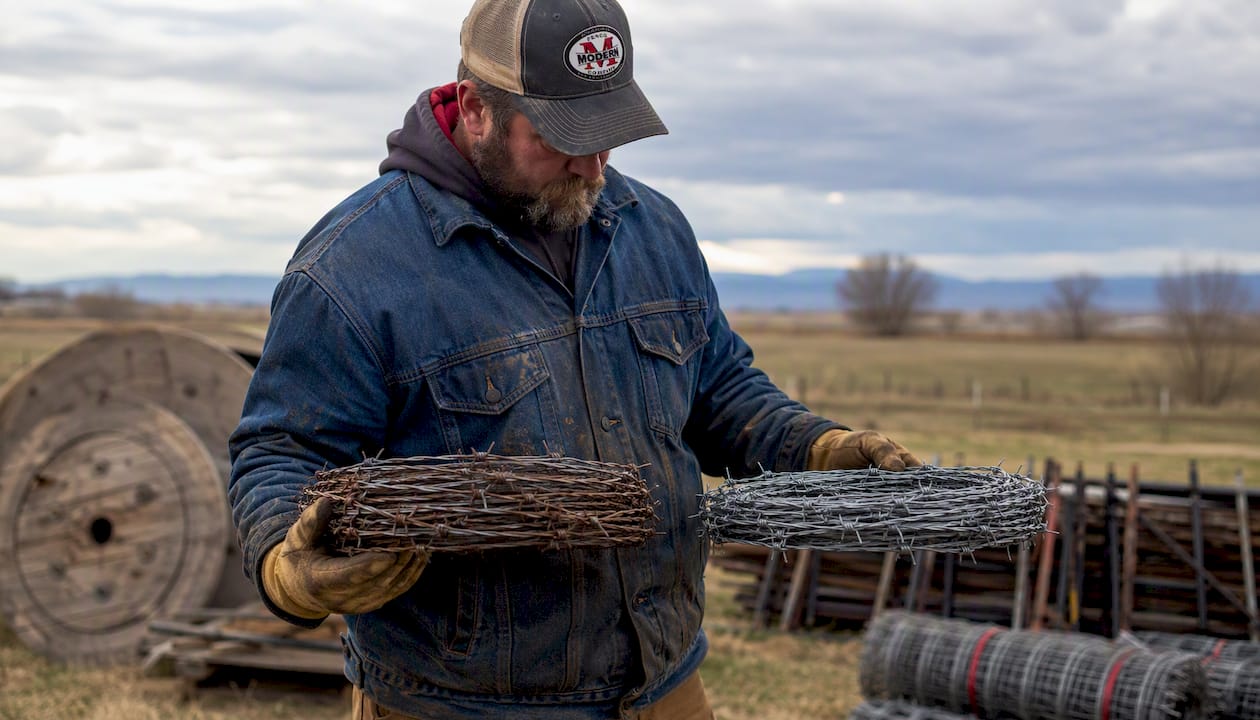
Table of Contents
- What types of barbed wire should you use on a fence?
- Where barbed wire works well and where it does not
- What legal and safety checks do you need before installation?
- How do you install barbed wire on a fence correctly?
- How do you maintain a barbed wire fence over time?
- When should you hire a licensed fencing contractor?
- Key Takeaways
- Why the legal check matters more than the wire choice
- Modernfence handles barbed wire and perimeter fence projects across Western Arkansas and Eastern Oklahoma
- Useful sources for installation specs, legal checks, and agricultural standards
What types of barbed wire should you use on a fence?
Not all barbed wire is the same, and the wrong choice for your terrain or use case will cost you in performance and compliance.
Common wire types
- 2-point barbed wire: Two-point barbs are spaced along a single or double twisted strand. This is the most common agricultural wire, lighter to handle, and adequate for cattle and general livestock containment.
- 4-point barbed wire: Four barbs per twist point in four directions, making it a stronger deterrent. Used for perimeter security and where livestock pressure is higher.
- High-tensile barbed wire: Made from thinner but higher-strength steel, high-tensile wire resists stretching and loosening better than standard soft wire. It handles expansion and contraction from heat and animal pressure by flexing within wider elastic limits, which makes it better suited for long runs. It is harder to handle and somewhat dangerous for inexperienced installers.
- Standard galvanized (zinc-coated) wire: Soft or mild-steel wire with a zinc coating for corrosion resistance. Easier to work with but less durable over long spans. Best for repairs, gates, and short runs.
- Razor wire and concertina wire: These use stamped steel tape with blade-like edges rather than twisted-strand barbs. Their injury potential is significantly higher, which is why razor wire draws stricter regulation in nearly every jurisdiction that distinguishes between the two. Do not confuse them with standard barbed wire under local codes.
Specification reference table
| Wire Type | Typical Gauge | Barb Spacing | Roll Length | Recommended Use |
|---|---|---|---|---|
| Standard galvanized 2-point | 12.5-gauge | 5 inches | 1,320-foot | General agriculture, cattle |
| Standard galvanized 4-point | 12.5-gauge | 3–5 inches | 1,320-foot | High-traffic livestock, perimeter deterrent |
| High-tensile barbed wire | 15.5-gauge | 5 inches | 1,320-foot | Long runs, sag resistance, commercial perimeter |
| Razor / concertina wire | Varies | Continuous blade | Varies | High-security commercial/industrial only |
Standard agricultural barbed wire is typically double-strand 12.5-gauge, zinc-coated steel in 1,320-foot rolls, with 5-inch barb spacing for general use and 3-inch spacing for higher-traffic or exclusion applications. Strand spacing on a finished fence runs commonly 10–12 inches.
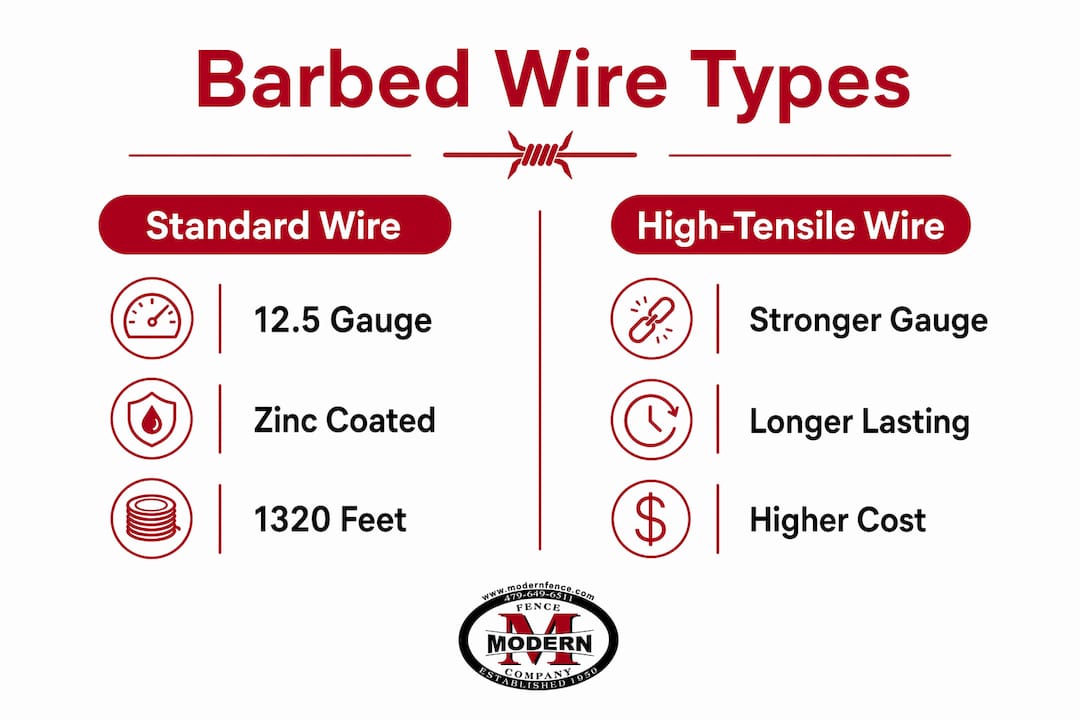
Pro Tip: High-tensile wire costs more upfront but outlasts standard soft wire on long runs because it holds tension through seasonal temperature swings. If you are fencing more than a few hundred feet, the durability trade-off usually favors high-tensile. Just know it requires a wire stretcher and proper H-brace corners — it will not forgive shortcuts the way soft wire does.
Where barbed wire works well and where it does not
Barbed wire is the agricultural standard for livestock containment across most of the United States. It is also a practical perimeter deterrent for commercial and industrial properties. The problems start when it is applied in the wrong context.
Agricultural and rural uses
For cattle, sheep, and similar livestock, a standard 4-strand or 5-strand barbed wire fence is the go-to solution on farms and ranches across Western Arkansas and Eastern Oklahoma. The wire goes on the inside (pasture side) of the posts so livestock pressure pushes against the post rather than the staples. Maintenance load is real: livestock lean on fences, vegetation grows into them, and corrosion works steadily in humid climates. Plan for quarterly visual checks and annual hands-on inspections.
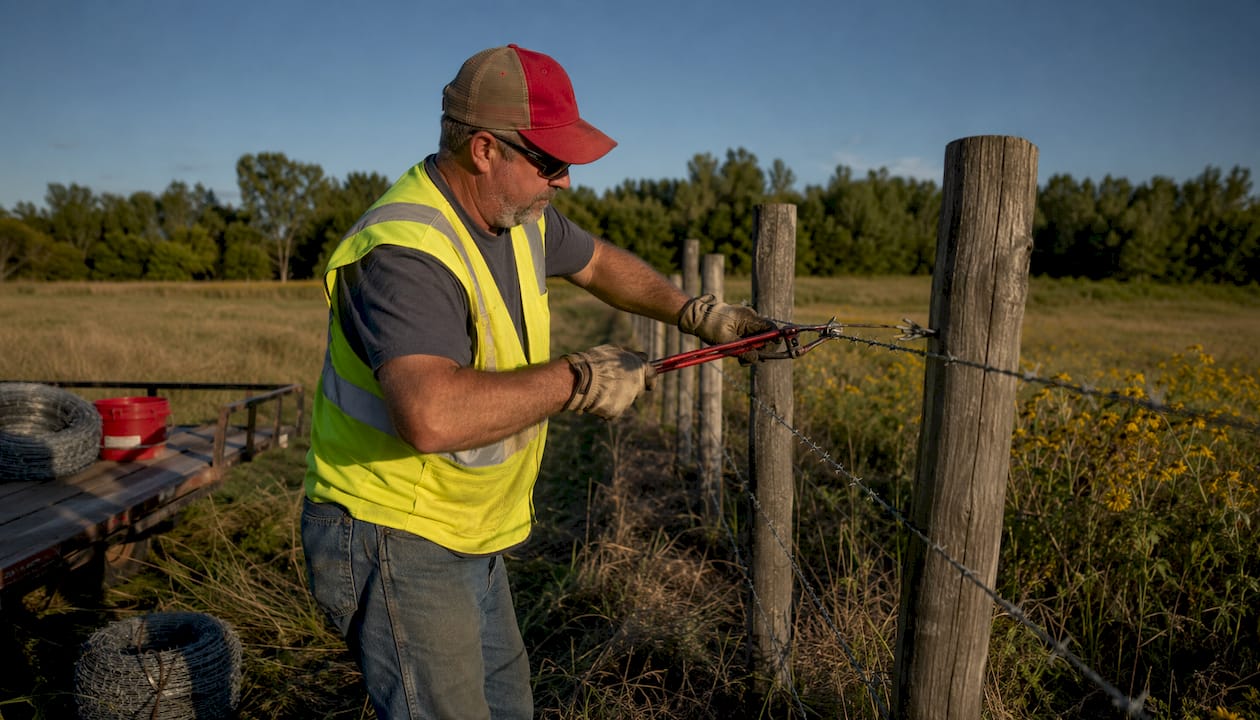
Wildlife interaction is worth thinking through before you install. Deer and other animals can become entangled in low-strung wire, particularly the bottom strand. Keeping the bottom strand at least 12–16 inches off the ground reduces entanglement risk without sacrificing containment for cattle.
Commercial and industrial perimeter uses
Back-of-yard storage facilities, utility substations, and construction sites commonly use barbed wire on top of chain-link fencing as a cost-effective deterrent. A few strands angled outward at 45 degrees on a bracket above a chain-link fence make climbing significantly harder. This application is widely permitted in commercial and industrial zones, though height minimums and setback rules still apply.
Barbed wire remains the agricultural standard for livestock containment; razor wire is for high-security commercial and industrial uses and draws stricter regulation because of its higher injury potential. Before specifying either product, confirm which category your local code places it in — the distinction between “barbed wire” and “razor wire” is not always obvious in the product catalog, but it matters enormously in the permit office.
Where barbed wire is a poor fit
Residential front yards are the clearest example of a poor fit. Most municipalities prohibit barbed wire in residential zones, and even where it is technically allowed, HOA covenants frequently ban it. The risk profile in a neighborhood, where children, pedestrians, and pets are present daily, is fundamentally different from a pasture or a warehouse yard. If you need perimeter security for a residential property, layered security fence options like tall privacy fencing, woven wire with visibility, or access control systems are more appropriate and far less likely to trigger code violations or civil liability.
High-pedestrian areas near sidewalks or public rights-of-way are another poor fit, regardless of zoning. Even where permitted, wire that faces a public walkway creates liability exposure that most property owners are not prepared to manage.
What legal and safety checks do you need before installation?
There is no single federal prohibition on barbed or razor wire on private property. Legality is controlled locally through municipal zoning ordinances, county codes, and HOA covenants, which means the rules change every time you cross a jurisdictional line. Running the right checks before installation is not optional.
The compliance checklist
Contact each of the following before purchasing materials or breaking ground:
- City or county building and zoning department: Confirm whether barbed wire is permitted in your zone, what height minimums apply, and whether a fence permit is required. Most cities publish their ordinances online; search for “barbed wire,” “razor wire,” or “security fencing” in the municipal code.
- HOA architectural committee: Pull your community’s CC&Rs and check for material restrictions. HOA restrictions exist independently of municipal zoning. A city permit does not override an HOA prohibition, and violating CC&Rs can result in fines, forced removal, and in some cases a lien on your property.
- Local fire marshal: Many jurisdictions require razor wire to be mounted above a minimum height, often around 8 feet, and prohibit configurations that block gates or emergency responder access. Some jurisdictions require Knox Boxes where gates are secured with locks.
- Insurance agent: Confirm that your property and liability policy covers the installation. Some carriers exclude coverage for injuries caused by hazardous fencing.
Premises liability
Compliance with zoning does not eliminate civil exposure. Premises liability doctrine holds property owners responsible for unsafe conditions that cause injury, including injuries to trespassers in some circumstances. A properly permitted barbed wire fence that injures a child or a passerby can still result in a civil suit. Visible warning signage, adequate mounting height, and inward-facing wire all reduce but do not eliminate that risk.
Statistic callout: Legal precedent under premises liability holds that property owners can face civil suits for hazardous fencing injuries even when the installation complied with local codes. Adequate signage and proper mounting height are your first lines of defense.
For residential permit guidance specific to your situation, the residential fence permit guide walks through the permit process step by step.
How do you install barbed wire on a fence correctly?
Good installation comes down to two things: braced corners and correct tensioning. Get those right and the rest of the fence follows. Get them wrong and no amount of wire or staples will save you.
Materials and PPE checklist
- Posts: H-brace assemblies for all corners and ends (heavy timber or steel pipe set in concrete); T-posts for line posts at 8–16 foot intervals depending on livestock pressure
- Wire: 12.5-gauge galvanized double-strand for general agriculture; 15.5-gauge high-tensile for long runs
- Fasteners: Wire staples for wood posts; wire clips for T-posts
- Tools: Come-along or wire stretcher, post driver or auger, level, fencing pliers, wire cutters
- Concrete: For corner and brace post footings
- PPE: Heavy leather gloves (not standard work gloves), safety glasses, long sleeves, and steel-toed boots
Step-by-step installation sequence
- Survey and mark the layout. Walk the fence line, mark corner and end post locations, and confirm you are within your property boundaries. Check for underground utilities before digging.
- Build corner and end H-braces first. Set corner posts at least 3.5 feet deep in concrete. The H-brace connects the corner post to a brace post with a horizontal rail; a diagonal wire from the top of the brace post to the base of the corner post prevents leaning. Allow concrete to cure fully before applying any wire tension.
- Drive T-posts for line posts. Space line posts at 8–16 foot intervals. T-posts handle vertical support only; they cannot anchor horizontal tension. Never use a T-post as a corner or end post.
- Attach wire to the first corner post. Use a timber hitch or staple to anchor the wire at the correct height on the corner post. Start with the bottom strand.
- Reel out the wire along the fence line. Replace rolls every 1,320 feet. Keep the wire off the ground as you go.
- Pre-tension before stapling. Attach the come-along or wire stretcher to the far corner post. Prestretch to approximately 600 lb, then relax to an operating tension of approximately 250 lb. On undulating terrain, adjust the procedure and avoid stapling until the correct operating tension is achieved across the full run.
- Staple or clip to line posts. Drive staples partially into wood posts so the wire can still move slightly. Attach clips to T-posts. Run wire on the studded side of T-posts.
- Work bottom strand to top. Install from the bottom strand upward to prevent upper wires from tangling with or interfering with the stretching and stapling of lower strands.
- Finish with gates, signage, and access checks. Install gate hardware, post warning signs where required, and confirm that emergency access points are clear and functional.
Pro Tip: Temperature matters when tensioning metal wire. Wire contracts in cold weather and expands in heat. If you tension wire tight on a cold morning, it may over-tension and snap when summer temperatures arrive. Tension in moderate conditions when possible, or account for seasonal movement in your target operating tension.
How do you maintain a barbed wire fence over time?
A barbed wire fence that goes uninspected will sag, corrode, and eventually fail. A consistent maintenance schedule is far cheaper than a full replacement.
What to inspect and when
Quarterly visual walk:
- Check for sagging strands between posts, which usually signals a corner brace problem or a broken staple
- Look for vegetation growing into or over the wire, which adds weight and accelerates corrosion
- Note any leaning T-posts from frost heave or livestock pressure
- Check gate hardware for rust and alignment
Annual hands-on inspection:
- Test wire tension by pressing mid-span; significant deflection means the fence needs attention
- Inspect all staples and clips for looseness or rust
- Check corner post embedment and brace assembly integrity
- Look for corrosion on wire, especially at staple contact points where zinc coating wears first
- Assess wildlife entanglement risk and clear any debris caught in lower strands
Common repairs
Sagging wire usually traces back to a corner brace problem, not the wire itself. Retensioning barbed wire after stapling is difficult because barbs catch on staples during the process. If sag is widespread, inspect the H-brace first. A leaning or settling corner post is the most common cause.
Broken strands can be spliced for temporary repairs using a wire splice or a short section of matching gauge wire twisted in. For permanent repairs on high-tensile wire, a proper crimp splice tool gives a cleaner, stronger result than hand-twisting.
Leaning T-posts from frost heave can often be reset with a post driver. Repeated leaning in the same spot suggests poor soil drainage; adding a concrete collar or switching to a heavier post solves it more permanently.
Corrosion management depends on your environment. In humid climates like Western Arkansas, galvanized wire typically lasts 15–20 years before significant corrosion compromises structural integrity. High-tensile wire with a heavier zinc coating extends that life. When corrosion is widespread rather than isolated, replacement is more cost-effective than strand-by-strand repair. For ongoing fence maintenance guidance specific to Arkansas conditions, a local contractor can assess whether repair or replacement makes more sense for your fence’s age and condition.
Wildlife entanglement is a real concern, particularly for deer. Keeping the bottom strand at least 12–16 inches off the ground and the top strand no higher than 40 inches reduces entanglement risk for most wildlife. Post visible warning signs at regular intervals along any perimeter fence accessible to the public.
When should you hire a licensed fencing contractor?
DIY barbed wire installation is feasible for straightforward agricultural runs on flat terrain with no permit complications. Several situations call for a professional.
When to call a pro
Hire a licensed contractor when your project involves any of the following:
- Permit or variance requirements: If your municipality requires a fence permit, a licensed contractor handles the application, inspections, and code compliance documentation.
- Proximity to public rights-of-way: Fences near sidewalks, roads, or utility easements require precise setback compliance and sometimes engineered drawings.
- Razor wire or high-security installations: Razor wire installation requires certified crews familiar with the stricter regulatory requirements and higher injury risk.
- Mixed materials: Combining barbed wire with wood, chain-link, or iron fencing requires coordination across materials and fastener systems.
- Steep, rocky, or wet terrain: Difficult ground conditions affect post embedment depth, brace design, and tensioning procedures in ways that trip up inexperienced installers.
- Large-scale commercial or industrial projects: Scale amplifies every error. A poorly braced corner on a 2,000-foot run is a much bigger problem than on a 200-foot run.
What a competent contractor provides
A qualified installer will conduct a site walkthrough before quoting, pull required permits, build engineered H-brace corners, use proper tensioning equipment, and provide proof of licensing and insurance. Ask for a written scope of work, references from similar projects, and confirmation of local licensing. Expect a written estimate, not a verbal ballpark.
On cost: material and labor costs vary significantly by region, terrain, wire type, and project scale. As a general estimate only, basic agricultural barbed wire installation in the US ranges from roughly $1–$3 per linear foot for materials alone, with professional installation adding labor on top. Get local quotes for accurate figures. Modernfence provides free on-site estimates for projects across Western Arkansas and Eastern Oklahoma.
Key Takeaways
Barbed wire on a fence is appropriate for agricultural and commercial properties in the US, but local zoning, HOA rules, and premises liability checks are required before installation, and correct tensioning with braced corners determines whether the fence lasts.
| Point | Details |
|---|---|
| Check legality first | No federal ban exists, but local zoning, county ordinances, and HOA covenants frequently restrict or prohibit barbed and razor wire. |
| Match wire to use case | 12.5-gauge galvanized for general agriculture; 15.5-gauge high-tensile for long runs; razor wire only for high-security commercial/industrial with proper permits. |
| Brace corners properly | T-posts cannot anchor horizontal tension; H-brace assemblies set in concrete are required at all corners and ends. |
| Tension correctly | Pre-tension to approximately 600 lb, relax to approximately 250 lb operating tension, and install bottom strand first. |
| Modernfence handles the hard parts | Modernfence provides licensed, insured barbed wire and perimeter fence installation across Western Arkansas and Eastern Oklahoma, including permit handling and engineered corner braces. |
Why the legal check matters more than the wire choice
Most property owners spend their research time comparing wire gauges and barb spacing. That is the wrong starting point. The single most consequential decision in any barbed wire fence project is whether the installation is permitted at all, and in what form.
Here is what gets overlooked: zoning compliance and civil liability are separate problems. A fence that passes the permit office can still expose you to a lawsuit if it injures someone. Premises liability doctrine does not care whether you had a permit. It asks whether the hazard was reasonably foreseeable and whether you took reasonable steps to warn people. Signage, mounting height, and wire orientation are not afterthoughts. They are your legal defense.
The other thing worth saying plainly: barbed wire and razor wire are not interchangeable under most local codes. Installers who buy razor wire thinking it is “just a stronger version” of barbed wire often find themselves out of compliance in a zone that permits one but not the other. The distinction matters in the permit office even when it seems minor at the hardware store.
For most agricultural and rural property owners in Western Arkansas and Eastern Oklahoma, a properly installed barbed wire fence is a practical, durable, and legally straightforward solution. For commercial and industrial properties, the path is navigable with the right contractor. For residential properties, the honest answer is that barbed wire is usually the wrong tool, and a residential fence built to code will serve you better on every dimension.
Modernfence handles barbed wire and perimeter fence projects across Western Arkansas and Eastern Oklahoma
Barbed wire installation done right requires more than a roll of wire and a post driver. It requires correct corner engineering, proper tensioning, permit coordination, and a clear understanding of local codes. Modernfence brings more than 70 years of licensed, insured fencing experience to every project, from straightforward agricultural runs to commercial perimeter systems with access control and signage.

Our crews handle site surveys, permit applications, engineered H-brace construction, professional wire tensioning, and fire and emergency access coordination when required. We work with property owners, contractors, and businesses across the region, and every project comes with a written estimate and clear scope of work before a single post goes in the ground. Warranties and maintenance options are available for qualifying installations.
Ready to get your fence done right? Request a free on-site estimate or visit our fence installation guide to see what a professional installation looks like from start to finish.
Useful sources for installation specs, legal checks, and agricultural standards
These sources are worth consulting directly for technical specifications, local code language, and agricultural fencing standards.
- BC Ministry of Agriculture — Wire Fence Construction (technical factsheet): The primary technical reference for pre-tension and operating tension values, installation sequence, and corner brace design. The tension figures cited in this article (600 lb pre-tension, 250 lb operating) come from this document.
- Cornell Law School Legal Information Institute — Premises Liability: Authoritative legal reference for understanding civil liability exposure from hazardous fencing, including installations that comply with local codes.
- California Office of the State Fire Marshal: Reference for fire and emergency-access rules affecting razor wire height minimums and gate access requirements. Check your own state fire marshal’s guidance for local rules.
- Your city or county building and zoning department: The definitive source for local fence permit requirements, material restrictions, and height minimums. Most publish their municipal code online; search for “barbed wire” or “security fencing.”
- Your HOA architectural committee: Pull your CC&Rs before purchasing materials. HOA restrictions apply independently of municipal permits.
- Bekaert fencing: Manufacturer-level specifications for wire gauges, barb spacing, roll lengths, and installation guidance for agricultural and perimeter fencing.
- USDA/NRCS fencing practice standards: The Natural Resources Conservation Service publishes agricultural fencing practice standards relevant to farm and ranch applications. Search “NRCS fence practice standard” for your state’s version.
This article provides general information for educational purposes. It is not legal or professional advice. Confirm current local codes, permit requirements, and liability rules with your city or county building department, a licensed attorney, or a qualified fencing contractor before beginning any installation.