

Fence security systems are defined as integrated perimeter protection solutions that combine physical fencing with detection technologies, verification tools, and active intervention to stop unauthorized access before losses occur. Property owners across Oklahoma face real threats from trespassing, theft, and vandalism. A fence alone slows intruders. A fence security system stops them. Only 1–5% of unverified alarms correspond to actual crimes, which means most passive systems waste police resources and leave properties exposed. The right system detects a breach, confirms it is real, and triggers a response fast enough to matter.
What are the main types of fence security systems?
Perimeter security, the industry term for what most property owners call a “fence security system,” covers every layer of protection at a property’s boundary. That includes the physical fence, the sensors mounted on or near it, and the response protocols triggered when a breach occurs. Choosing the right combination starts with understanding what each fence type actually does.
Chain link fencing is the most common entry point for commercial perimeter security in Oklahoma. It is affordable, visible, and easy to top with barbed wire or razor coil for added deterrence. Chain link works well for storage yards, construction sites, and low-to-medium risk commercial properties.
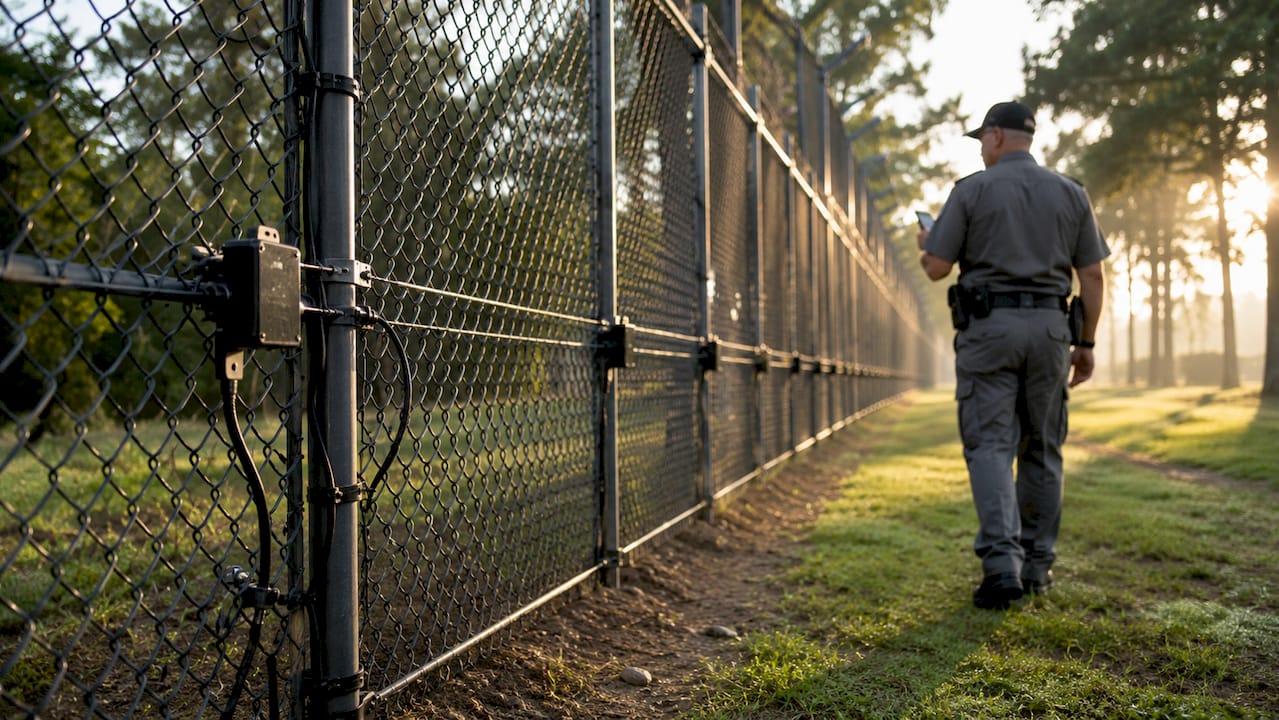
Ornamental iron fencing adds a visual deterrent without sacrificing sight lines. Security teams and law enforcement can see through it, which makes monitoring easier. It suits residential properties, schools, and municipal facilities where appearance matters alongside security.
V-mesh and anti-climb panels are engineered specifically to resist cutting and climbing. The tight mesh pattern prevents footholds and makes wire cutters less effective. These panels are common in utility facilities and data centers across Eastern Oklahoma.
High-security fencing escalates to a different threat level entirely. D10 (SR4) rated fencing and Department of State K-rated vehicle barriers like K4, K8, and K12 are designed to stop hostile vehicle attacks. K4 stops a 15,000-pound vehicle at 30 mph. K12 stops the same vehicle at 50 mph. These ratings matter for government facilities, critical infrastructure, and high-value commercial sites.
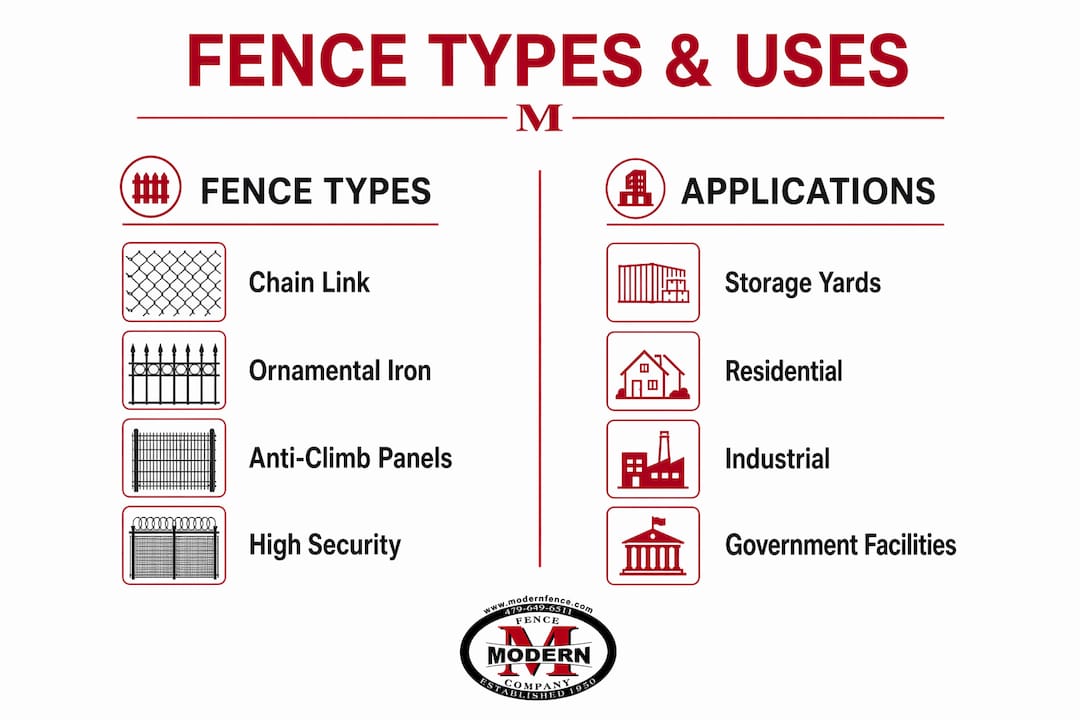
The table below maps fence types to their primary security applications.
| Fence type | Best application | Key security feature |
|---|---|---|
| Chain link | Storage yards, construction sites | Cost-effective, easy to top with deterrents |
| Ornamental iron | Residential, schools, municipal | Visibility for monitoring, strong deterrent |
| V-mesh / anti-climb | Utilities, data centers | Resists cutting and climbing |
| High-security (D10/SR4) | Government, critical infrastructure | Rated impact resistance |
| K-rated vehicle barriers | Embassies, military, high-value sites | Stops hostile vehicle attacks |
Site-specific threat assessment drives every good fence selection decision. A warehouse in Tulsa has a different risk profile than a school in Fort Smith. Matching the fence type to the actual threat prevents both under-protection and unnecessary cost.
What technologies and sensors are used in fence security?
Physical fencing stops casual trespassers. Detection technology catches determined ones. Modern property perimeter security systems layer multiple sensor types to cover the gaps that any single technology leaves open.
The most common sensor types include:
- Vibration sensors mounted directly on fence posts or rails. They detect the physical disturbance of cutting, climbing, or ramming. Traditional vibration sensors trigger on wind, animals, and passing trucks, generating high false alarm rates.
- Fiber optic sensors woven into the fence fabric. They detect changes in light transmission caused by physical contact. They are harder to defeat than surface-mounted sensors and perform well in harsh weather.
- Passive infrared (PIR) motion detectors positioned along the fence line. They detect body heat crossing a defined zone. PIR sensors work well in open areas but struggle in dense vegetation or extreme temperature swings, both common in Oklahoma summers.
- AI-enabled cameras with video analytics. These cameras analyze movement patterns in real time, distinguishing a person climbing a fence from a deer walking past it.
The real advance in modern perimeter security is AI sensor fusion, which combines fiber optic vibration data with camera analytics simultaneously. When both sensors agree that an intrusion is occurring, the system flags it as a confirmed event. When only one triggers, the system holds the alert for review. This approach eliminates most environmental false positives caused by wind or animal movement.
Pro Tip: Ask any sensor vendor for their false alarm rate per month per sensor zone. A system generating more than two false alarms per zone per month will exhaust your monitoring team and train them to ignore alerts.
Integrating physical fencing with AI-powered remote monitoring creates a system that performs consistently across weather conditions. Oklahoma’s weather ranges from ice storms in January to 110-degree heat in august. Your detection technology needs to handle both without degrading.
How do verification and intervention make fence security effective?
Detection is only the first step. The critical question is what happens after the sensor fires. Most commercial burglaries occur within 8–10 minutes, which means a system that only records events provides forensic evidence, not prevention.
The industry standard for effective perimeter security is the Detect-Verify-Intervene workflow. Each stage has a specific function:
- Detect. A sensor or camera identifies a potential breach and generates an alert. This happens automatically.
- Verify. A trained operator or AI system reviews the alert to confirm it is a real intrusion, not a false alarm. Verification is what separates actionable intelligence from noise.
- Intervene. A response is triggered. This can be automated, human-driven, or both.
Intervention options range from low-cost to high-assurance:
- Automated voice warnings broadcast a recorded message when a sensor fires. They deter casual trespassers at low cost.
- Live remote voice-down connects a monitoring operator to an on-site speaker in real time. A human voice telling an intruder they are being watched stops most incidents immediately.
- On-site guard dispatch sends a physical responder to the location. This is slower but appropriate for high-value or high-risk sites.
- Police dispatch prioritization is the highest-assurance option. Jurisdictions that receive verified alarm signals, rather than unverified ones, respond faster and with greater resources.
Facility managers who prioritize recording over intervention consistently experience higher losses. Active, real-time intervention like remote voice-down or live guard dispatch is the most effective tool for loss prevention. Detection without response is just documentation.
The Detect-Verify-Intervene model works because it closes the gap between an alarm and a consequence. Systems that include active real-time intervention reduce losses significantly more than alarm-only or camera-only setups. For Oklahoma property owners managing large lots, agricultural land, or commercial facilities, this distinction is the difference between a security system and a security theater.
How to choose and implement a fence security system for your property
Choosing a property perimeter security solution starts with an honest assessment of your threat profile. A rural Oklahoma property storing heavy equipment faces different risks than an urban retail center in Oklahoma City. Getting this assessment right before you spend money on fencing or sensors saves significant cost and prevents mismatched solutions.
Work through these questions before contacting any security fencing companies:
- What is the primary threat? Theft, vandalism, trespassing, or vehicle intrusion each require different responses.
- What are your site constraints? Soil type, terrain, and existing structures affect fence post depth, foundation requirements, and sensor placement. Site-specific variables like fence post depth and soil type directly impact system performance. Off-the-shelf solutions ignore these factors.
- What are your operational needs? A 24-hour facility needs different monitoring than a property that is only occupied during business hours.
- What are your regulatory requirements? Some Oklahoma commercial properties and all government-adjacent facilities face specific compliance standards for perimeter protection.
Once you have answered these questions, match your fence type and sensor technology to the threat level. Custom specifications for fence materials and technology levels consistently outperform catalog solutions. A fence installed without accounting for local soil conditions or gate engineering will fail faster and cost more to maintain.
Pro Tip: Plan your access control integration before the fence goes in, not after. Retrofitting gate operators, card readers, or intercoms into an existing fence line costs two to three times more than installing them during the original build. Modernfence handles access control integration as part of the initial installation process.
Maintenance is the factor most property owners underestimate. Sensors drift. Camera lenses get dirty. Fence posts shift after freeze-thaw cycles. Schedule quarterly inspections of both the physical fence and the detection equipment. A sensor that has been offline for three weeks provides zero protection.
Key Takeaways
Effective fence security systems require physical fencing, verified detection, and active intervention working together to stop intrusions before losses occur.
| Point | Details |
|---|---|
| Verification reduces false alarms | Only 1–5% of unverified alarms are real crimes; verified systems get faster police response. |
| Match fence type to threat level | Chain link suits low-risk sites; K-rated barriers are required for vehicle attack threats. |
| AI sensor fusion improves accuracy | Combining fiber optic and camera data eliminates most environmental false positives. |
| Intervene, don’t just record | Active response like remote voice-down stops losses; camera-only systems only document them. |
| Custom installation outperforms catalog | Site-specific design accounting for soil, terrain, and gate engineering delivers better long-term results. |
What I’ve learned after years of watching fence security go wrong
The most common mistake I see property owners make is buying detection without buying response. They install cameras, add a vibration sensor to the fence, and call it a security system. Then they wonder why they are still filing police reports every few months.
The uncomfortable truth is that most perimeter security failures are not technology failures. They are workflow failures. The sensor worked. The camera recorded. Nobody acted in time. The Detect-Verify-Intervene model exists precisely because detection alone is not enough. Property owners who understand this spend their budget differently. They invest in monitoring contracts and verified response protocols, not just hardware.
The second mistake is treating fence selection as a commodity decision. I have seen properties in Eastern Oklahoma where the fence was installed without any consideration of the clay-heavy soil that shifts dramatically between wet and dry seasons. Posts heave. Rails gap. The fence that looked solid in year one becomes a liability by year three. Working with contractors who understand local conditions, not just fence catalogs, is the difference between a fence that lasts and one that needs replacing.
The trend I find genuinely worth watching is the move toward integrated perimeter ecosystems. AI sensor fusion is not a marketing term. It is a real operational improvement that reduces the alert fatigue that kills monitoring effectiveness. When your team stops ignoring alerts because the false alarm rate is manageable, your entire security posture improves. That is where the industry is heading, and Oklahoma property owners who adopt it early will see the clearest return on their investment.
— mark
Modernfence can help you build the right perimeter solution
Protecting your Oklahoma property starts with the right fence, installed correctly, with the right technology built in from day one. Modernfence has served property owners across Western Arkansas and Eastern Oklahoma for more than 70 years, handling everything from standard chain link to custom iron and specialty security fencing.

Whether you need a commercial security fence for a business facility or a residential perimeter solution for your home, Modernfence matches the fence type, materials, and access control setup to your specific site and budget. The team is licensed, insured, and experienced with the soil conditions and site variables common across Eastern Oklahoma. Read the fence installation guide to understand what a professional installation covers, or call Modernfence directly for a free estimate tailored to your property.
FAQ
What is perimeter security?
Perimeter security is the combination of physical barriers, detection sensors, and response protocols designed to prevent unauthorized access at a property’s boundary. It includes fencing, cameras, motion sensors, and intervention systems working together.
What are the best fence types for residential perimeter security?
Ornamental iron and chain link are the most common choices for residential perimeter security systems. Iron provides visibility and a strong deterrent, while chain link offers cost-effective coverage for larger lots.
How do property perimeter sensors reduce false alarms?
AI-based sensor fusion combines fiber optic vibration data with camera analytics to confirm whether an alert is a real intrusion or an environmental trigger like wind or animals. This approach eliminates most false positives that plague single-sensor systems.
Why does verification matter in a fence security system?
Unverified alarms have a real-crime rate of only 1–5%, causing many jurisdictions to deprioritize their response. Verified alarms receive faster police dispatch and result in fewer losses.
How do I find reliable security fencing companies in Oklahoma?
Look for contractors with documented experience in site-specific installation, local soil and terrain knowledge, and the ability to integrate sensors and access control during the original fence build. Modernfence serves Eastern Oklahoma with all three capabilities.