Powder coating delivers a thicker, more durable, and more sustainable finish than most liquid paints, and for many metal commercial applications it lowers lifetime cost despite a higher upfront process investment. It resists chipping, abrasion, and corrosion better than sprayed paint, wastes far less material, and cuts VOC emissions close to zero. The trade-off is real: heat curing and equipment costs limit which parts and substrates qualify.
TL;DR:
- Powder coating’s high material utilization above 95 percent reduces powder costs and hazardous waste compared to liquid paints, especially in high-volume applications.
- The upfront investment in equipment and size limitations mean powder coating is most cost-effective for consistent, large-volume projects rather than small or one-off jobs.
- Its near-zero VOC emissions and ability to recycle overspray improve air quality and simplify environmental compliance for manufacturers.
- Thickness and edge coverage ensure that powder coatings last decades outdoors, provided surface preparation and chemistry are appropriate for the exposure environment.
- Effective for durable finishes on outdoor ironwork and high-traffic metals, but less suited for heat-sensitive substrates or complex geometries requiring field touch-up.
Table of Contents
- What Are the Main Powder Coating Benefits?
- The Real Economics: Cost and Total Ownership
- Environmental and Workplace Advantages
- How Durable Is Powder Coating in Real Conditions?
- Which Finishes and Substrates Work Best?
- Where Powder Coating Falls Short
- How to Specify Powder Coating and Vet a Coater
- Powder Coating on Iron Fences and Custom Metalwork
- When Powder Coating Actually Makes Sense
- Get a Powder-Coated Metal Estimate From Modernfence
- Sources
- FAQ
What Are the Main Powder Coating Benefits?
Ask any fabricator why they switched from liquid paint to powder, and the answer usually comes down to six things. Here’s how they rank by practical impact:
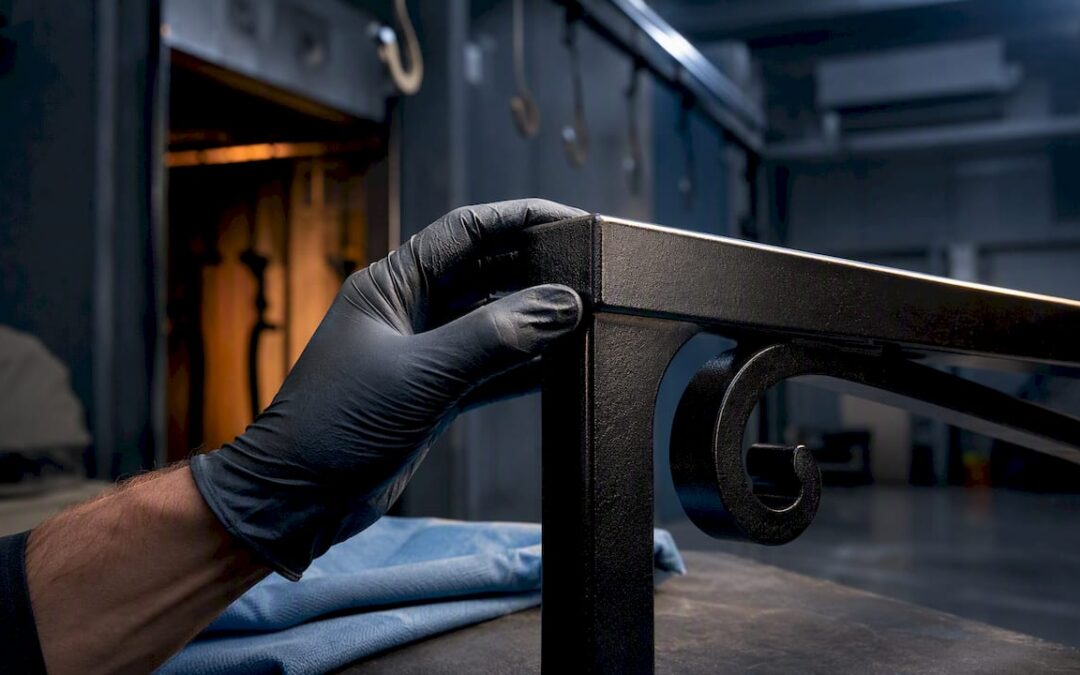
- Durability under abuse. Powder-coated surfaces resist chipping, scratching, and abrasion far better than sprayed enamel, which matters on gates, railings, and equipment that gets bumped and scraped daily.
- Corrosion protection and edge coverage. Powder wraps corners and edges more evenly than liquid paint, which tends to thin out exactly where rust starts, on sharp edges and welds, giving superior corrosion protection with better edge coverage.
- Material efficiency. Overspray isn’t lost. Reclaim systems capture unused powder and feed it back into the line.
- Near-zero VOCs. No solvents means no evaporating chemicals drifting into the shop or the atmosphere.
- Design range. Gloss levels, textures, metallics, and custom colors all sit within reach of the same process.
- Faster, more consistent cure cycles. Parts move through the oven on a predictable schedule, and thickness stays uniform part to part.
Quick Stat: Well-run powder lines regularly achieve material utilization above 95% once reclaim systems are in place, a number liquid spray booths rarely approach.
The Real Economics: Cost and Total Ownership
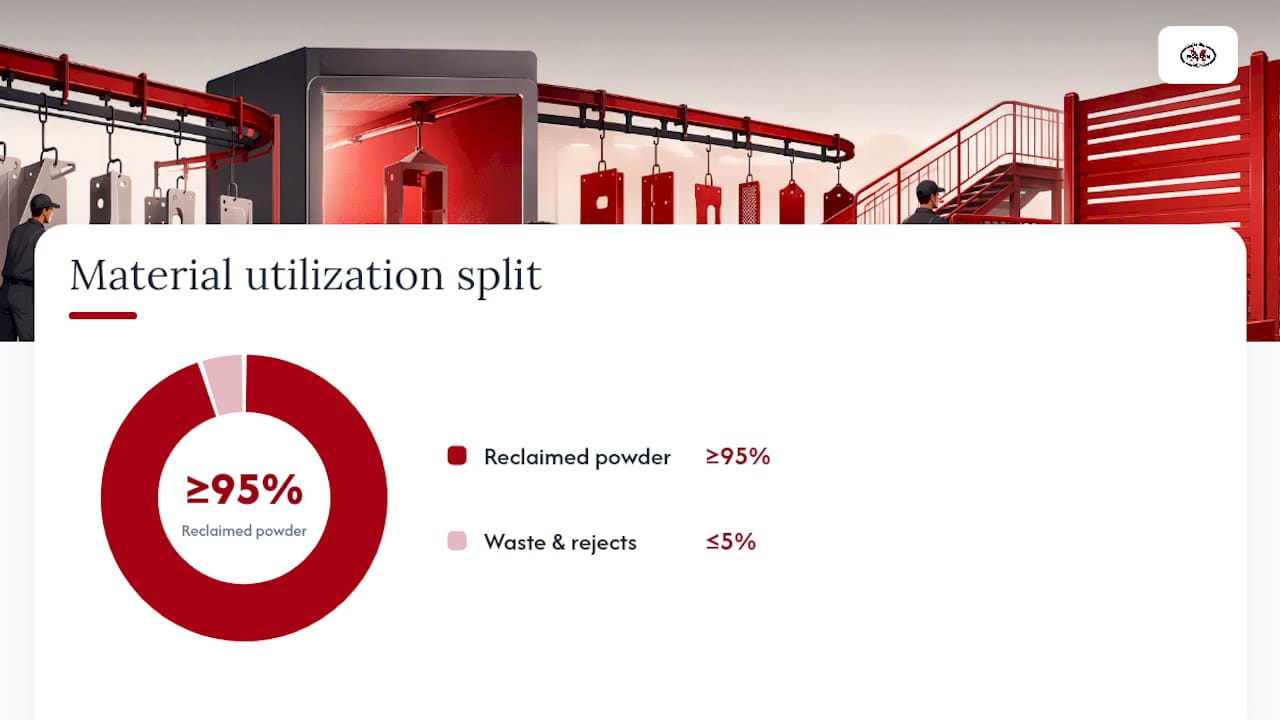
The reclaim rate is where the savings start, but it’s not where they end. When overspray gets captured and reused, material utilization commonly exceeds 95%, which means less powder purchased per finished part and far less hazardous sludge to haul away. By contrast, liquid paint systems generate solvent-laden waste that carries its own disposal and compliance costs.
The catch is upfront investment. A powder booth, oven, and pretreatment line cost more to install than a spray booth, so the economics favor shops running consistent volume rather than one-off jobs.
- Material reclaim reduces per-part powder consumption over time.
- Lower VOC output trims air-permit and compliance overhead.
- Fewer rejects and less rework come from consistent film thickness.
- Break-even typically favors higher-volume or repeat production runs.
Pro Tip: *Ask any coater for their actual reclaim percentage, not just a sales brochure number.
Environmental and Workplace Advantages
Powder coating’s biggest edge over solvent-based paint may be what it doesn’t emit. Powder formulations are typically solvent-free and release close to zero VOCs, which changes the air quality picture inside a finishing shop and simplifies permitting under most state and federal air rules.
- No solvent flash-off means fewer ventilation and respiratory concerns for workers on the line.
- Captured overspray becomes reused material instead of hazardous solid waste.
- Reduced VOC output helps facilities meet air-quality reporting requirements with less paperwork.
- These numbers translate directly into sustainability disclosures, since near-zero VOCs and reclaimable overspray make powder an efficient ESG lever for manufacturers tracking environmental performance.
Quick Stat: Facilities that pair powder lines with heat recovery and air recirculation systems can also cut energy waste in the curing process, stacking operational savings on top of the material gains.
How Durable Is Powder Coating in Real Conditions?
Powder coating durability starts with film thickness. A single powder pass commonly lays down 2 to 5 mils (50 to 125 microns) of dry film, thicker and more uniform than what most multi-coat liquid paint jobs achieve. That thickness matters because a single dense layer resists impact and abrasion better than several thin, brushed-on coats that can separate or peel at the seams.
Edge coverage is the other half of the story. Powder’s electrostatic application pulls material evenly around corners and welds, the spots where liquid paint typically runs thin and rust gets a foothold.
| Exposure environment | Typical performance | Key factor |
|---|---|---|
| Outdoor residential (fences, railings) | Strong, long service life | UV-stable powder chemistry |
| Coastal or marine | Good with the right pretreatment | Zinc-rich primer, proper DFT |
| Heavy industrial | Very good | Chemical-resistant powder blend |
| High-traffic commercial | Excellent | Abrasion-rated formulation |
Realistic service life ranges widely, often multiple decades on properly prepped exterior ironwork, but that range collapses fast without correct surface prep and the right powder chemistry for the exposure.
Which Finishes and Substrates Work Best?
Color and texture options in powder are broader than most people expect, going well beyond flat and gloss into textured, metallic, and specialty effects that hold up outdoors far longer than comparable liquid finishes.
- Standard gloss levels range from matte to high shine, with textured and hammered finishes available for a rougher, more industrial look.
- Metallic and specialty-effect powders give architectural metalwork a finish liquid paint struggles to match consistently.
- Newer formulations extend to some plastics and wood composites, though results vary by substrate and manufacturer.
- Heat-sensitive materials remain the sticking point: anything that can’t tolerate oven curing temperatures is a poor fit for the process.
Where Powder Coating Falls Short
No finishing process is universal, and powder coating carries real limitations worth planning around.
- High capex for in-house lines. Booths, ovens, and pretreatment tanks require serious upfront investment, which is why most fabricators outsource rather than build their own line.
- Oven size and temperature limits. Large or heat-sensitive parts simply don’t fit the process.
- UV fade on standard chemistries. Some polyester powders chalk or fade under prolonged sun exposure unless a UV-stable formulation is specified upfront.
- Field touch-up is harder. Scratches and dings are tougher to blend seamlessly compared with a liquid paint brush-up.
- Masking tolerances matter. Precision assemblies with tight fits need careful masking, since even a few extra mils of film thickness can throw off clearances.
How to Specify Powder Coating and Vet a Coater
Getting the durability and environmental benefits on paper starts with the spec sheet, not the quote. Ask for the powder chemistry (polyester, TGIC, or fluoropolymer for exterior work), target dry film thickness, cure schedule, and pretreatment method in writing.
- Request the AAMA 2603, 2604, or 2605 performance level that matches your exposure, since fluoropolymer-rated 2605 finishes hold color longer than base-level 2603.
- Ask for salt spray, adhesion, and color-retention test results, not just warranty claims.
- Confirm reclaim practices, oven capacity, and pretreatment tank condition during a shop visit if possible.
- Watch for quotes that skip pretreatment detail entirely. That’s usually where corrosion failures start.
Pro Tip: A quote that’s dramatically cheaper than competitors is often skipping pretreatment steps like phosphating or iron oxide conversion coating. Ask specifically what happens to the metal before it ever sees powder.
Powder Coating on Iron Fences and Custom Metalwork
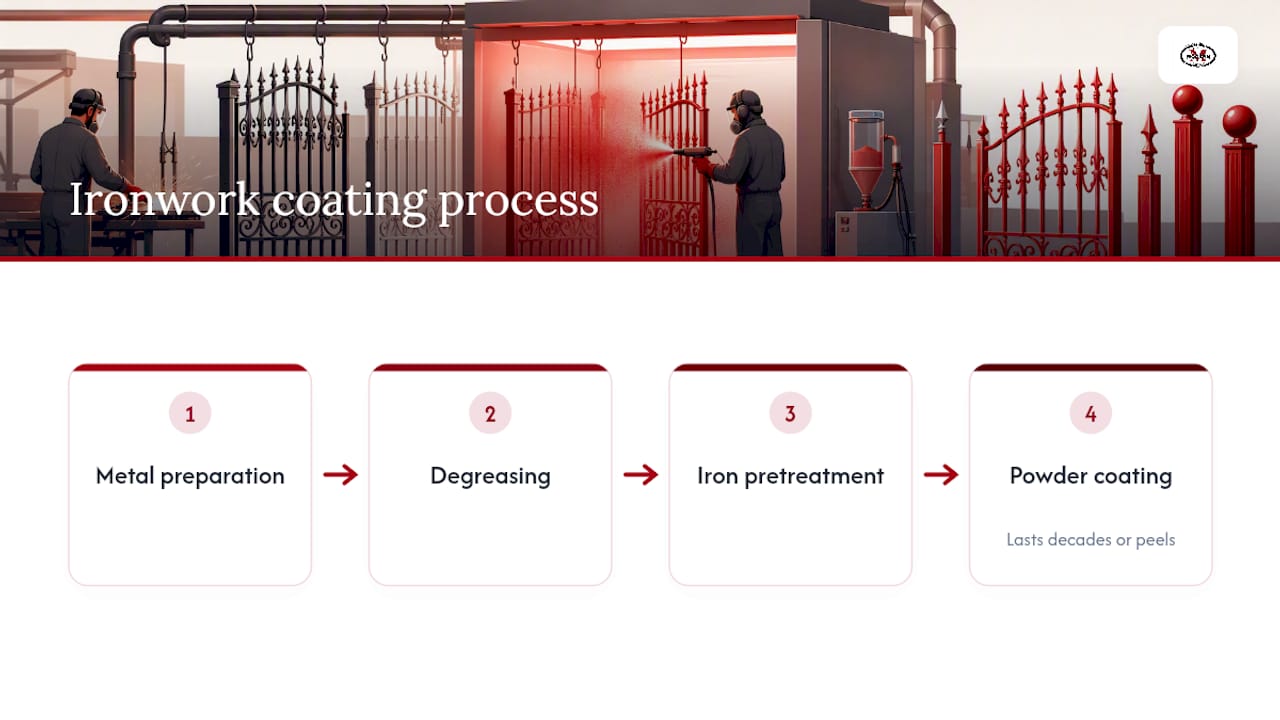
Ornamental iron fences, gates, and railings live outdoors year-round, which is exactly why fabricators specify powder coating over liquid paint on this kind of work. Proper metal prep, degreasing, and iron-specific pretreatment before coating determine whether the finish lasts decades or peels within a few seasons. Modernfence applies these standards on custom metal fabrication and iron fence installation projects, and homeowners can extend that finish’s life with periodic rinsing and prompt attention to any surface damage.
When Powder Coating Actually Makes Sense
Powder coating earns its cost on exterior ironwork and high-traffic commercial metal, where durability and edge protection matter most. Liquid paint still fits small touch-up jobs or oddly shaped parts an oven can’t hold. Judged on lifecycle cost, the finish usually wins.
— mark
Get a Powder-Coated Metal Estimate From Modernfence
This fabricator offers a practical alternative to guessing your way through a finish decision. Instead of researching coaters, chemistries, and pretreatment standards on your own, you get straight answers from experienced professionals familiar with ornamental iron and custom metalwork.
Whether you need a new iron fence with a powder-coated finish built to handle decades of outdoor exposure, custom railings through our metal fabrication services, or an access control system to pair with a new perimeter, our team can walk you through the specs before you commit to anything. If your current fence needs upkeep instead of replacement, our fence cleaning service handles routine maintenance on painted and coated metal alike. Contact Modernfence for a free estimate and we’ll help you figure out exactly what finish and fabrication approach fits your property and budget.
Sources
For deeper technical detail, the Powder Coating Institute maintains buyer’s guides and a member directory of certified coaters. Readers weighing overall perimeter security alongside finish durability may also find this security fencing overview useful.
- Powder vs. Liquid — Powder Coating Institute
- Advantages of powder coatings — PPG
- Powder Coating vs. Liquid Paint: OEM Guide for Large-Scale Mfg — Sintel
FAQ
What Are the Disadvantages of Powder Coating?
The main drawbacks are high upfront equipment costs for in-house lines, oven size and heat limits that rule out some parts, potential UV fade on standard powder chemistries, and harder field touch-up compared with liquid paint.
How Long Does Powder Coating Usually Last?
Service life varies by exposure and prep quality, but properly prepped exterior ironwork with the right powder chemistry commonly holds up for two to three decades before it needs refinishing.
What Is the Average Cost to Powder Coat?
Cost depends on part size, powder chemistry, and production volume, so it’s best to get project-specific quotes; Modernfence provides estimates for iron fence and custom metal fabrication work upon request through its iron fence and metal fabrication service pages.
What Are the Health Risks Associated With Powder Coating?
Powder coating is solvent-free and produces near-zero VOC emissions, which reduces the inhalation risks tied to solvent-based liquid paint, though proper ventilation and dust control during application still matter for worker safety.