

A parking lot gate is a vehicle access barrier installed at a property’s entry or exit point to control who drives in, when, and under what conditions. The term covers several distinct hardware categories: barrier arms, swing gates, sliding and cantilever gates, vertical pivot gates, bollards, and roll-up gates. For most high-turnover commercial surface lots, a barrier arm (also called a boom barrier) is the practical default. For controlled perimeters around gated communities, industrial yards, or office campuses, a sliding or swing gate is usually the better fit. Modern systems pair the physical gate with access-control technology such as RFID, ALPR/ANPR (Automatic License Plate Recognition), or mobile credentials to automate entry and reduce staffing needs. Modernfence installs and integrates these systems across Western Arkansas and Eastern Oklahoma.
- Barrier arm: Best for high-volume lots needing fast throughput
- Swing gate: Suited to lower-traffic residential or commercial perimeters with adequate swing clearance
- Sliding/cantilever gate: Right for tight spaces or debris-prone surfaces where a swing gate cannot operate
- Vertical pivot/lift gate: Used where overhead or lateral space is severely limited
- Bollard systems: Ideal for pedestrian-priority zones or anti-ram security requirements
Pro Tip: Before requesting quotes, count your peak-hour vehicle entries. Sites with higher vehicle traffic during peak times typically benefit from automated gates with loop detectors rather than manual arms.
Key Takeaways
The right parking lot gate matches your traffic volume, site constraints, and access-control requirements — and a licensed local installer should assess all three before any hardware is specified.
| Point | Details |
|---|---|
| Match gate type to traffic | Barrier arms suit high-turnover lots; sliding or swing gates fit controlled perimeters with lower volume. |
| Budget for the full system | Installed costs range widely depending on system complexity, from basic automated arms to multi-lane ANPR systems. |
| Access control is the differentiator | ALPR, RFID, and cloud dashboards reduce staffing needs and provide searchable audit logs for every gate event. |
| Verify installer credentials | Confirm state license, insurance, local references, and a written warranty covering parts and labor before signing. |
| Modernfence for local projects | Modernfence provides gate installation, access-control integration, and maintenance plans across Western Arkansas and Eastern Oklahoma. |
Table of Contents
- What types of parking lot gates are available?
- What components does a gate system require?
- How much does a parking lot gate system cost?
- How do you choose the right gate for your property?
- How does modern access control work with parking gates?
- What should you expect from installation and ongoing maintenance?
- A practical perspective on parking gate decisions
- Ready to get a site survey and written estimate?
- Sources
What types of parking lot gates are available?
Gate type determines almost everything downstream: cost, footprint, maintenance schedule, and which access-control hardware will work. Here is a practical breakdown of each category.
Barrier arm (boom barrier)
A motor-driven arm, typically 10–20 feet long, raises and lowers to allow one vehicle at a time. Barrier arms are the most common gate type for commercial parking because they cycle quickly (2–4 seconds), cost less than full-panel gates, and pair naturally with ANPR and RFID readers. Modern barrier arms are available with smartphone control, ANPR integration, timers, and solar-powered options suitable for sites without reliable mains power. The trade-off: a barrier arm does not physically block a determined driver the way a solid gate panel does.

Swing gate
A single or bi-parting panel that swings inward or outward on hinges. Swing gates work well for lower-traffic residential communities, office parks, and secured commercial entrances where the driveway is wide enough for the arc. They offer a more substantial physical barrier than a boom arm and can be fabricated in iron, steel, or aluminum. Steep grades or narrow driveways can prevent a swing gate from operating safely.
Sliding and cantilever gate
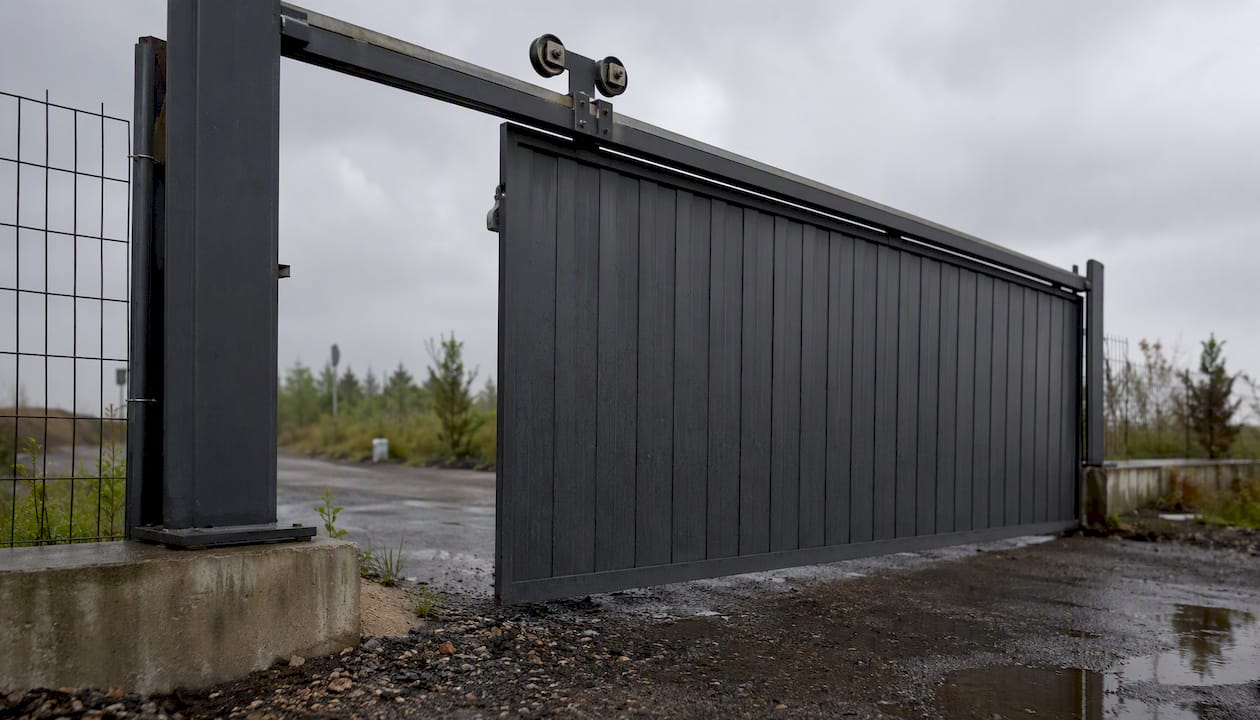
A sliding gate travels laterally along a ground track. A cantilever variant hangs from overhead rollers, eliminating the ground track entirely. Cantilever designs are preferable where debris, uneven grades, or ice would foul a ground track. They are common on industrial yards and commercial perimeters in climates with harsh winters. Both types require a clear run-back space equal to the gate’s width, so they need more lateral room than a swing gate.
Vertical pivot and vertical lift gate
These gates rise straight up rather than swinging or sliding. Vertical pivot gates rotate on a center axis; vertical lift gates rise on a frame. Both suit locations where lateral and swing clearance is unavailable, such as narrow urban driveways or multi-level garage entries.
Bollard systems
Retractable or fixed bollards block vehicle access at pedestrian plazas, building entrances, or high-security perimeters. They are not a parking gate in the traditional sense, but they serve as an access-control barrier where vehicle throughput is low and anti-ram protection is the priority.
Pro Tip: In high-wind regions, a solid swing or sliding gate panel creates significant wind load. Ask your installer for the gate’s wind-load rating and whether the operator motor is rated for that load before signing a contract.
| Gate Type | Best Use Case | Key Advantage | Main Limitation |
|---|---|---|---|
| Barrier arm | High-turnover commercial lots | Fast cycle time, low cost | Minimal physical deterrent |
| Swing gate | Residential/office perimeters | Solid barrier, attractive | Needs swing clearance, grade-sensitive |
| Sliding/cantilever | Industrial, debris-prone sites | No swing space needed | Requires lateral run-back |
| Vertical pivot/lift | Narrow urban entries | Minimal footprint | Higher cost, slower cycle |
| Bollard | Pedestrian zones, anti-ram | Highest vehicle resistance | Low throughput |
What components does a gate system require?
A gate is never just the arm or panel. Every functional system includes several hardware and control layers, each of which appears as a line item on a professional quote.
- Gate operator/motor: The drive unit that moves the arm or gate leaf. Operator class (residential, commercial, industrial) determines duty cycle and longevity.
- Gate leaf or barrier arm: The physical barrier, sized to the opening width.
- Control board/controller: The brain of the system. It receives signals from readers and detectors, executes open/close commands, and logs events. Controllers can cache credentials locally so gates operate during internet outages, which is critical for 24/7 facilities.
- Loop detectors: Inductive loops embedded in the pavement that detect vehicle presence. They prevent the gate from closing on a vehicle and trigger exit cycles.
- Photo-eye sensors and safety edges: Optical beams and pressure-sensitive edges that stop or reverse the gate if an obstruction is detected. UL 325 compliance requires these on automated gates in the United States.
- RFID/QR/ALPR readers: The credential-reading hardware mounted at the entry column. The reader type determines which access-control method the site supports.
- Intercom and video: Allows remote staff or a cloud-based answering service to verify visitors and open the gate manually.
- Backup power: A battery backup or generator connection keeps the gate operational during power outages. Solar-powered operators are an option for remote sites.
- Wiring and conduit: Low-voltage and line-voltage runs connecting all components. Trenching and conduit are a significant civil cost on large sites.
Pro Tip: Ask any installer whether their controller supports local credential caching and a cellular backup connection. A cloud-only system that goes offline during an internet outage can lock out every authorized user simultaneously.
For properties integrating gates with parking management software, confirm that the controller’s API or interface is compatible with your existing platform before purchasing hardware.
How much does a parking lot gate system cost?
Cost varies widely based on gate type, opening width, automation level, access-control technology, and site conditions. The ranges below reflect typical installed costs in the United States for commercial projects; residential projects at the lower end of each range are common.
Major cost drivers include:
- Gate style and opening width: A 20-foot cantilever gate costs significantly more than a 10-foot barrier arm.
- Automation and operator class: Commercial-duty operators cost more upfront but last longer under heavy use.
- Access-control technology: ALPR cameras and their software licenses add cost but reduce per-transaction staffing.
- Site preparation: Concrete pads, pavement cuts, trenching for conduit, and electrical panel upgrades are often the largest variable on a quote. Coordinating pavement and surface prep before gate installation avoids costly rework.
- Permits and inspections: Local building permits are required in most jurisdictions. Fees vary by municipality.
- Recurring costs: Cloud dashboard subscriptions, annual maintenance contracts, and extended warranties add $300–$1,500 per year depending on system complexity.
In high-turnover urban settings, operators are shifting from ticket-based parking to ANPR and contactless payments to reduce bottlenecks and operating costs. The upfront investment in ANPR is higher, but reduced staffing and faster throughput often recover that cost within two to three years on busy lots.
Government procurement references such as GSA Advantage can provide specification benchmarks for gate hardware, which is useful for commercial buyers building a bid package.
How do you choose the right gate for your property?
Start with a site assessment, then match your findings to gate type and access-control technology. Here is a practical decision sequence.
- Count peak-hour traffic. More than 30 vehicles per hour points toward a barrier arm with ANPR or RFID. Fewer than 10 per hour may justify a swing or sliding gate with a keypad.
- Measure the opening width. Width determines gate type options and operator sizing.
- Check grade and surface condition. A steep slope or debris-prone surface eliminates ground-track sliding gates and may require a cantilever or vertical design.
- Confirm power availability. Is 120V or 240V service within reach of the gate location? If not, budget for electrical work or consider a solar-powered barrier arm.
- Identify emergency access requirements. Fire departments require unobstructed access. Knox Box key switches or crash-rated breakaway arms are standard solutions.
- Clarify ADA and pedestrian access. Pedestrian gates or call boxes adjacent to the vehicle gate are often required.
When interviewing installers, ask these specific questions:
- Are you licensed and insured in this state? Can you provide proof?
- Will you pull the required building permits, or is that my responsibility?
- What safety devices are included, and do they meet UL 325 standards?
- What is your warranty on parts and labor, and who handles service calls?
- Do you have local references for commercial gate installations?
- What is the realistic timeline from site survey to final inspection?
- What does your maintenance plan include, and what is the annual cost?
Red flags on quotes: missing safety edge or photo-eye line items, no mention of permits, vague warranty language (“manufacturer’s warranty only”), and no local service contact for after-hours calls.
Pro Tip: Manual gates are appropriate for very low-traffic sites (fewer than 5 vehicles per day) or as a secondary emergency exit. For any primary commercial entry, automation pays for itself quickly in reduced staffing and improved access logging.
For smaller residential properties, a property-matched access control approach often starts with a simpler keypad or RFID system before scaling to full ANPR.
How does modern access control work with parking gates?
Modern parking lot access control systems centralize credentials and automate entry using plates, app tokens, QR codes, or RFID cards. The physical gate is just the enforcement point; the intelligence lives in the controller and its connected software.
Modern systems combine multi-layered authentication including keypads, RFID readers, intercoms, and ANPR, and let managers whitelist license plates so gates open automatically while maintaining searchable logs. Here is how the main technologies compare:
| Technology | How It Works | Best Fit | Trade-off |
|---|---|---|---|
| RFID card/fob | Reader detects passive tag at entry | Controlled employee/tenant lots | Cards can be lost or shared |
| ALPR/ANPR | Camera reads license plate, matches database | High-volume lots, permit programs | Higher upfront cost |
| QR code | Camera or reader scans code from phone/ticket | Event parking, short-term lots | Requires user action |
| Mobile/Bluetooth | App token or BLE signal opens gate | Residential, managed lots | Requires smartphone |
| Keypad/PIN | User enters code | Low-volume, low-budget sites | PINs get shared |
| Intercom/video | Staff or remote agent verifies and opens | Visitor management, mixed-use | Requires staffing or monitoring service |
Booking- and permit-based systems tie gate access to active sessions or permits so each gate opening is linked to a valid booking, enabling frictionless app- or plate-based entry. This approach removes the need for physical tickets entirely, and existing gate hardware often stays in place while the parking management software handles the decisioning.
Integrated gate and video management systems give facility managers real-time occupancy monitoring and stronger security accountability. When the gate controller feeds data to a VMS, you get unified audit logs, tailgating alerts, and real-time occupancy counts from a single dashboard.
Cloud-based dashboards allow remote gate opening, schedule management, and log review; controllers can cache credentials locally so gates operate during internet outages. For mission-critical sites, adding a 4G/LTE cellular backup means the system synchronizes logs once connectivity is restored without ever locking out authorized users.
For a deeper look at modern gate automation trends including remote dashboards and cloud-based credential management, Modernfence has published a dedicated resource for property owners.
What should you expect from installation and ongoing maintenance?
Installation of a commercial gate system typically follows five stages, and the timeline depends heavily on permit processing and civil work.
- Site survey and design: The installer measures the opening, checks grade and power, identifies permit requirements, and produces a written quote with a component list.
- Permit application: Most jurisdictions require a building permit for automated gate installation. Local design guidelines can affect where and how gates are installed in parking structures, particularly regarding ADA access and fire department entry. Permit timelines range from a few days to several weeks.
- Civil and electrical work: Concrete pads are poured, conduit is trenched, and electrical service is extended to the gate location. Coordinating this phase with pavement repairs or sealing prevents cutting into fresh asphalt later.
- Gate and operator installation: The gate hardware, operator, control board, readers, and safety devices are installed and wired.
- Testing and commissioning: Loop detectors, safety edges, photo-eyes, and all credential methods are tested. The installer should demonstrate UL 325 compliance for safety devices and walk you through the management interface.
Ongoing maintenance keeps the system reliable and extends equipment life. A practical annual schedule includes:
- Monthly: Visual inspection of gate travel, arm condition, and safety device alignment.
- Quarterly: Test all safety edges and photo-eye sensors; confirm backup battery charge.
- Annually: Full service call covering operator lubrication, controller firmware updates, loop detector calibration, and safety device certification.
- After severe weather: Inspect for physical damage, check alignment, and test all functions before returning to normal operation.
Pro Tip: Request a written maintenance plan with a fixed annual cost before the installation contract is signed. Verbal promises about service response times are worth nothing when the gate fails at 2 AM on a Saturday.
Installer trust signals worth verifying: state contractor license number, certificate of insurance naming your property, at least two local commercial references, and a written warranty covering both parts and labor for a minimum of one year.
For general workmanship expectations and scheduling guidance, Modernfence’s fence installation guide covers the same project-management principles that apply to gate installations.
A practical perspective on parking gate decisions
The most common mistake property owners make is choosing a gate type based on appearance rather than traffic pattern. A handsome iron swing gate looks right on a commercial property, but if peak-hour traffic exceeds 20 vehicles, that gate will cycle slowly, queue cars onto the street, and wear out its operator motor in a fraction of its rated life. The barrier arm that looks utilitarian is often the smarter operational choice.
The second mistake is underestimating the access-control side. The gate itself is a commodity. What differentiates a well-run parking operation from a frustrating one is whether the controller, readers, and software are specified correctly for the site’s actual credential mix. A lot serving monthly permit holders, daily transient parkers, and delivery vehicles simultaneously needs a system that handles RFID, ANPR, and intercom without requiring staff to intervene on every edge case.
Modernfence has been installing fencing and access-control systems across Western Arkansas and Eastern Oklahoma for more than 70 years. When a commercial property in the region needed a controlled entry for a mixed-use lot serving both tenants and daily visitors, the solution was a cantilever sliding gate paired with RFID for tenants and an intercom for visitors, with a cloud dashboard the property manager could access from a phone. The result was a reduction in unauthorized access and no on-site attendant required during off-hours. That outcome is repeatable when the site assessment is done correctly and the hardware is specified to match actual traffic.
Ready to get a site survey and written estimate?
Modernfence provides automatic gate installation and access-control integration for commercial and residential properties throughout Western Arkansas and Eastern Oklahoma. With more than 70 years of licensed and insured service, the company handles every phase of a gate project from site assessment through permitting, installation, and ongoing maintenance.
What a site survey and estimate from Modernfence includes:
- On-site traffic and grade assessment
- Gate type and operator recommendations matched to your property
- Access-control technology options with cost comparisons
- Local permit identification and support
- Written quote with itemized components and labor
- Warranty and maintenance plan options
Modernfence is licensed and insured, carries local commercial references, and serves clients across the region with the same crew that installs, services, and stands behind the work. To request your free estimate, contact Modernfence directly at Modernfence or call the Fort Smith office. For properties with custom gate leaf requirements, the company’s custom metal fabrication services cover non-standard openings and architectural metalwork.
Sources
The following sources were used in researching this guide. Each covers a specific aspect of parking gate technology, access-control integration, or installation practice.
- Barrier Control System – LEXOH